Contents
Bangs for your face shape: what a fringe actually changesSeven face shapes, one tableBlunt bangs on a round face? The guides disagreeHigh foreheads, cowlicks and hair typeBefore the cut: start long, then go shorterFAQKey points
- The more forehead a fringe covers, the more the visible length-to-width ratio moves.
- Blunt bangs draw a horizontal line; curtain and side-swept bangs draw diagonals; wispy bangs a broken one.
- Long faces can try heavier bangs just above the brows; square, heart and diamond faces often start with curtains or side-swept. On round faces, guides disagree about blunt bangs.
- This is stylists' experience, not experiment. Start long, then go shorter.
Bangs for your face shape: what a fringe actually changes
Most haircuts work on the sides of the face, hiding some width. Bangs work on length.
Whatever part of the strip between hairline and brows a fringe covers, that much less face shows. So the face length ÷ cheekbone width that people see changes with bangs. To find your own numbers, see what is my face shape, or get a free face report from one front-facing photo.
The edge of a fringe also draws a line. That leaves three settings:
- Length: from baby bangs about an inch above the brows to long pieces reaching the cheekbones or chin.
- Weight: thick hair with a one-length edge makes a heavy line; less hair with feathered ends, a light one.
- Direction: straight across, parted in the middle as curtains, or swept to one side.
Seven face shapes, one table
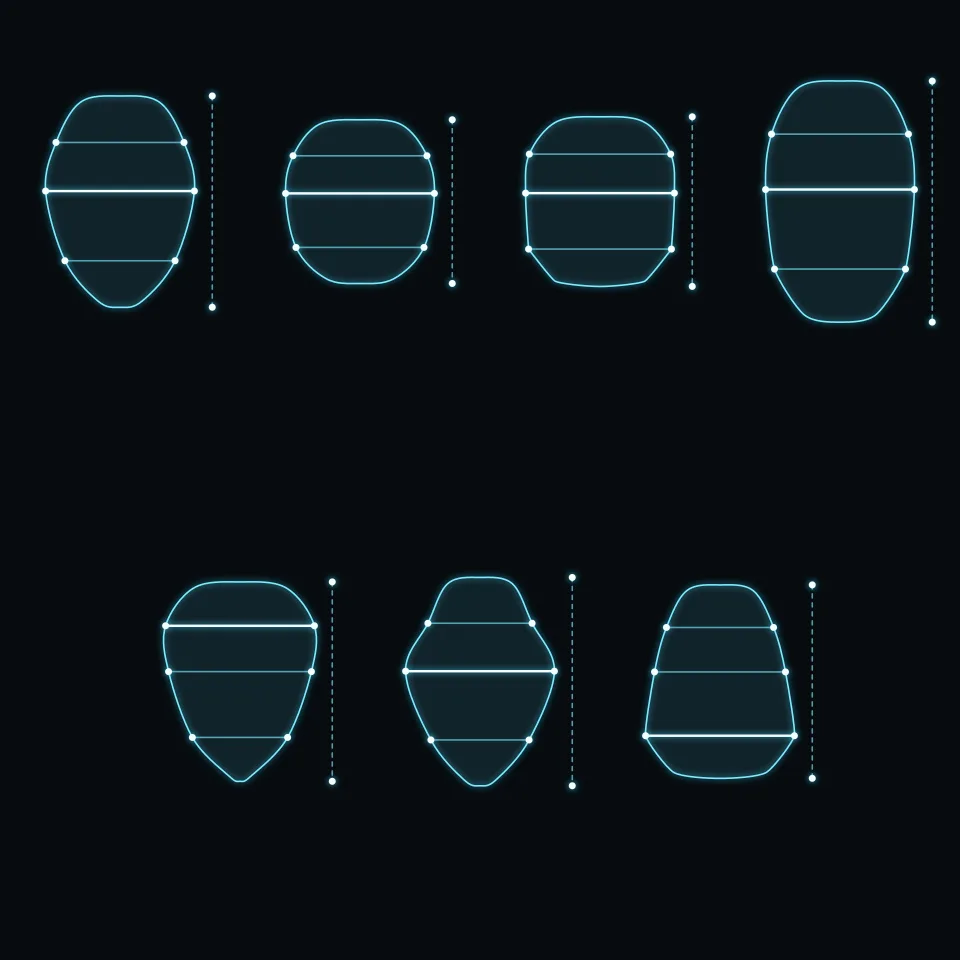
The table squeezes several hairstyling guides into three columns. If you sit between two shapes, read both rows.
| Face shape | Length | Weight | Direction |
|---|---|---|---|
| Oval | Anything, short baby bangs included | Heavy or light | Straight, curtain or side-swept |
| Round | Brow-grazing, or down to the cheekbones | Two views: heavy and blunt, or wispy | Curtain, long side-swept; straight across is disputed |
| Square | Past the brows to the cheekbones | Light, piecey | Side-swept or curtain; heavy blunt only with soft layers |
| Oblong (long) | Just above the brows, or down to the chin | Can be heavy | Straight, curtain or side-swept |
| Heart | Curtains starting at the cheekbones, or long side-swept | Soft; go easy on short blunt bangs | Middle-parted curtains or a deep side part |
| Diamond | Long side-swept | Soft | Side part; go easy on heavy blunt bangs |
| Pear (triangle) | Down to the brows | Fuller, to add weight up top | Straight or side-swept |
Where it says “two views”, the guides contradict each other.
Blunt bangs on a round face? The guides disagree
- One view: heavy, blunt bangs that just graze the brows give a soft outline a crisp edge.
- The other: a straight-across fringe draws a horizontal line and shortens the visible face, pushing the ratio toward 1, so the face reads rounder. Try curtains or long side-swept bangs instead.
The first looks at how hard the line is, the second at the proportion left showing. Try first whichever matters more to you.
Heart faces get a similar split: one guide likes neat bangs just below the brows, another says short blunt bangs make a narrow chin stand out.
To be straight: all of this comes from stylists and beauty media, not controlled experiments. Treat it as things to try, not rules.
High foreheads, cowlicks and hair type
The taller the forehead, the more bangs do: the covered strip is a bigger share of face length, so the ratio moves further. That is why long-face advice leans toward bangs just above the brows, or a fringe down to the chin.
With a low forehead, heavy bangs hide most of it; light bangs, or curtain pieces at the sides, leave some showing. To measure that strip, see facial thirds.
Cowlicks and texture change how a fringe falls. Curls spring up as they dry, so cut longer than you think. More on hair type in hairstyles for your face shape.
Before the cut: start long, then go shorter
Short bangs are hard to undo. The stylists agree: start long and see how it goes.
- Test first: comb the front forward and clip it, or begin with cheekbone-length curtains that tuck behind your ears.
- Count the upkeep: blunt bangs need a trim about monthly; curtains roughly every six to eight weeks; side-swept bangs are easiest and pin back for workouts.
- Mind the forehead: bangs sit on skin that gets oily and go limp sooner. Go easy on heavy skincare there.
FAQ
Can I wear blunt bangs with a round face?
Worth a try. Some stylists say a blunt edge adds structure to a soft outline; others say it shortens the visible face. Pin your hair forward first, and if you cut, start at brow length.
Curtain bangs or side-swept bangs?
Curtain bangs part in the middle and draw a diagonal on each side of the face. Side-swept bangs draw a single diagonal and are less symmetrical. Pick curtains for cover on both sides, side-swept to break the symmetry.
Do bangs work with a low forehead?
Yes, keep them light, or wear only curtain pieces at the sides. Heavy bangs would cover almost all of an already short forehead.