Start here
Hairstyles for your face shape: seven shapes, one table
Hairstyles for your face shape come down to two moves: add or go easy. One table covers seven shapes. Find your shape free with one front photo.
Read the overview5 min read
What to add and what to go easy on for each of the seven shapes, from long hair to bangs.
Choosing a hairstyle by face shape is usually presented as seven rulebooks, but it comes down to two moves: add something to the outline, or go easy on something. This topic is for anyone who wants to know what suits their face before a haircut or a new look. By the end you can find whether your widest part is the forehead, cheekbones or jaw and how much longer than wide your face is, and use that to decide where volume goes and where bangs and length stop. You will also know which advice is only hairdressers’ experience, which varies from guide to guide.
Start with hairstyles for your face shape, whose table of seven shapes is the overview of the whole topic. If you are not sure of your shape, check what is my face shape first. Then read the guide for yours: round, square, long, heart-shaped, diamond and pear-shaped faces each have one, and the oval guide is about choosing when nearly everything works. Another covers wide faces and starts with finding which level the width sits at. Finish by taking two photos the same way and comparing them, instead of trusting the rules alone.
Treat these suggestions as ideas worth trying first, not conclusions. The same cut behaves differently on different hair: straight hair falls close, curls spread out, fine hair goes flat and coarse hair can become one block. Think about your hair type before you read the advice.
Hairstyles for your face shape come down to two moves: add or go easy. One table covers seven shapes. Find your shape free with one front photo.
Filter by face shape
Showing 11 guides
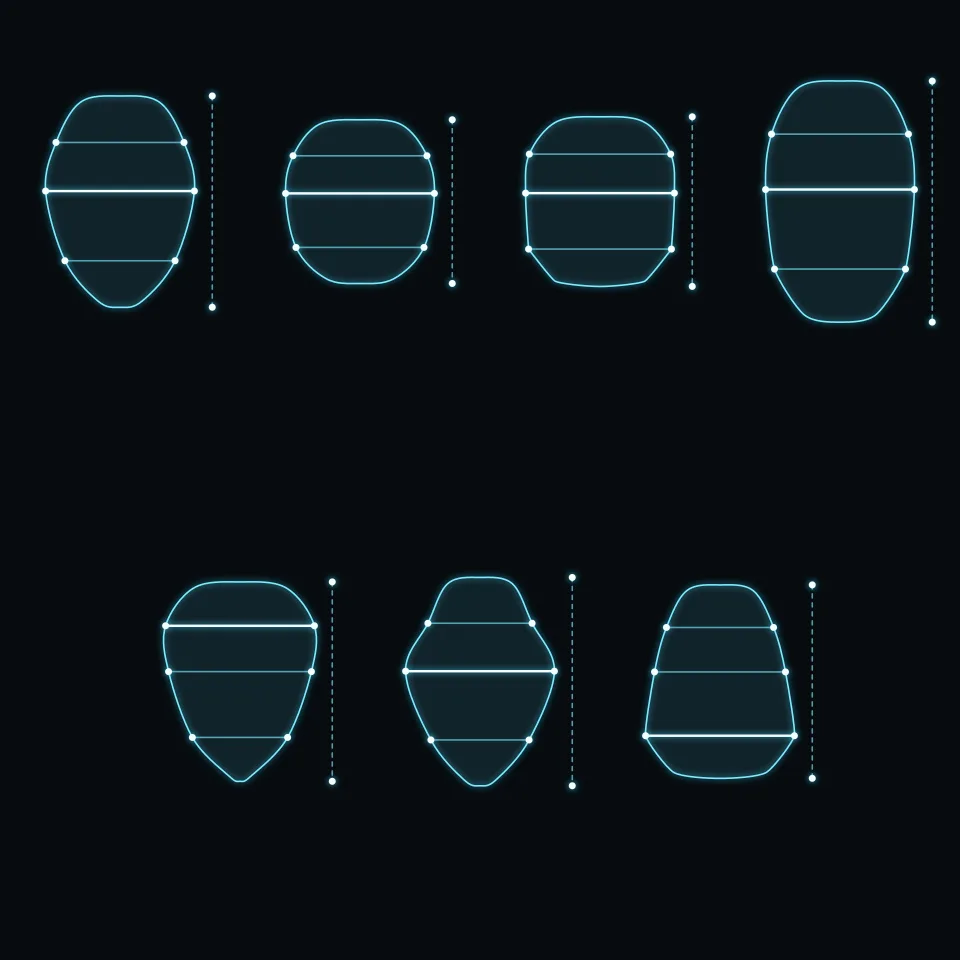
Look at two things: whether your face is widest at the forehead, cheekbones or jaw, and how much longer than wide it is. Volume makes the level where it sits wider, height on top lengthens the outline, and a blunt edge draws a line at the height where it stops.
For a round face, add some height on top and keep blunt edges away from cheekbone and chin level; for a square face, avoid a straight edge that ends at the jaw corner and use curves and diagonals instead; for a long face, add width, use bangs to cover some forehead and let the ends stop between chin and shoulders.
Not by experiments. Most come from hairdressers’ practice and guides often differ on details, such as whether a heart-shaped face should wear straight-across bangs. Treat them as things worth trying: take two photos the same way and see whether the part you wanted to change really changed.