Contents
Glasses for your face shape: contrast or echoSeven face shapes, seven starting pointsWhat the top edge, bottom edge and width each doFit matters more than shapeBetween two shapes?FAQKey points
- Two strategies: frame lines that run against your outline, or lines that repeat it.
- Corners contrast a curved face, curves soften an angular one, a lifted top edge draws the eye up.
- Match frame width to the widest part of your face, or go a touch wider.
- This is brand and stylist experience, not experiment. Fit and taste matter more.
Glasses for your face shape: contrast or echo
A frame is the strongest line you put on your face. It sits around the eyes, and its colour and edges are harder than any feature. Where that line goes changes how the whole face reads.
There are only two ways to use it:
- Contrast: the frame’s lines run against the outline. Straight edges and corners on a face full of curves; curves on a face full of angles.
- Echo: the frame repeats the outline and makes an existing feature stronger.
Both are valid; it depends on whether you want to soften a feature or show it off. And to be clear: this advice comes from eyewear brands and stylists, not controlled experiments. Two articles from the same brand recommend different frames for a pear-shaped face. Treat the chart as a starting point.
Seven face shapes, seven starting points
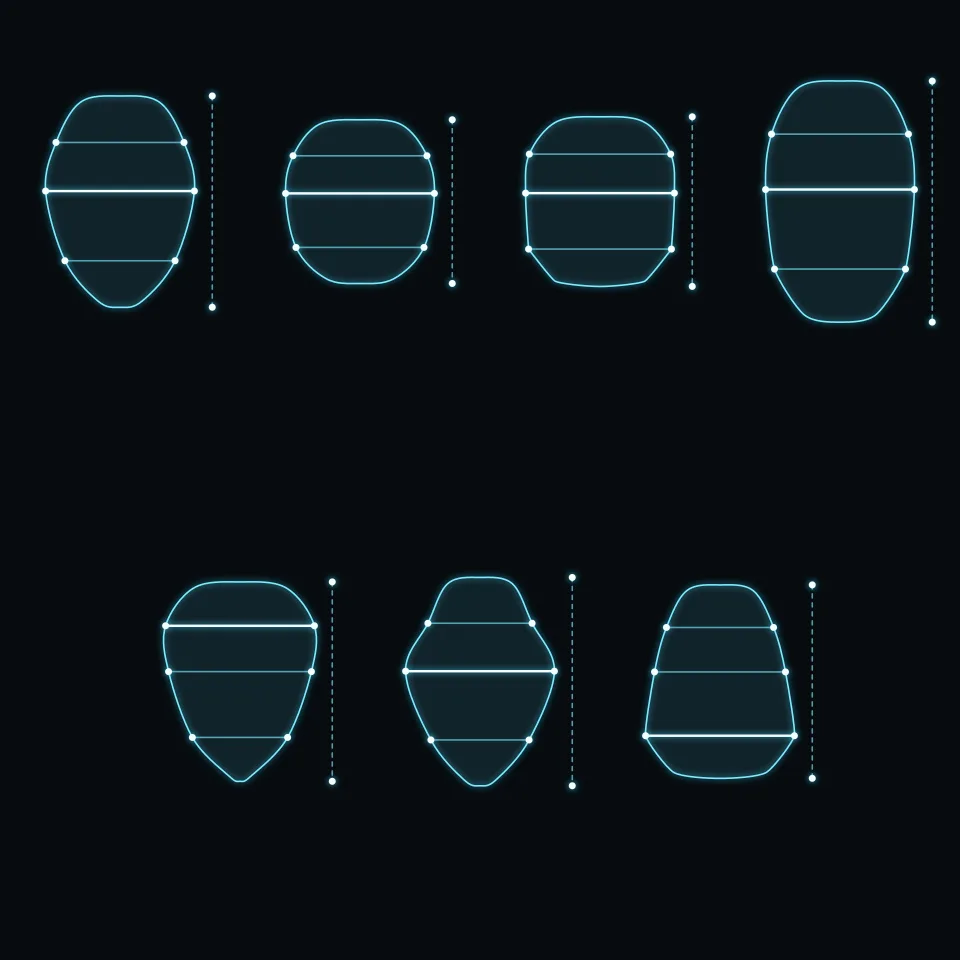
Find where your face is widest and whether your jaw turns a corner, then read across.
| Face shape | Try | Go easy on | Why |
|---|---|---|---|
| Oval | Almost anything: rectangle, square, cat-eye, aviator | Frames far wider than the face; very small, narrow ones | Proportions are already even, so width matters most |
| Round | Rectangle, square, geometric, cat-eye, browline | Perfectly round or oval frames, small frames, clear frames | Straight edges give a curved face some borders |
| Square | Round, oval, fine wire, semi-rimless | Square, rectangle, geometric | Curves soften the corners of the jaw; reverse it to stress them |
| Oblong | Deep lenses, decorated temples, round, oversized | Small, narrow, shallow frames | Depth breaks up the length; detail at the temples adds width |
| Heart | Oval, round, aviators with a rounded bottom, semi-rimless | Oversized, narrow square frames | Forehead is widest; a frame a little wider than it, curved below, gives the lower face weight |
| Diamond | Cat-eye, browline, round, oval, semi-rimless | Very narrow frames, frames that sit low | Cheekbones are widest, brow and chin narrow; keep weight up top and balanced |
| Pear | Cat-eye, browline, rectangle | Small frames with a thin top edge | Wide jaw, narrow brow; a top-heavy frame adds width above the eyes |
What the top edge, bottom edge and width each do
Three parts of the frame do the work in that chart.
- The top edge lifts the eye. A cat-eye flicks up at the corners and a browline thickens the top, so brows, eyes and cheekbones get seen first. Diamond and pear faces, narrow at the brow, use this to add weight up top. A square face wearing the frame a little higher works the same way.
- The bottom edge shapes the lower face. A curved lower rim makes a pointed chin less prominent; semi-rimless frames look lighter.
- Width is judged against the widest part. Oval: match the cheekbones or go slightly wider. Heart: a little wider than the forehead. Square: wider than the middle of the face. Too narrow and the face’s width stands out; far too wide and the frame swamps your features.
People forget colour. A bright full rim makes the line very clear; a clear or skin-toned frame melts into the skin and the contrast fades.
Fit matters more than shape
The right shape in the wrong size still won’t work. Too wide and your eyes drift off the centre of the lenses and the frame slides; too narrow and it pinches the temples and presses the nose. Outer edges in line with the sides of your face, eyes centred in the lenses: those are the basics. Reading the numbers on the temple arm, choosing a bridge and checking fit in a mirror are covered in Glasses size. Even the brands behind these charts call face shape a tie-breaker.
Between two shapes?
Most faces don’t sit in one row. Round and square differ only in whether the jaw turns a corner; oval and diamond in whether the cheekbones are clearly widest. Go by your strongest feature and mix two rows if you like.
Not sure of your shape? Start with What is my face shape and measure length-to-width and jaw width on a photo, or get a free face report from one front-facing photo. Contrast-or-echo works for fringes and make-up too: see Bangs for your face shape and Contouring for your face shape.
Then try frames on. If you like the mirror and the frame sits comfortably on nose and ears, that beats any cell in the chart.
FAQ
Do I have to choose glasses by face shape?
No. It is a tie-breaker between frames you already like. Fit, comfort and taste count for more.
Which face shapes suit clear frames?
Clear or skin-toned frames blend in, so there is little contrast. Skip them when you want the frame to add a line; pick them when you want your face to lead.
Can a square face wear square frames?
Yes. They repeat the corners of the jaw and make the angles stronger. For softer angles, choose curves.
Does the chart work for sunglasses?
The logic is the same. Sunglass lenses are usually bigger to block light, so large frames are fine, even over the brows.