Contents
Glasses for oval faces: almost anything works, so what’s the variable?Which way a frame can push an ovalWidth: the one number every source repeatsEach frame on an oval faceOne dissent, and one surveyHow FacialRate does it: see which end you’re atFAQKey points
- One guide gives an oval four numbers: about 1.24 length to width, 0.88 forehead to cheekbones, 1.26 cheekbones to jaw, a 137° jaw angle. The sample fits all four.
- With no dominant feature, contrast has nothing to work against. Shape becomes taste; width and size are the variables.
- Match the cheekbone line or go slightly wider. Much narrower, or big enough to cover brows and cheeks, shifts the proportions.
- A Korean textbook says ovals should avoid square and octagonal frames, against most sources. The rules don't agree.
Glasses for oval faces: almost anything works, so what’s the variable?
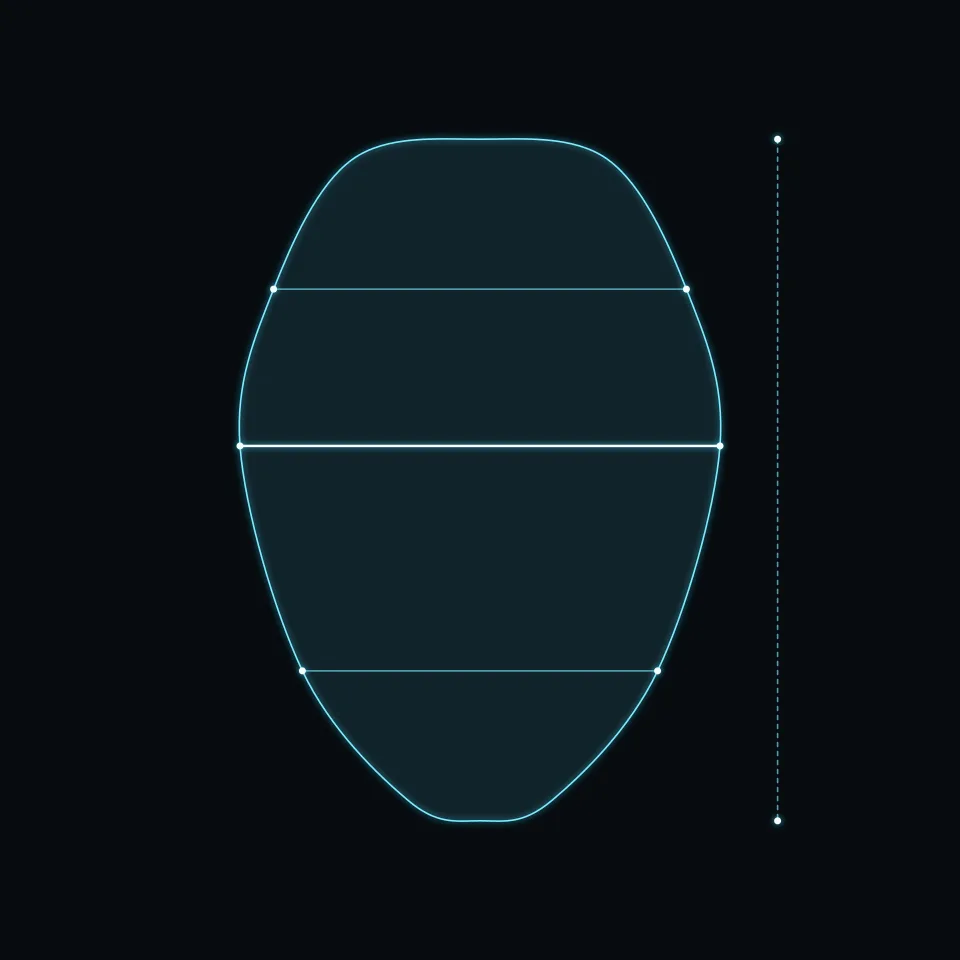
One guide gives an oval face four numbers, each with a range: face length ÷ cheekbone width 1.24 ± 0.1, forehead ÷ cheekbones 0.88 ± 0.07, cheekbones ÷ jaw 1.26 ± 0.1, jaw angle 137° ± 10°.
The sample photo measures 1.19, 0.85, 1.27 and about 135°: all inside, length near the low end. A short oval, cheekbones widest, nothing standing out.
Hence “almost anything”. Contrast needs something to work against, and an oval has no dominant feature, so shape becomes taste. What remains is size: how wide, how big, how deep.
Which way a frame can push an oval
Proportion can still shift. The sources name three cases:
- Very small, narrow lenses make the face look longer, one guide says.
- Much narrower than the cheekbones leaves a gap between frame edge and cheekbone, and the middle of the face reads wider.
- Oversized frames running far past the temples, over brows and cheeks, soften the features and push proportions to one end.
An inference, not from any source: an oval near the short end could borrow long-face advice and try slightly deeper lenses; near the long end, the reverse. The sample, at 1.19, is the first case. A photo will tell.
Width: the one number every source repeats
The sources nearly agree: equal to the widest part of the face, or slightly wider. On an oval that is the cheekbones; the sample’s are 582 px, against 496 for the forehead and 460 for the jaw.
Two smaller details:
- Bridge. One guide: a keyhole bridge for a high nose bridge, a saddle bridge for a low one, so the frame doesn’t slide.
- Lens height. Medium is enough: coverage without weight.
A Japanese optician’s check also applies: the pupil within ±5 mm of the lens centre. Sizes: how should glasses fit.
Each frame on an oval face
| Frame | On an oval face | Works when / doesn’t |
|---|---|---|
| Rectangle, square | Wider than long, against the face | Width meets the cheekbones |
| Round | A different curve, balanced | Medium; very small or large less so |
| Cat-eye | Eye drawn to the cheekbones | To break the evenness |
| Aviator | Teardrop lenses, room around the eyes | Medium or slightly wide |
| Wayfarer, D-frame | Classic, a little structure | Everyday |
| Clear | Low presence; the face leads | When the frame should recede |
| Oversized | Covers brows and cheeks | In moderation |
| Very small, narrow | Lengthens | Most sources say use less |
One dissent, and one survey
Most sources list square frames among the best for ovals. A Korean optics textbook says an oval suits everything except square and octagonal frames. Both can’t be laws; both are habits.
A 2023 Korean survey points the same way. Its 214 university students cared about face shape (4.09 on a 5-point scale), but grouped by self-rated face shape, the frame shapes they liked did not differ (p = 0.371).
Hair for ovals: hairstyles for oval faces. All seven shapes: glasses for your face shape.
How FacialRate does it: see which end you’re at
- Your photo stays on your device. The face analyzer runs in the browser and finds 478 face landmarks there; neither the photo nor any face image made from it is sent to a server.
- The free face report shows face shape, strongest feature, three highlights and 11+ dimensions, contour included. What face shape do I have, without measuring by hand.
- Free, no limit on tries. Test another photo a few days later; readings that agree are the ones to trust.
- It says a reading describes this photo. Light, angle and expression change it. Tips cover photography, hair, makeup and skincare, nothing medical.
FAQ
Do oversized frames work on an oval face?
In moderation. Once a frame runs far past the temples and covers most of the brows and cheeks, it sits on top of the features.
Will round frames make an oval face look round?
Not much. One guide says the curves differ, so they balance. Medium sizes are safest; very small or very large rounds are the ones to use less.
Is oval the best face shape?
No research supports that. It is used as a reference only because most styling advice aims at its proportions.