Contents
Glasses for square faces: first, measure the jaw angleCurves, thin lines and width: what a frame does hereEach frame on a square faceWeight high or low? Here the sources splitRead jaw and frame together on a photoHow FacialRate does it: the contour is read on your deviceFAQKey points
- The jaw angle splits square from round: about 130° against about 141° in one guide.
- Round and oval frames oppose the corners; thin metal and rimless add the least weight.
- The jaw is about as wide as the cheekbones, so the frame should reach at least the jaw line.
- English sources put the weight on top, a Japanese optician puts it low. Compare on photos.
Glasses for square faces: first, measure the jaw angle
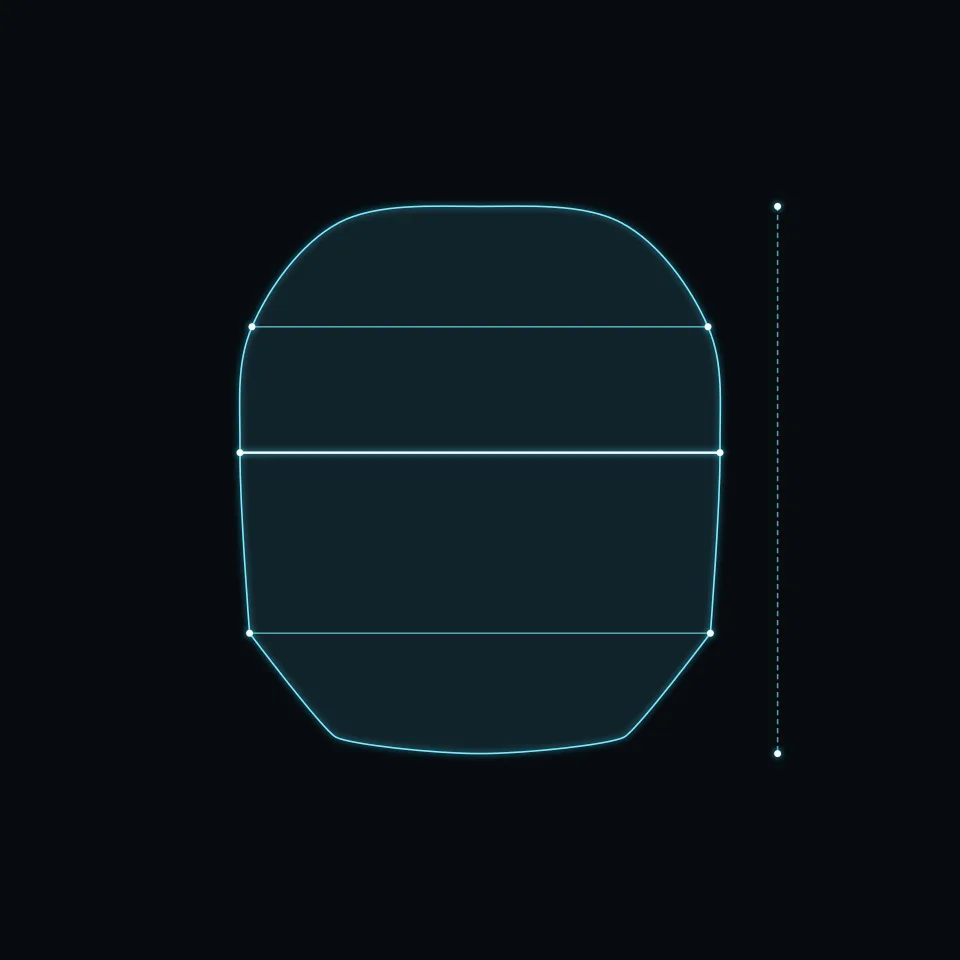
Square and round faces share a length ÷ cheekbone width near 1 (one guide puts square at about 1.16) and a jaw that barely narrows. The divider is the jaw angle: about 130° for square, 137° for oval, 141° for round in the same guide. Smaller is harder.
Draw a line down the face side below the ear and another along the lower jaw. The sample photo reads about 135° on the left and 138° to 141° on the right, because the head is turned slightly. Face the camera and measure both sides.
The sample’s jaw is only 79% of its cheekbone width, so it is not square. A square jaw is nearly as wide as the cheekbones, which sets the frame width below.
Curves, thin lines and width: what a frame does here
- Curves against corners. A round frame is the opposite of a square; an oval is curved but wider, suiting a broad face.
- Line weight. Thin metal has no hard edge; two-point rimless nearly removes the frame. A Japanese chain recommends both rimless and half-rims so the jaw corners draw less attention.
- At least jaw width. One guide: at least as wide as the jaw, preferably a little more; narrower and the lower face reads wider.
- Echo works too. Square and geometric frames repeat the corners, which one guide says suits you if you want angularity. Rounded squares sit between.
Each frame on a square face
| Frame | On a square face | Works when / doesn’t |
|---|---|---|
| Round, oval | Strongest contrast | Wide enough; small rounds look cramped |
| Boston, barrel | Flat top, rounded bottom | A Japanese optician prefers deeper ones |
| Thin metal | Light, no extra hard lines | Round or oval shapes show it most |
| Rimless, two-point | Frame nearly vanishes | To let the jaw speak |
| Half-rim, browline | Weight on top, curved bottom | When the top follows the brow |
| Cat-eye, aviator | Draws the eye up | For a stronger look |
| Rounded square | Structure, softer corners | Some angle without hardness |
| Sharp square, geometric | Repeats the jaw corners | To play up angularity |
Weight high or low? Here the sources split
- High. English sources load the top edge: half-rims and browlines pull the eye to the brows, cat-eyes carry it away from the jaw.
- Low. A Japanese chain says the opposite: emphasis on the lower half, deeper and slightly larger frames such as Boston, barrel and big rounds. Another cites a 44 mm deep Boston.
- The textbook. A Korean optics textbook asks for medium rims, slightly larger than the face, visible end pieces, round rims.
Watch the names: Japanese and Taiwanese sources treat the Boston as roundish, the Korean survey files it with squares. “Bostons suit square faces” can mean two frames. None of it was tested in a controlled study.
Read jaw and frame together on a photo
Hair behind the ears, same phone, same spot 1.5–2 m away: one shot in a round frame, one in a square. Measure:
- Frame width ÷ jaw width in pixels. Below 1, the lower face reads wider.
- Both jaw angles. Big differences between shots mean your head turned.
Then ask which you like. Pads and temples: how should glasses fit. Hair: hairstyles for square faces. Other shapes: glasses for your face shape.
How FacialRate does it: the contour is read on your device
- Your photo stays put. The face analyzer finds 478 face landmarks in the browser; neither the photo nor any face image made from it goes to a server.
- A free face report from the face shape detector: face shape, strongest feature, three highlights, 11+ dimensions including contour, one tip to try.
- Free, no limit on tries. Head turned? Retake and rerun.
- It says the reading belongs to this photo. Angle and light change what the model sees. Tips cover photography, hair, makeup and skincare only.
FAQ
What happens if a square face wears square frames?
The right angles repeat the jaw's corners, so angularity reads more. For structure without hard corners, pick rounded squares.
Thick frames or thin?
Most sources lean thin, metal or rimless, for less weight. Thick frames work if curved and wide enough.
How do I measure the jaw angle on a photo?
One line down the face side below the ear, one along the lower jaw; read the angle between them, on both sides.