Contents
Thick glasses lenses: why the edge is thick, and what moves itWhy your eyes look smaller behind the lensChoose the frame first: width, shape and how far the lens is shiftedThen choose the lens: index, aspheric and coatingFive common mistakes when buying lensesAt the optician: what to bring and what to askPhotos: glasses on, glasses off, or contactsFAQKey points
- A lens for short sight is thin in the middle and thick at the edge. The edge is thicker than the centre by about power × distance² ÷ (2000 × (index − 1)), where distance is from the pupil to the farthest point of the lens edge, in millimetres.
- Moving the farthest edge from 30 mm to 25 mm saves about as much thickness as swapping 1.50 for 1.74, roughly a third each. Do both and you save more than half.
- Eyes look smaller behind the lens because of its power and its distance from the eye: about 7% smaller at −6.00 D (an estimate). A higher index does not change that; aspheric may soften it; contact lenses sit on the eye and mostly avoid it.
- At the optician, pick the frame first and the lens second, and ask for the edge thickness at its thickest point for that frame and your prescription.
Thick glasses lenses: why the edge is thick, and what moves it
Choose the frame first, then the lens. Three things can change: how far the lens edge sits from your pupil (frame width, frame shape, how far the lens is shifted), the lens index, and the lens design. The prescription itself cannot.
A lens for short sight is concave. It spreads light out, so the middle is thin and the edge is thick. Opticians use a quick formula for how much thicker the edge is than the centre:
extra thickness (mm) ≈ power × distance² ÷ (2000 × (index − 1))
Power is in diopters (D). Distance is from the point of the lens in front of your pupil (the optical centre) to the farthest point of the lens edge, in millimetres.
One example: −6.00 D, standard plastic (index 1.50), farthest edge 25 mm away. 6 × 25² ÷ (2000 × 0.5) = 3.75 mm. The centre needs at least about 1.5 mm, so the edge comes out a little over 5 mm.
It is an estimate. Lens labs use the real curves, and when I checked against exact curves the true figure ran 0.2 to 0.4 mm higher. But it shows how each factor weighs:
- Power is linear. Going from −3.00 D to −6.00 D doubles the extra thickness.
- Distance is squared. Going from 30 mm to 25 mm multiplies the extra by 0.69, a saving of about 30%.
- Index enters as (index − 1). From 1.50 to 1.74 the divisor goes from 0.50 to 0.74, so the extra drops by about a third; with 1.67, by about a quarter.
A third against a third: shortening the farthest edge by 5 mm saves about as much as swapping 1.50 for 1.74, and it only means choosing a different frame. Do both and the 5.4 mm of a 30 mm, 1.50 lens becomes 2.5 mm at 25 mm and 1.74. That is more than half gone.
Why your eyes look smaller behind the lens
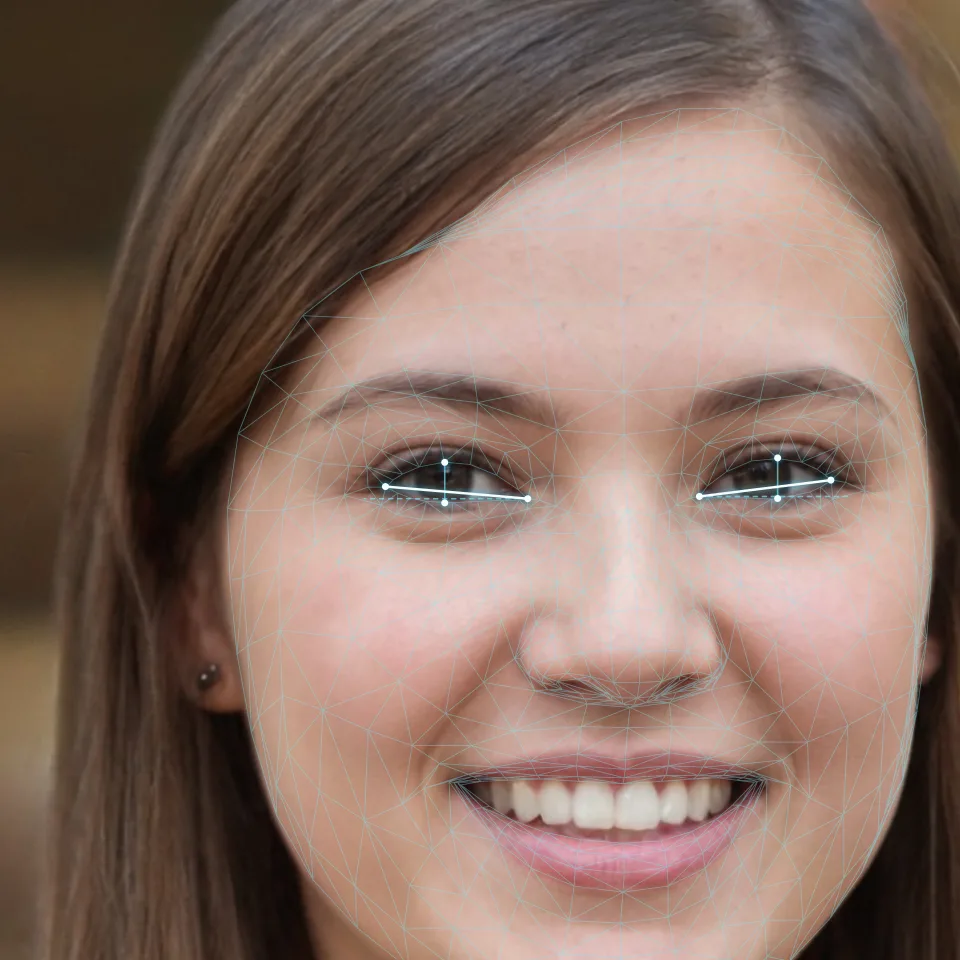
The thing that makes eyes look smaller is the lens power, not its thickness, so a thinner lens does not fix it.
The same concave lens that corrects your sight shrinks the view of whatever sits behind it for anyone looking at you. Your eyes sit behind it. A thin-lens estimate of the reduced size is 1 ÷ (1 − lens-to-eye distance × power), with power taken as negative. A routine eye test is done at 12–14 mm; using 12 mm:
- −3.00 D: about 3.5% smaller
- −6.00 D: about 6.7% smaller
- −10.00 D: about 10.7% smaller
A real lens will differ a little, but that is the scale. Your eyes have not changed; the image of them has. The patch of face seen through the lens shrinks too, so the outline of your cheek or temple steps inward where it meets the lens edge; zoom in on a photo and you can see it.
What you can rely on:
- The shrinking depends on power and lens-to-eye distance, not on the index. A 1.74 lens has a thinner edge and your eyes look just as small.
- The closer the lens sits to the eye, the less it shrinks; the distance is in the formula. Nose pads are set by the optician; see how should glasses fit.
- Aspheric lenses are flatter and sit closer to the face. All About Vision says they may reduce the shrinking, which means soften it, not remove it.
- Contact lenses sit on the surface of the eye, so the lens-to-eye distance is close to zero and this shrinking mostly disappears. That is also why a contact lens prescription for short sight is usually weaker than the glasses one; the American Academy of Ophthalmology gives −10.00 D glasses and about −9.00 D contacts as an example. Whether contacts suit you is a question for your eye doctor, not for a web page.
Look at it on your own photo. Prop your phone at eye height 1.5–2 m away, rear camera, 3–10 second timer, same spot and same light (see selfie lighting). Take one with your glasses on, then one with them off. If you cannot see the screen without them, set up with them on and take them off after; photos with glasses covers that. Now zoom in and look at three things: how much narrower your eye is inside the lens than in the bare photo; whether the outline of your face steps inward at the lens edge; where the thick ring at the lens edge sits, and whether the frame covers it. Which one bothers you most tells you whether to change the frame or the lens.
Choose the frame first: width, shape and how far the lens is shifted
A narrow frame, a rounder shape and a lens centred on your pupil all shorten the distance in the formula.
Width and shape. The distance runs to the farthest point. On a rectangle that point is a corner; on a round or oval lens of the same width it is much closer. An optometrist’s article in a trade magazine gives an example: −6.00 D, lens shifted 6 mm, 50 mm lens width. A rectangle needs a blank of about 72 mm, an oval about 64.5 mm. The bigger the blank, the thicker the thickest point.
Put −6.00 D into the formula and the edge is this much thicker than the centre, in millimetres:
| Pupil to farthest edge | Index 1.50 | Index 1.67 | Index 1.74 |
|---|---|---|---|
| 25 mm | 3.8 | 2.8 | 2.5 |
| 30 mm | 5.4 | 4.0 | 3.7 |
| 35 mm | 7.4 | 5.5 | 5.0 |
For a rough figure of your own: for a round lens use half the lens width; for a rectangle use half the diagonal of the lens, about 31.6 mm for a 52 × 36 mm shape, a little less with rounded corners; then add the shift described next. Your optician can read the exact number from their software.
Lens shift. The optical centre must sit in front of your pupil, but the geometric centre of the frame often does not. A frame’s “frame PD” is lens width plus bridge width, the first two numbers inside the temple arm; see how should glasses fit. It is usually larger than your pupillary distance (PD), so each lens centre moves toward your nose by half the difference. That makes the edge on the temple side farther from the centre, and thicker. The same optometrist suggests keeping the shift to 1 to 3 mm per eye.
Run it once: lens width 52, bridge 18, frame PD 70; your PD is 63. The difference is 7, so each eye shifts 3.5 mm. A round 52 mm lens centred on the pupil has its farthest edge 26 mm away; shifted 3.5 mm, the temple side is 29.5 mm away. At −6.00 D and index 1.50 the extra thickness goes from 4.1 mm to 5.2 mm. Same prescription, same material, and a frame that does not match the PD adds more than a millimetre. When how should glasses fit says PD does not change frame size, it means comfort. This is different: at a strong prescription, PD decides which frame gives the thinner lens.
Rim and material. A thick full rim of plastic hides the lens edge; rimless, semi-rimless and thin metal frames show all of it. They change what you can see, not how thick the lens is. All About Vision advises large, rimless and semi-rimless frames to go with thinner lens materials, and thick lenses with a smaller frame, but not so small that it cannot carry the weight.
The tension with face shape. Which frame shapes suit your face is in glasses for your face shape, with a page per shape such as round, square and oval. Some advice, like square frames for a round face, puts the farthest point on a corner. I think the practical way through is to pick, among the shapes that suit your face, the narrowest lens with softly rounded corners.
Then choose the lens: index, aspheric and coating
Index and aspheric design thin the edge. The coating does nothing for thickness; it deals with reflections.
- Index. Standard plastic is 1.50. All About Vision, an optometry education site, gives these rough figures against standard plastic, with the prescription range each suits in brackets: 1.61 about 20% thinner (roughly ±2.00 to 4.00 D), 1.67 about 30% (roughly ±4.00 to 6.00 D), 1.74 about 45% (roughly ±6.00 D and up), the thinnest plastic option. A lens lab says 1.74 is about a third thinner than 1.49. The sources count differently, so the numbers do not match. The ranges are approximate. The higher the index, the stronger the reflection off the surface.
- Aspheric. The surface curve changes gradually from centre to edge, which makes it flatter and closer to the face. The same site says the effect is most dramatic for farsighted lenses; for short sight the thinning is smaller but the edge is still thinner than a standard spherical lens. Fitting needs more care, and your eyes should sit in the middle of the opening.
- Anti-reflective coating. The coating is 0.2 to 0.3 microns thick, about 0.02% of the lens, so it cannot thin a lens. It cuts reflections off the surface and makes your eyes easier to see. High-index lenses can produce more glare than plain plastic, and flatter aspheric lenses close to the face can reflect more, so coating is usually recommended.
- None of them gives you your eyes back. At a strong prescription each only softens the effect.
These figures come from optometry education sites and trade magazines (one of the sites is owned by a lens maker). No controlled test tells you how thin is thin enough to look good. That depends on your face and the frame together.
Five common mistakes when buying lenses
- Picking a big or rimless frame, then asking for the thinnest lens. The order is backwards: a lens lab says material and finishing cannot fully make up for the wrong frame.
- Paying for a higher index and ignoring frame width and PD. In the table above, moving the farthest edge in by 5 mm does as much as going from 1.50 to 1.74.
- Going too small. If your eyes are not centred in the lens, the frame pinches your temples or the lenses press on your cheeks, it is a fit problem; see how should glasses fit.
- Expecting a higher index to make your eyes look bigger. The shrinking comes from power and lens-to-eye distance; index does not change it.
- Guessing the PD or copying it from old glasses. A wrong PD moves the optical centre, and one edge gets thicker, by the same formula as above. When ordering online, make sure the PD was measured.
At the optician: what to bring and what to ask
- Bring your prescription and get a measured PD, ideally two numbers, one per eye.
- Choose the frame first, then talk lenses. Pick two or three you like: narrow lenses, round or rounded corners, a full rim in plastic is better. Pick the shapes by face shape.
- Ask: how thick will the edge be at its thickest with this frame and my prescription? Ask for a figure each for 1.60, 1.67 and 1.74. A lens lab can calculate edge and centre thickness for a specific frame, lens and material, though some labs charge for it.
- Ask: how far does this frame make you shift the lens centre? Frame PD minus your PD, divided by two, is the shift per eye. Under 3 mm is best.
- Ask: can aspheric be made in my prescription? For short sight the thinning is smaller, but it may make your eyes look less small.
- Add anti-reflective coating. High-index lenses need it most.
- Look at a demo lens of a similar power, or a finished pair, on your face.
- At pick-up, look in the mirror again: eyes in the middle of the lenses, no pinching at the temples, the four checks in how should glasses fit.
- Thinking about contact lenses? Ask your eye doctor. This article does not decide that for you.
Photos: glasses on, glasses off, or contacts
It depends on what the photo is for.
- An everyday photo, glasses on. Add anti-reflective coating, tip the lenses down a little, and move the light to the side or higher. Photos with glasses covers the glare. A thick plastic full rim hides the thick edge, so the photo looks cleaner.
- Want your eyes at their real size, glasses off. It is your call. If you cannot see the screen, set up with glasses on, then take them off.
- A photo you want to read your face shape and features from, glasses off. The frame covers the eye corners and the lens changes the eye size. Ratios like eye spacing drift with glasses on too; see how to measure eye spacing.
- Contacts for a photo: ask your eye doctor.
Do not treat the readings from a glasses-on photo and a glasses-off photo as two measurements of the same face. Through the lens, you are no longer measuring the same eyes.
FAQ
Why are lenses for short sight thin in the middle and thick at the edge?
They are concave lenses, which spread light out, so the middle is the thinnest part. The stronger the prescription and the farther the lens edge is from your pupil, the thicker the edge gets.
Which is thinner, 1.60, 1.67 or 1.74?
The higher the number, the thinner the lens, and 1.74 is thinnest. One optometry site puts 1.61 at about 20% thinner than standard plastic, 1.67 at about 30% and 1.74 at about 45%; a lens lab says 1.74 is about a third thinner. The sources count differently.
Does frame size change how thick my lenses are?
Yes, and a lot. Thickness grows with the square of the distance from your pupil to the farthest edge, and frame width, frame shape and lens centring all change that distance. That is why the frame comes first.
Why do my eyes look smaller in glasses?
It is the power of the lens, not its thickness, so a thinner lens does not fix it. A smaller frame and aspheric lenses can soften it; contact lenses sit on the eye and mostly avoid it. Ask your eye doctor whether they suit you.
Are rimless glasses lenses thicker?
No. Thickness comes from the prescription, the index and the distance to the edge. Rimless frames just show the whole edge, so a thick one is easiest to see.