Contents
Glasses for diamond faces: line the frame up with the cheekbonesMeasure first: how much wider are your cheekbones?Three places a frame changes a diamond faceFrame by frame on a diamond faceTest it on a photo: three measurable checksHow FacialRate does it: check diamond across several photosFAQKey points
- Widest at the cheekbones; one guide puts the forehead near 0.84 of that width and the jaw near 76%.
- Frame about cheekbone width; narrower leaves a strip of cheek past each edge.
- Cat-eye corners and a heavy top bar add width where the forehead is narrow.
- One website contradicts itself on diamond faces; test on photos.
Glasses for diamond faces: line the frame up with the cheekbones
The short answer: ovals, cat-eyes, browlines and heavy-topped half-rims, sized to the cheekbones. Go easy on narrow frames, heavy lower rims and frames worn low.
Only the middle of a diamond face’s three widths is wide. The cheekbone’s high point sits roughly below the outer eye corner, near the lens’s lower outer edge, and the frame is the one hard line across that band. Its width decides how far the cheekbones extend past it; its top rim decides whether the narrow forehead gets any weight.
Measure first: how much wider are your cheekbones?
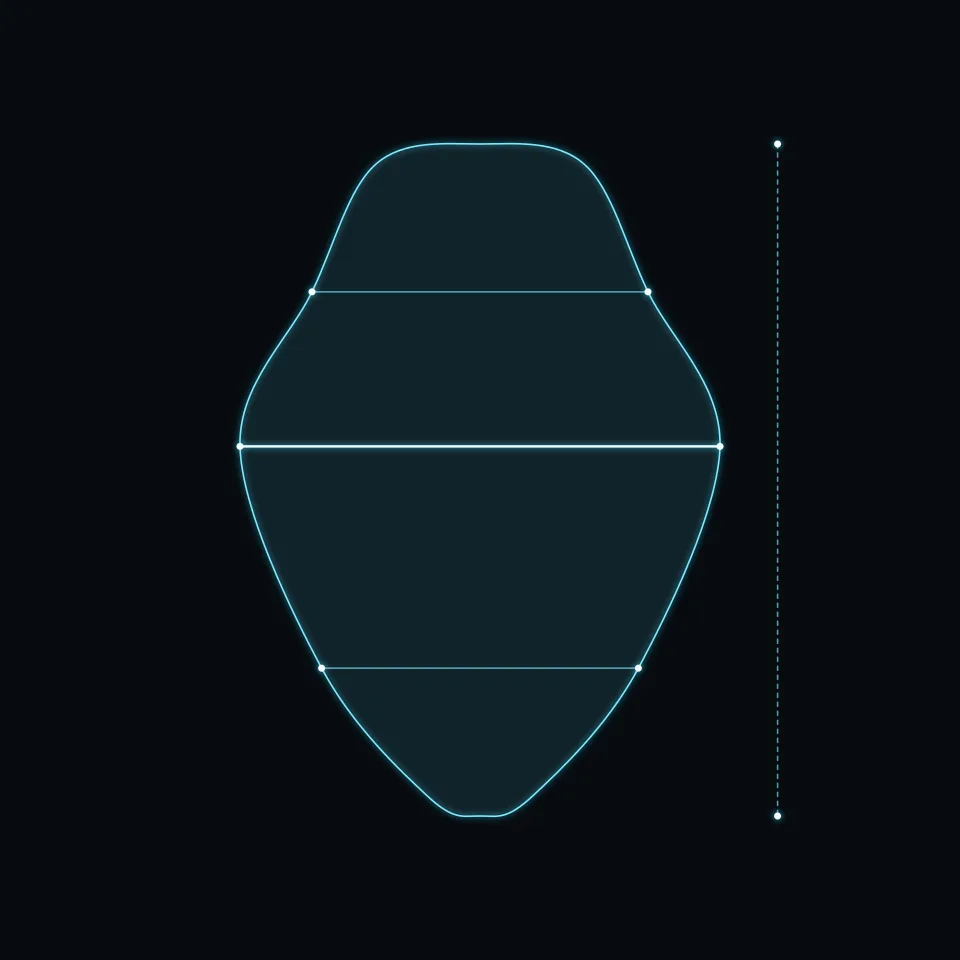
One face-shape guide gives diamond faces forehead ÷ cheekbones of about 0.84 and cheekbones ÷ jaw of about 1.31, so the jaw is about 76% of the cheekbones. Oval: 0.88 and 79%.
On the sample photo, forehead 496 ÷ cheekbones 582 = 0.85, jaw 460 ÷ 582 = 0.79. The forehead sits between the two shapes, the jaw matches oval, so it reads as oval. A point placed a few pixels off can flip that 0.04 gap.
So look at shape too: a diamond face turns visibly above and below the cheekbones, with a pointier chin and forehead and jaw close in width. Still asking “what face shape do I have?” See how to tell your face shape.
Three places a frame changes a diamond face
- The cheekbone gap: one guide wants the frame about cheekbone width. Narrower, and a strip of face shows past each edge, so the middle reads wider; much wider looks oversized.
- Top rim and temples: cat-eye corners sweep toward the temples; browlines and heavy-topped half-rims put weight across the forehead.
- Lower rim and height: a heavy lower rim or a low-set frame pulls the eye down; the forehead reads narrower.
With high cheekbones, a smile can push the frame up. It shouldn’t rest on the cheekbones.
Frame by frame on a diamond face
| Frame | Effect | Works when | Doesn’t when |
|---|---|---|---|
| Oval | Curves, slightly wide | Near cheekbone width | Small, narrow |
| Cat-eye | Corners lead to temples | Sweep ends past the brow | Narrower than the cheekbones |
| Browline | Weight at the forehead | Dark top bar | Thin, pale top |
| Round | Curves against angles | Medium or larger | Small rounds |
| Heavy lower rim | Eye moves down | Rarely | Forehead already narrow |
Sources clash here. One website’s face-shape page says add weight at the brow; its own blog says avoid frames wide at the top. One retailer says half-rims draw the eye down; another guide recommends heavy-topped half-rims for forehead weight.
Test it on a photo: three measurable checks
Nobody has tested these rules. In a 2023 Korean survey of 214 students, people said face shape mattered, yet their preferred frames didn’t follow it. So check:
- The gap: wear the frame, face the camera from 1.5–2 m, and see how much face shows between frame edge and cheekbone.
- A homemade ruler: the temple arm lists the lens width, say 50 mm. Measure it in pixels and you have a scale; then measure how far the pupil sits from the lens centre. A Japanese optician chain aims for within ±5 mm.
- Smile: the frame shouldn’t lift. If it does, see how glasses should fit.
All seven shapes: glasses for your face shape. Hair: hairstyles for diamond faces.
How FacialRate does it: check diamond across several photos
Diamond and oval differ by a few percent, so one photo can fall either way. The free FacialRate face report says up front that it describes this photo; light, angle and expression change the reading. So run it more than once, free with no limit: two or three photos without glasses, same light and the same 1.5–2 m distance, and see whether diamond holds and the contour reading stays steady. You also get your strongest feature, three highlights, 11+ dimensions and one tip.
The face analyzer runs on your device, finding 478 face landmarks in the browser; neither the photo nor any face image made from it is sent to a server. The full report is an optional one-time purchase.
FAQ
Can a diamond face wear square frames?
Yes. Right angles repeat the face's angles and sharpen the outline. For softness, pick rounded rectangles or ovals.
My frames lift when I smile. What helps?
Usually the pads sit too low. Metal frames can have them raised; with acetate, try a low-bridge fit that lifts the lenses off the cheeks.