Contents
Glasses size: three numbers first, face shape lastFrame width: compare it with your cheekbonesHow to read the numbers on the armThe bridge and nose pads: where the weight sitsTemple arms: long enough, not tightFour quick checks in a mirrorFAQKey points
- Compare frame width with your cheekbone width. About the same or a touch wider, with the outer edges not sticking out past your face.
- The three numbers inside the arm are lens width, bridge width and temple length, in millimetres.
- The bridge carries most of the weight. With a low nose bridge, a wide face or high cheekbones, look for a low-bridge style.
- Four mirror checks: eyes centred, no pinching at the temples, frame no wider than your face, no sliding.
Glasses size: three numbers first, face shape last
Frame shape decides how glasses look. Whether they are comfortable, stay put and let you see clearly is down to size, set by three measurements:
- Frame width: the widest point across the front, compared with your face.
- The bridge: the part between the lenses, where most of the weight rests.
- Temple length: from the hinge to the tip behind your ear.
A poor fit is more than a nuisance. Too wide, and your eyes aren’t centred in the lenses; looking through the side of a lens is less sharp and can mean tired eyes or headaches.
Frame width: compare it with your cheekbones
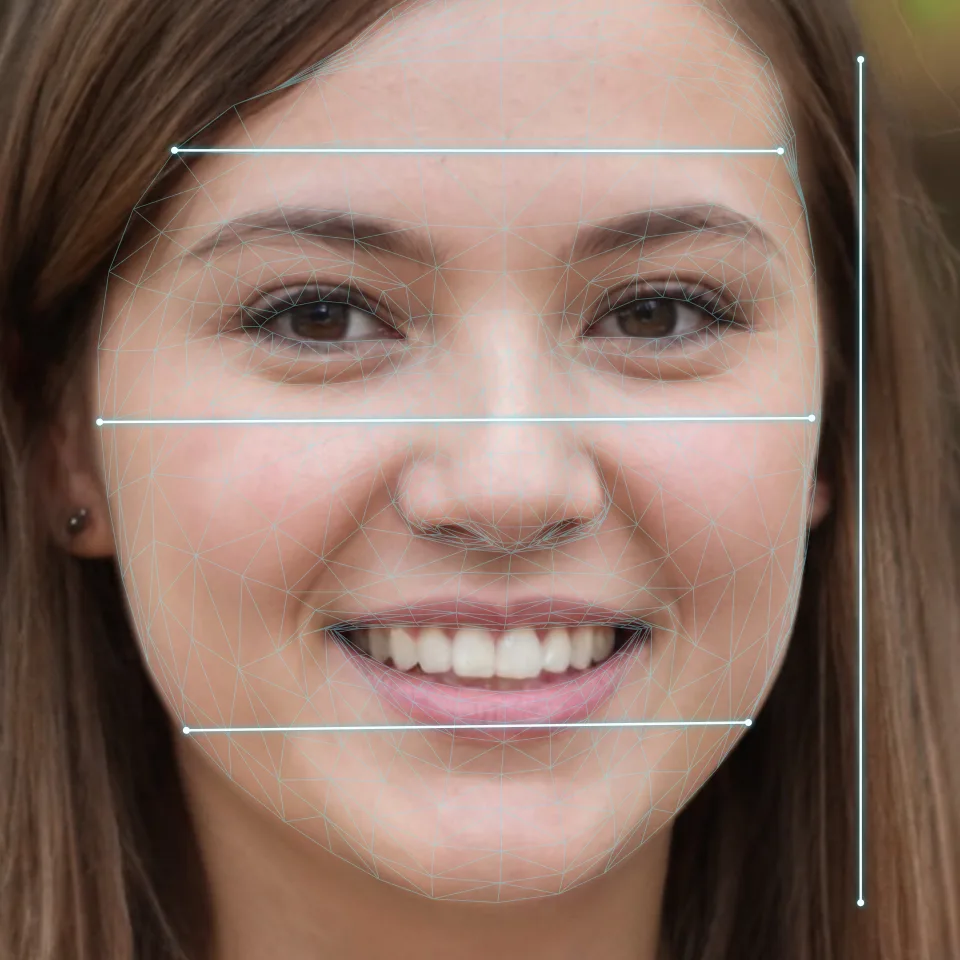
The sample photo above marks the four numbers used to judge face shape: length, forehead, cheekbones and jaw. For frames, the one that matters is cheekbone width, the widest line across the face. Here it is 582 pixels, wider than the forehead (496) and the jaw (460).
Pixels don’t convert to millimetres, but they do tell you which line is widest. Most guides compare the frame with it: about the same width or a touch wider, with the outer edges roughly in line with your temples and not sticking out past the sides of your face.
Frame width is the widest point of the front, usually end piece to end piece, decorative bits included. It is commonly 125–150 mm and isn’t printed on the arm, so measure it or check the product details. Too wide and your eyes look bunched near the bridge; too narrow and it pinches the temples.
How to read the numbers on the arm
Inside one temple arm you will usually find three numbers in millimetres, in this order: lens width, bridge width, temple length. They may be split by spaces, dashes or a small square; other letters and numbers are usually the model or colour.
| Number | What it measures | Common range (mm) |
|---|---|---|
| Lens width | One lens at its widest, rim not included | 40–60 |
| Bridge width | The shortest gap between the lenses | 14–24 |
| Temple length | Hinge to the tip of the arm | 120–150 |
Temple lengths usually end in 0 or 5; 135, 140, 145 and 150 are the most common.
Copy down the numbers of a pair that fits well as a starting point. They are only a guide: the same sizes in another thickness or material can feel different.
No old pair? A bank card can estimate lens width. Its short edge is about 54 mm. Hold that edge under one eye with one end at the centre of your nose, and see where the other end lands. Past the outer corner of your eye, go for narrower lenses; right at it, a medium usually fits; short of it, go wider.
The bridge and nose pads: where the weight sits
The bridge joins the lenses and rests on your nose, carrying most of the frame’s weight. A saddle bridge follows the line of the nose and spreads the load along it; a keyhole bridge, shaped like an old keyhole on its side, moves it to the sides of the nose and is common for wider noses.
For bridge width, look in a mirror at how far apart your eyes sit. A narrow bridge suits a smaller number, a wide one a bigger number; most people fall between 14 and 24 mm.
Then look at height. If your nose bridge starts at or below pupil level, or your face is wide, or your cheekbones are high, standard frames tend to slide and rest on your cheeks. A low-bridge style has bigger pads and adjusted lens tilt and arms. Metal frames usually have adjustable pads an optician can tweak.
Temple arms: long enough, not tight
The arms should reach behind your ears without running far past them. If they bend, the bend should start where the arm meets the ear.
A rule of thumb: good glasses disappear after a while. If you keep noticing them, they are too tight or too loose. Too tight means pressure at the sides of the head, soreness behind the ears or red marks on the nose; too loose means sliding and wobbling.
Four quick checks in a mirror
When you try a pair on, give it thirty seconds:
- Eyes centred in the lenses, not high, low, left or right.
- No pinching at the temples, and no movement when you shake your head.
- Frame no wider than your face: the lens edges don’t stick out past your sides.
- No sliding when you lean forward or look down at your phone.
Two extras: your brows should show above the top rim, and when you smile the frame shouldn’t touch or ride up on your cheeks. If the pair looks crooked, don’t use your brows as the guide, since many people’s sit at different heights; check whether the bottom rim runs parallel to the lower edges of your eyes.
Once the size is right, choose a shape with Glasses for your face shape; a free face report from one front-facing photo can show your face shape first. If glasses give you headaches, the cause may be fit or prescription, so see an optician.
FAQ
Does pupillary distance (PD) change frame size?
No. PD sets where the optical centre of each lens goes, so your pupils line up with it. It is handled when the lenses are made.
My glasses keep sliding down. What now?
Usually the frame is too wide or too loose overall. An optician can adjust pads and arms on metal frames; if several pairs slide, try a low-bridge style with bigger pads.
My frames touch my cheeks when I smile. What helps?
Choose frames with adjustable nose pads and raise the frame off the cheeks. If it happens with many pairs, a low-bridge style probably suits you.