Contents
What is a round face? Really, two numbersHow to tell if you have a round face: four numbersOne face, two standards, two different face shapesWhy can a haircut change how your face shape looks?Hairstyles for round faces: long and mid-length hairShort hair and bangs for a round faceHow to cut for your hair typeTest a haircut with two photosWhat glasses suit a round face?FAQKey points
- A round face comes down to two numbers: face length ÷ cheekbone width close to 1, and a jaw nearly as wide as the cheekbones.
- There is no single standard. Different guides put the line between round and oval at different numbers, so one face can land in two categories.
- Hair changes the outline people see: cover the widest part at the sides, add a little height on top, and keep hard edges away from cheekbone and chin level.
- Try long layers past the collarbone, an angled lob and curtain bangs first; go easy on a chin-length blunt bob and heavy straight-across bangs.
- Rather than memorising rules, take two photos the same way and check whether the outline's height-to-width ratio actually changed.
What is a round face? Really, two numbers
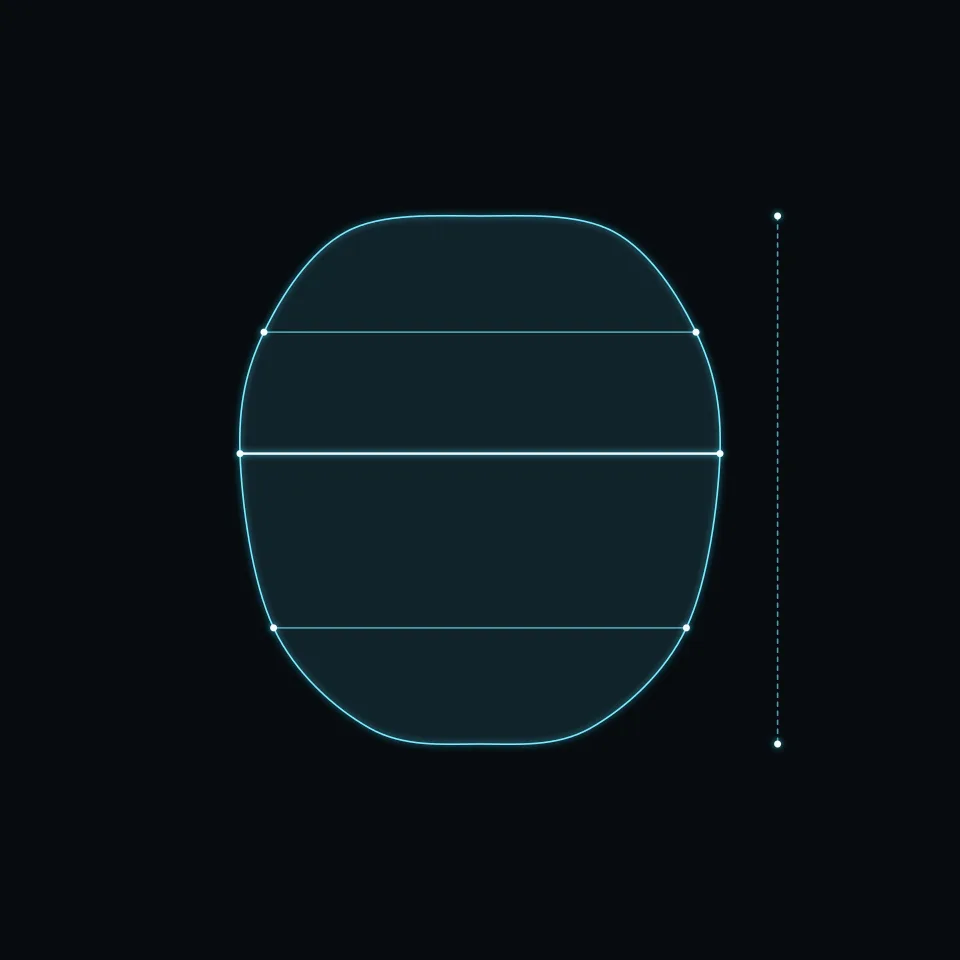
“Round face” sounds like a fact. It is closer to a summary of two numbers.
- Length to width: face length ÷ the width at the cheekbones. On a round face the two are close, so this number sits near 1.
- How similar the three widths are: forehead, cheekbones and jaw are within a small range of each other, the cheekbones are the widest, and the jaw doesn’t step in much.
Add one thing you judge by shape rather than number: the line from cheekbone to chin is a soft curve with no obvious corner. The hairline and chin are curves too.
A round face is most often confused with a square one. Both are about as wide as they are long; the jaw tells them apart. A square jaw turns a clear corner, a round one doesn’t.
One more thing: a round face isn’t something to fix. The ideas below are for people who want the outline to read a little longer or more angular. If you like the soft, round look, do the opposite.
How to tell if you have a round face: four numbers
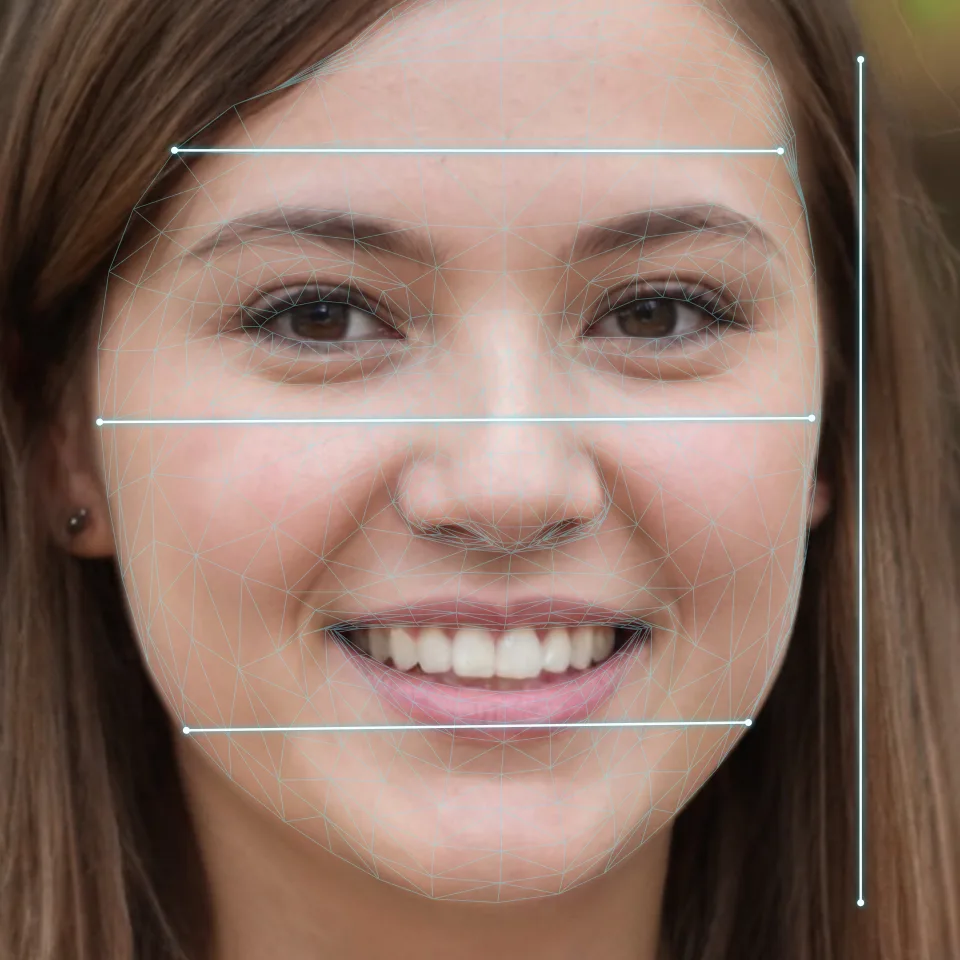
Judging face shape from your reflection is easy to get wrong; light and angle both mislead. Measuring is better, and all you need is one photo and an app that measures distances, or a face report built from one front-facing photo.
- Take the picture. Pull all your hair back so the forehead, both cheeks and the jawline show. Face the lens squarely with your head level, phone propped at eye height 1.5–2 m away (rear camera, timer). Closer than that, the wide lens enlarges the centre of the face and the length-to-width ratio itself changes.
- Measure four numbers: face length (hairline to the tip of the chin), forehead width, cheekbone width (the widest point across the cheekbones) and jaw width (between the two jaw angles).
- Work out two ratios: face length ÷ cheekbone width, and jaw width ÷ cheekbone width.
How to read them:
- The closer length ÷ width is to 1, the shorter and wider the face; clearly above 1, the face is long.
- The closer jaw ÷ cheekbones is to 1, the wider the lower face; clearly below 1, the face tapers.
- Both near 1, plus a jaw that curves instead of turning a corner, is a textbook round face.
One face, two standards, two different face shapes
We measured the sample photo shown earlier, in pixels:
- Face length: 690 (from a point high on the forehead to the tip of the chin)
- Forehead: 496
- Cheekbones: 582
- Jaw: 460
That gives length ÷ cheekbones = 1.19 and jaw ÷ cheekbones = 0.79.
Is this a round face? It depends on which guide you ask.
- One widely read guide puts a round face at about 1.13 and an oval at about 1.24. By that yardstick, 1.19 lands right between them.
- Another puts round at about 1:1 and oval at about 1.5:1. By that one, 1.19 is closer to round.
- But look at the jaw: at 79% of the cheekbone width, this face clearly narrows toward the chin, which doesn’t fit “three similar widths” at all.
There is a subtler problem too: where face length starts. Here it starts at a point high on the forehead, not the hairline; measured from the hairline, the face would be longer and the ratio bigger. Different guides don’t agree on the starting point either.
So a face-shape label is heavy compression. It squeezes at least two independent numbers into one word, and every guide draws its boundaries in a different place. Knowing your two ratios, how long relative to wide and how much the jaw tapers, is more useful than knowing which label you got.
Why can a haircut change how your face shape looks?
A haircut doesn’t change your face. It changes the outline other people see, in roughly three ways:
- Covering the widest part at the sides. Hair that falls outside the cheekbones leaves less face showing across. Less visible width means a bigger length-to-width ratio.
- Adding height on top. A little lift at the crown makes the whole silhouette of head plus hair taller.
- Where the ends fall. A blunt-cut edge or a straight-across fringe draws a horizontal line on the face. If that line lands at cheekbone or chin level, it underlines the width right there.
You may have heard that vertical lines make things look longer. It isn’t that simple. A 2011 perception study of striped clothing found that a figure in horizontal stripes looked about 5% narrower, the opposite of the popular rule; a later study with a real person wearing a striped dress found the reverse again. The effect of lines alone is small and depends heavily on context.
And to be straight with you: advice about hairstyles for round faces comes mainly from stylists’ experience, not from controlled experiments. Treat everything below as a hypothesis worth testing first, then check it on yourself with photos.
Hairstyles for round faces: long and mid-length hair
Going by those three mechanisms, these are good first tries for long and mid-length hair:
- Long layers past the collarbone. Start the layers below the cheekbones so the midface gets no extra width, and let the length fall at the sides to cover a little of the outer cheek.
- An angled lob, longer at the front. The front pieces reach past the jaw, so the ends form a slant instead of a horizontal line at chin level.
- Long S-shaped waves. Let the waves travel down the length. If they flip outward at ear level, they add the width straight back.
- A deep side parting with some lift. The diagonal and the extra height at the roots change the look without a cut.
- A high ponytail or bun. Pull the volume upward and keep a little softness at the crown rather than slicking it flat.
The ones to go easy on all share the same problem, a horizontal edge or added width:
- A blunt bob ending at the chin: the ends sit exactly at chin level and trace the width of the lower face.
- Sleek, flat, long straight hair: no height on top, and the sides hang straight beside the cheekbones.
- Big curls at ear level: the volume piles up at the widest part of the face.
Short hair and bangs for a round face
Short hair works. What matters is texture and height on top, with the sides kept close.
- A textured pixie: texture and height on top, close-fitting sides; showing the ears is fine.
- Another short route: a pompadour or quiff piled up on top with faded sides, or, less formally, a medium-length crop with loose texture.
- Short cuts to skip: a uniform buzz cut or a bowl cut with no height. Both repeat the round outline.
Bangs work too:
- Curtain bangs: parted in the middle, with the side pieces sloping down from the cheekbones. They form two diagonals at the sides of the face and hide a little of the outer cheekbone.
- Long side-swept bangs: angled across the forehead, breaking up its width.
- Heavy straight-across bangs, sparingly: they add a horizontal line across the forehead and shorten the visible face.
How to cut for your hair type
The same style lands differently on different hair:
- Straight hair: it lies close to the head and rounds the outline, so build height at the crown; a deep side parting suits it better than a sleek centre parting.
- Wavy hair: the natural S-bend already runs downward. Guide the waves down rather than letting them burst out at the ears.
- Curly hair: curls grow outward and easily widen the face at cheekbone level. Keep enough length to weigh the curl down, or move the volume up to the crown.
- Fine hair: it falls flat, and extra length makes it hug the head even more. Use styling products for texture and lift first.
- Thick, coarse hair: it holds a shape well but can puff out around the midface. Internal layers or thinning take bulk off the sides.
Test a haircut with two photos
No amount of advice beats one comparison on your own face. It’s simple:
- Fix how you shoot. Same phone, same spot 1.5–2 m away, same light, facing the lens squarely. That way the only thing that changes between the two pictures is your hair. Research has also found that the distance between camera and face changes the length-to-width ratio of the face in the picture.
- Shoot a baseline. All hair pulled back.
- Shoot the test. Style the version you want to try: hair down at the sides, lift at the crown, or bangs parted into curtains.
- Measure the visible outline. On both pictures, measure the width of face showing at cheekbone level and the height from the top of the head (hair included) to the chin, then divide height by width.
- Read the number, then your gut. If the ratio went up, the style really did lengthen the outline. Then ask yourself whether you like it.
Doing this before a salon visit is more reliable than bringing someone else’s photo: their face isn’t yours, but your two pictures show the same face.
What glasses suit a round face?
Frames are among the most visible lines on a face, and the logic is the same as for hair:
- Square and rectangular frames: their straight edges and corners contrast with the curves of the face; a slightly wide frame adds some horizontal structure.
- Geometric, cat-eye and browline frames: the first adds more lines, the other two draw the eye toward the upper half of the face.
- Round and oval frames: they echo the curves of the face. If you like that echo, go for it.
- Size: a frame that is too small looks swallowed by the face; one about as wide as the cheekbones, or a touch wider, sits more comfortably.
With a beard, keep it short on the cheeks and slightly longer at the chin to add a little length to the lower face; neat stubble or a short beard works too. A thick, bushy full beard makes the outline rounder.
These are common starting points, not rules. Comfort and liking what you see matter more than face shape. For the other proportions of the face, see facial thirds and fifths and facial asymmetry.
FAQ
How do I tell a round face from a square one?
Both are about as wide as they are long. The difference is the jaw. A square face has a clear corner at the jaw angle and a flatter chin; a round face runs from cheekbone to chin in one soft curve.
I'm between round and oval. Which advice should I follow?
Most people fall between two shapes. Go by the strongest feature. If length and width are very close and the jaw is wide, lean on the round-face ideas; if the face is clearly longer than wide and narrows toward the chin, lean on the oval ones. You can mix both and compare with photos.
Can I have short hair with a round face?
Yes. A pixie with texture and height on top and close-fitting sides is a common choice. What to avoid is a shape whose edge runs straight across at cheekbone level with a flat top.
Does a centre parting work on a round face?
It can. A sleek, flat centre parting has no height on top and drops hair straight down beside the cheekbones. Add a little lift at the roots, or pair it with curtain bangs or layers around the face, and it works much better.
Does weight change face shape?
Yes. The amount of fat in the face changes how wide it looks and how clear the jawline is, so the shape you measure can shift when your weight does. Face shape describes a period of time, not a lifelong label.
What short haircuts suit a round face if I keep it very short?
A pompadour or quiff with height on top and faded sides is the most common route; for something less formal, a textured crop of medium length. With a beard, keep it short on the cheeks and a little longer at the chin.