Contents
What is my face shape? Unpack the label into numbersHow to take a photo you can measureTurning four numbers into three ratiosRead your face shape in two stepsBetween two face shapes? Go by the strongest featureFAQKey points
- Measure four things on one front photo: face length, forehead width, cheekbone width and jaw width.
- Step one is face length ÷ cheekbone width: near 1 means short and wide, clearly above 1 means long.
- Step two is which width wins, and whether the jaw turns a corner, curves, or narrows to a point.
- Most people sit between two shapes. Go by the strongest feature.
What is my face shape? Unpack the label into numbers
“Oval” or “square” sounds like a description. It is really a few numbers squeezed into one word, answering three questions:
- Length against width: how much longer the face is than it is wide at the cheekbones.
- The widest part: forehead, cheekbones or jaw.
- The jaw: does the outline turn a corner at the jaw angle, run in one curve, or narrow to a point?
The first two you measure; the third you look at. A pointed chin, a rounded hairline or prominent cheekbones don’t decide the shape on their own. They add detail.
So skip the mirror. Put a ruler on a photo.
How to take a photo you can measure
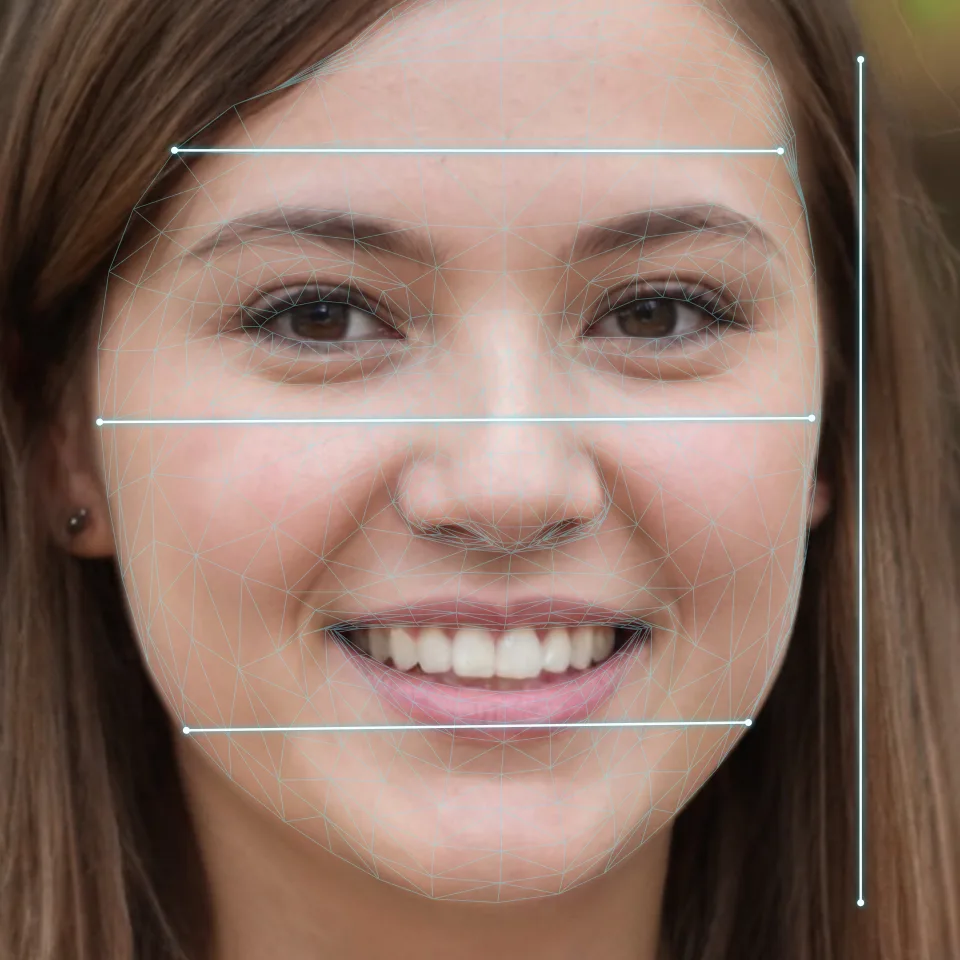
Use a photo, not a mirror, and take it the same way each time.
- Tie your hair back so forehead, cheeks and jawline show. Volume on top makes the face look longer; hair pressed flat makes it look rounder or squarer.
- Face the lens, head level, no turn.
- Keep the phone at least 1.5 m away. Closer than that, especially within about 30 cm, the wide lens enlarges the nose and cheeks, so the ratio itself changes. Prop the phone at eye height, use the rear camera (2×–3× zoom if you have it) and a timer. Research confirms that camera distance alters a face’s shape in a picture.
- Draw four lines. Length: middle of the hairline to the bottom of the chin. Forehead: across the forehead. Cheekbones: the widest point. Jaw: between the two jaw angles.
Any editor that measures pixels will do; units don’t matter. If you would rather skip the lines, a face report built from one front-facing photo shows your face shape alongside the other ratios.
Turning four numbers into three ratios
A bigger face has bigger numbers everywhere, so divide by the cheekbone width:
- Length ÷ cheekbones: how long the face is.
- Jaw ÷ cheekbones: how much the lower face narrows.
- Forehead ÷ cheekbones: how much the upper face narrows.
Add one cue you don’t calculate: trace the outline from below the ear to the chin and see whether it bends at the jaw angle.
On the sample photo, in pixels: length 690, forehead 496, cheekbones 582, jaw 460. That gives 1.19, 0.79 and 0.85. Cheekbones widest, then forehead, then jaw.
One catch: this length starts high on the forehead, not at the hairline. Move the start and the first ratio moves too, so note where yours starts.
Read your face shape in two steps
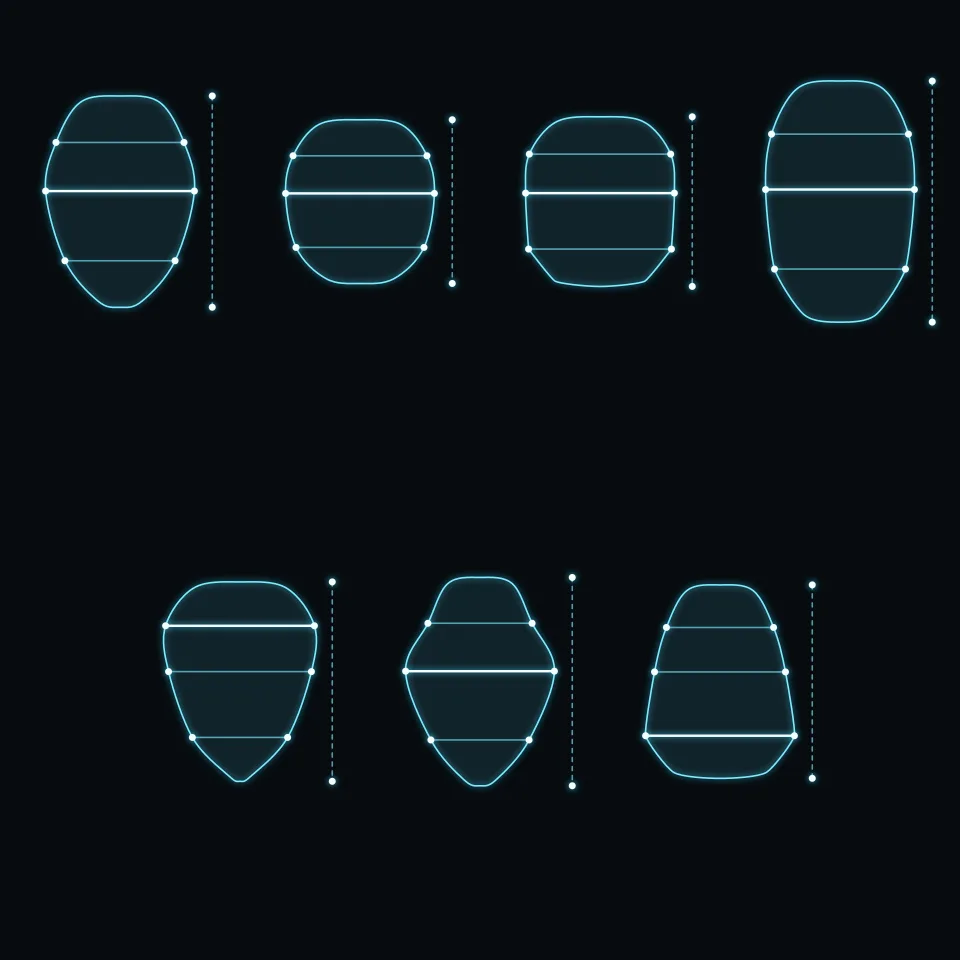
Step one: length. Near 1, the face is short and wide; look at round and square. Clearly above 1, look at the rest.
Step two: the widest part and the jaw.
- Cheekbones widest, forehead and jaw narrower, jaw curved: oval. Longer still, widths similar: oblong.
- Length close to width, jaw barely narrowing: round if it curves, square if it turns a corner.
- Forehead widest, down to a slim, pointed chin: heart.
- Cheekbones widest, forehead and chin both narrow, chin pointed: diamond.
- Jaw widest, forehead narrowest: pear.
The sample is a little longer than wide, with the jaw at 79% of the cheekbones and the forehead at 85%. One guide puts oval at a length ratio of 1.24 ± 0.1, a forehead ratio of 0.88 ± 0.07 and cheekbones about 1.26 times the jaw. All three numbers fall inside.
Between two face shapes? Go by the strongest feature
Most faces sit between two shapes: oval and oblong, oval and heart, round and square. Shape varies smoothly; categories are lines drawn across it.
Then go by the most obvious feature. The sample’s 1.19 is near that guide’s round at about 1.13, but its jaw clearly narrows, which a round face doesn’t. The tapering jaw wins, so it reads as a short oval.
Guides, like any face shape detector, draw their boundaries at different numbers; the seven shapes and where guides disagree are in face shape types. Your ratios matter more than the label. Next, see hairstyles for your face shape.
FAQ
My hairline is hidden or hard to see. Where does face length start?
Push the hair back. If it is still unclear, start at the highest visible point of the forehead and note it. A higher start gives a bigger ratio, so always use the same one.
Does the photo angle change the result?
Yes. Head tilt, camera distance and the start of the face length all move the ratios, whether you use a ruler or a face shape calculator. Face the lens from 1.5–2 m, take two or three shots and keep the numbers that agree.
Is the method the same for everyone?
Yes. It measures the outline, whatever your sex or age. With a beard, measure between the jaw angles, not to the beard's edge.