Contents
Glasses for heart-shaped faces: where does the frame sit?How much does a heart face taper?What each part of the frame doesFrame by frame on a heart faceTest it with two photosHow FacialRate does it: confirm the taper firstFAQKey points
- A heart face narrows from forehead to chin; one guide's ratios put the forehead at about 1.26 times the jaw.
- Most guides say thin, light top rim; rounded or slightly heavier lower rim.
- Guides size the frame to the forehead or to the cheekbones; on a heart face those differ by about 8%.
- This is optician habit; in the one survey, frame preference ignored face shape.
Glasses for heart-shaped faces: where does the frame sit?
The short answer: a thin top, a rounded base, little overall weight. Try fine metal round or oval frames, round-based aviators or clear frames first. Go easy on thick, decorated top rims.
The reason is position. The top rim follows your brows, along the lower edge of the forehead, the widest band of a heart face. The lower rim stops above the cheekbones, before the face narrows. Wherever a frame adds a line, that band gets more attention. So: add little where the face is widest, a bit more below.
How much does a heart face taper?
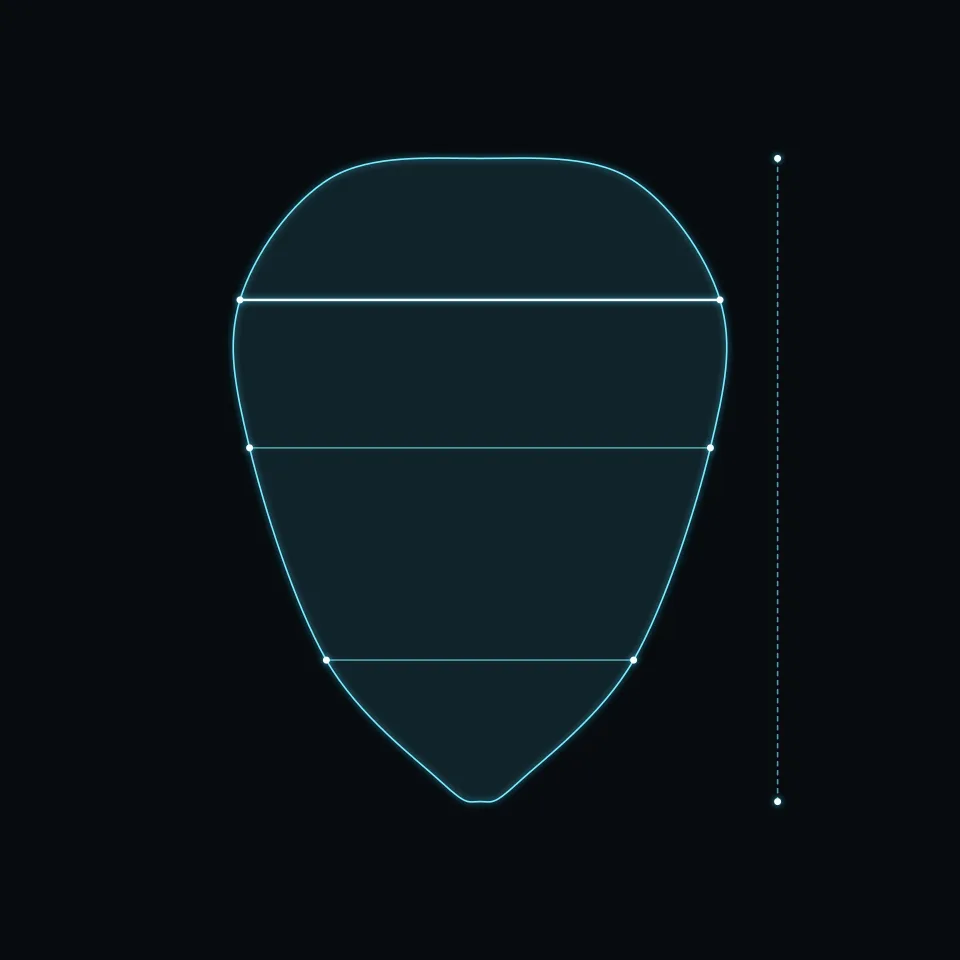
“Heart” is a label for two ratios. One face-shape guide gives forehead ÷ cheekbones at about 0.92 and cheekbones ÷ jaw at about 1.37. Multiplied, the forehead is roughly 1.26 times the jaw.
On the sample photo (pixels): forehead 496, cheekbones 582, jaw 460. Forehead ÷ jaw is 1.08, a far smaller taper: a short oval face.
If you’re asking “what face shape do I have?”, measure the three widths on one photo, hair back, facing the camera (how to tell your face shape). Keep one number, forehead ÷ jaw. Near 1.26, the advice below is worth trying; near 1, it barely matters.
What each part of the frame does
- Top rim: a line across the widest band. Thick or decorated makes the upper face louder; fine, pale or clear keeps it quiet.
- Lower rim: above the cheekbones. A heavier one pulls the eye down (one guide); a curved one follows the narrowing face.
- Width: wider than the forehead exaggerates the top; how wide is disputed.
- Height: set higher, the forehead looks shorter; set lower, the eye moves down (one guide). Adjustable pads tune this.
Frame by frame on a heart face
| Frame | Effect | Works when | Doesn’t when |
|---|---|---|---|
| Round, oval | Curves, no corners | Thin rim, medium size | Thick acetate top |
| Aviator | Teardrop lens | Wider at the bottom | Heavy top bar |
| Bottom-heavy | Eye moves down | Big forehead-to-chin gap | Top and bottom similar |
| Cat-eye | Raised corners | Gentle, worn a little low | Corners at the widest forehead |
| Oversized, heavy browline | Width up top | You want the forehead stressed | You want less taper |
Guides split. Width: slightly wider than the forehead, or about cheekbone width, a few millimetres apart here. Half-rims: one retailer recommends top-only ones; a Japanese optician chain says avoid designs that pull the eye up. A Taiwanese chain even recommends aviators and cat-eyes for faces wide on top.
Test it with two photos
None of this has been tested. A 2023 Korean survey of 214 students found they cared about face shape, yet their preferred frame shape did not differ by self-rated face shape (p = 0.371). So test the table:
- One front-facing photo per frame, same spot, same distance (1.5–2 m) and same light.
- Does the outer edge land on the forehead or the cheekbone line? Keep the one you prefer.
- Lens height about a third of brow-to-chin (Japanese opticians), brows just showing above the rim.
Sizing is in how glasses should fit, all seven shapes in glasses for your face shape, hair in hairstyles for heart-shaped faces.
How FacialRate does it: confirm the taper first
Every tip above assumes your forehead is clearly wider than your jaw. Check that first with the free FacialRate face report: use a photo without glasses, hair back. The face analyzer finds 478 face landmarks in your browser, and the mesh you see is drawn on your device; neither the photo nor any face image made from it reaches a server. You get your face shape, strongest feature, three highlights, a reading of 11+ dimensions including contour, and one tip. Free, no limit on tries; the full report is an optional one-time purchase.
It says plainly that it reads this photo; light, angle and expression change the result. Compare two photos, then try frames on.
FAQ
Can I wear cat-eye frames with a heart-shaped face?
Yes. One guide suggests a gentle sweep worn slightly low, so the corners miss the widest part of the forehead; one optician chain recommends them outright.
Do aviators suit a heart-shaped face?
Depends on the lens. A teardrop wider at the bottom keeps the weight low; a thick top bar moves it back to the forehead.