Contents
Glasses for pear-shaped faces: weight on topName it first, then measure forehead and jaw“Match the widest part” needs a rewrite hereFrame by frame on a pear-shaped faceWear it, photograph it, take three ratiosHow FacialRate does it: check the jaw is the widestFAQKey points
- Widest at the jaw, narrowest at the forehead: a heart face upside down. No source gives a cutoff; check whether forehead ÷ jaw is below 1.
- The rule "match the widest part" breaks here: the widest part is the jaw, below the frame.
- Start with cat-eyes and slightly wide rectangles, the only frames one retailer's two articles share.
- Some opticians' "triangle" means the face wide on top; don't borrow that advice.
Glasses for pear-shaped faces: weight on top
The short answer: weight on the top rim, width above the eyes. Try cat-eyes, browlines, slightly wide rectangles and aviators with a brow bar. Go easy on small frames with a thin top, and on frames weighted low.
The eye compares the two ends of an outline, and the top rim follows the brows, the narrowest band of this face. A strong line there shrinks the gap between top and bottom. The hair version is in hairstyles for pear-shaped faces.
Name it first, then measure forehead and jaw
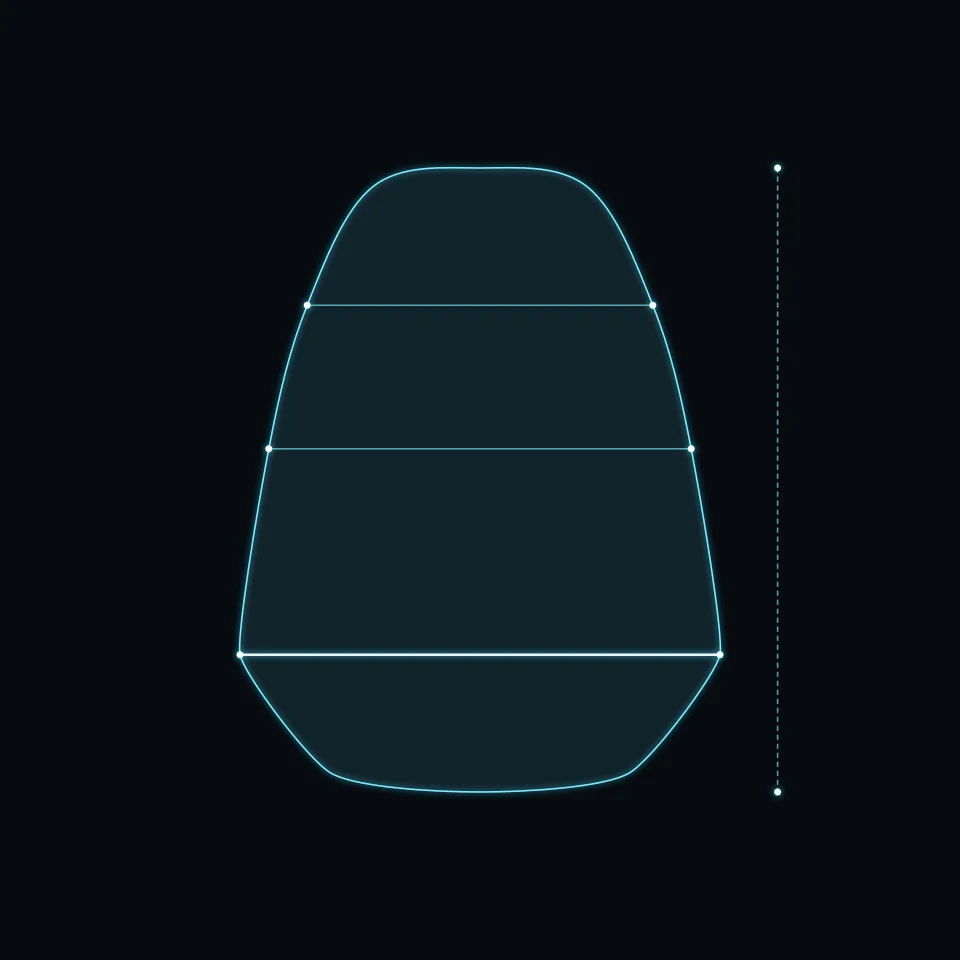
“Triangle face” means opposite things in different places. Here: jaw widest, forehead narrowest, cheekbones not prominent. A Japanese optician’s “triangle face” advice puts the emphasis low, which fits a face wide on top; a Taiwanese chain splits triangles in two and advises only the wide-top kind; a Korean optics textbook doesn’t say. Check which face a source means.
Then measure. No source gives a cutoff, so two numbers do: forehead ÷ jaw below 1, and jaw ÷ cheekbones near or above 1. On the sample photo, forehead 496, cheekbones 582, jaw 460 (pixels) give 1.08 and 0.79. The forehead is wider than the jaw: not pear-shaped. If you’re still asking “what face shape do I have?”, see how to tell your face shape.
“Match the widest part” needs a rewrite here
Sources give four answers on frame width: about the widest part, slightly wider, equal or slightly narrower, equal or slightly wider. All assume the widest part sits at frame level.
Not here: size to the jaw and the frame runs past the temples; to the forehead, it’s too small. The usable reference is the band the frame sits in, cheekbones and temples, as in how glasses should fit: about cheekbone width or slightly more, outer edges not clearly past the sides of the face.
Within that width, push the weight up: one retailer says browline detail can be bold, from cat-eye flicks to decorated hinges.
Frame by frame on a pear-shaped face
| Frame | Effect | Works when | Doesn’t when |
|---|---|---|---|
| Cat-eye | Corners widen the forehead | Flick sits above the brow tail | Frame too small overall |
| Browline | Weight at the brow | Dark top bar | Thin, pale top |
| Rectangle | Horizontal lines up top | Near cheekbone width | Narrow and shallow |
| Aviator with brow bar | Extra line above the eyes | Visible bar | No bar |
| Round, oval | Curves against jaw angles | Medium or larger | Small rounds |
| Lower-rim only | Weight goes low | Rarely | Width piles up below |
One retailer lists rectangles, browlines and cat-eyes in one article, then adds round, oval, aviator, square and geometric in another. Both include cat-eyes and rectangles. Start there.
Wear it, photograph it, take three ratios
This is all convention. In a 2023 Korean survey of 214 students, preferred frame shape didn’t change with self-rated face shape, except that self-rated triangle faces liked half-rims more. So measure:
- Frame width ÷ forehead width: above 1 means the frame adds width up top, the direction you want.
- Frame edges: no need to match the jaw; just keep them inside the temples.
- Lens height ÷ face length: a Japanese optician chain keeps it within a third.
Keep spot and distance the same. The seven-shape overview: glasses for your face shape.
How FacialRate does it: check the jaw is the widest
With names this tangled, start from your own face. The free FacialRate face report shows your face shape and 11+ dimensions including contour, to compare with the definition above, plus your strongest feature, three highlights and one tip.
Detection runs on your device: the face analyzer finds 478 face landmarks in the browser, and neither the photo nor any face image made from it goes to a server. It’s free with no limit; the full report is an optional one-time purchase.
It says the reading describes this photo; angle, light and expression change it. Try a second photo before deciding.
FAQ
How is a pear-shaped face different from a square one?
Look at the forehead. On a square face it is about as wide as the jaw; a pear-shaped face narrows upward to a clearly narrower forehead.
Do half-rims suit a pear-shaped face?
Top-only half-rims put the weight up, which fits. In a Korean survey, self-rated triangle faces liked half-rims most, though it didn't say which triangle.