Contents
What are facial thirds and fifths?Are facial thirds accurate? Almost nobody matches themHow to measure facial thirds on a photoHow to measure the facial fifthsA facial thirds test on a real photoWhy your measurements come out wrong: 6 sources of errorHow to read your facial thirds ratioWhat are facial thirds good for?FAQKey points
- Thirds: hairline to brows, brows to the base of the nose, nose to chin. Fifths: the face is about five eye widths across.
- Almost no real face fits it: in one study, the equal-thirds rule held for none of 103 people.
- Measure three times before you trust a number. How far the three results differ is how precise your ruler is.
- The most reliable reading is middle third ÷ lower third. The hairline is the least reliable point, so leave it out at first.
- It is a way of looking, not a scorecard. Knowing which part has a little more room tells you where to start with hair and makeup.
What are facial thirds and fifths?
Facial thirds and fifths are an old artists’ rule for placing the features of a face on paper.
- Thirds: cut the face into three parts from top to bottom. The upper third runs from the hairline to the brow line, the middle third from the brow line to the base of the nose, and the lower third from the base of the nose to the bottom of the chin. The rule says all three are the same height.
- Fifths: cut the face into five parts from side to side. At eye level, the face is about five eye widths across: one eye width between the eyes, one for each eye, and one from each outer eye corner to the edge of the face.
Chinese figure painting has the same idea under the name “three courts, five eyes”. Ancient Greek sculptors and Renaissance painters wrote down nearly the same rules, now called the neoclassical canons: a face divided into equal thirds, and a gap between the eyes equal to one eye. What people call facial thirds and fifths today is a mix of the two.
Think of it as a ruler. It measures how the space on a face is shared out. It does not say any arrangement is better than another.
Are facial thirds accurate? Almost nobody matches them
Here is the counterintuitive part. The rule has been passed down for a very long time, yet as soon as you measure real people, it almost never holds.
- 1985: Farkas and colleagues measured young North American adults with calipers. Very few had three exactly equal thirds, and the gap between the eyes often did not equal one eye. It was the first serious check of these proportions against real faces.
- 2012: a study measured 103 young adults from 3D photographs. The equal-thirds rule held for none of the 103.
- 2011: a review pooled measurements of 2,359 people from 27 populations across 7 studies. What differed most between populations was forehead height, followed by the distance between the eyes and the width of the nose.
That matters. Facial thirds and fifths do not describe a normal face. They describe an idealised starting point. If your thirds come out unequal, that is close to guaranteed.
How to measure facial thirds on a photo
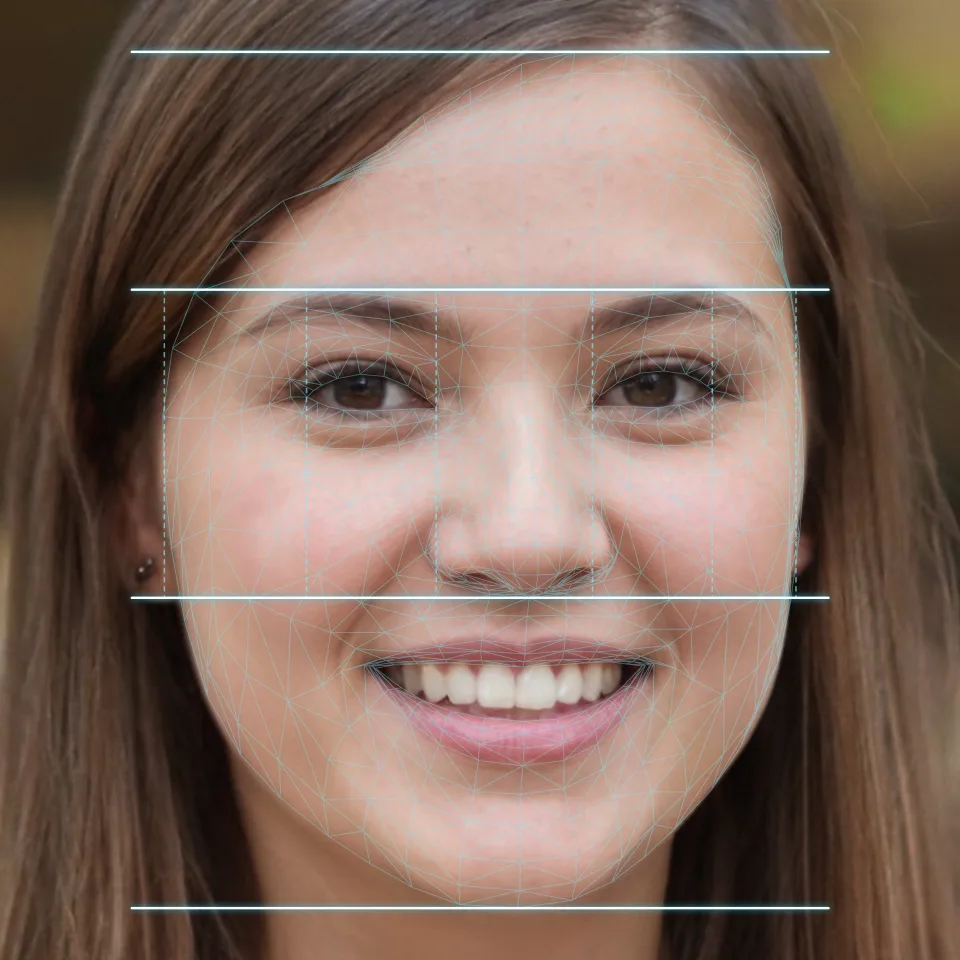
Measuring once teaches you more than reading ten explanations. You need very little: one photo and a ruler, or any photo editor that can measure distances.
- Take the photo. Face the camera straight on, in even light. Push all your hair back so your forehead and hairline show. Close your lips and relax your face. Keep your head level: no tilting up, down or to the side. Prop the phone at eye height 1.5–2 m away (rear camera, 2×–3× zoom if you have it, 3–10 second timer); the front-facing photo guide has the full setup.
- Draw four horizontal lines: at the hairline, the brow line, the base of the nose and the bottom of the chin.
- Measure three numbers: the height of the upper, middle and lower thirds. Write them down.
- Measure twice more. Take another photo the same way, or redraw the lines after a break, until you have three sets of numbers. Use the same phone, distance and light each time, so the only thing that changes between rounds is the hand drawing the lines.
Most guides skip step 4, yet it decides whether you can trust your result. If your three rounds differ by more than the thirds differ from each other, what you measured is mostly error from the photo and the lines, not your face. If you would rather not draw the lines, a face report built from one front-facing photo shows your facial thirds and fifths alongside other ratios.
How to measure the facial fifths
At eye level, measure five numbers from left to right: the left outer eye corner to the edge of the face, the length of the left eye, the distance between the inner eye corners, the length of the right eye, and the right outer eye corner to the edge of the face.
- The middle fifth is the one most worth looking at: it is the distance between the eyes. If it is about one eye long, it matches the rule.
- The two eyes are usually about the same length.
- The two outer fifths vary the most. Whether a face looks wide or narrow mostly comes down to these, and the edge of the face is the hardest point to find in a photo, because hair and head angle both get in the way.
While you are there, look at the nostrils: their width usually falls roughly between the two inner eye corners.
A facial thirds test on a real photo
Methods are abstract, so we measured the sample photo above. The numbers are in pixels on the photo.
Thirds
- Upper third (hairline to brow line): 219
- Middle third (brow line to base of the nose): 284
- Lower third (base of the nose to chin): 286
Middle ÷ lower = 0.99, almost exactly 1:1. The upper third comes out short, but don’t jump to conclusions: the hairline in this photo is estimated, and the upper third happens to be the least reliable of the three.
Fifths (left to right)
- Left outer 131 · left eye 120 · gap between the eyes 144 · right eye 110 · right outer 77
The gap between the eyes is about a quarter longer than one eye. That is common in real faces, and research keeps finding it: the distance between the eyes is often longer than an eye. The two outer fifths differ a lot (131 against 77). That is most likely not the face itself, but a slight turn of the head, or hair covering the right edge of the face.
So by the rule, this face has “balanced middle and lower thirds, wide-set eyes, upper third unclear”. A face that looks well balanced still does not fully match the rule, and within the same photo, some numbers are trustworthy while others deserve a question mark. That is what the next section is about.
Why your measurements come out wrong: 6 sources of error
A number is only as good as how steadily you measured it. The six most common sources of error:
- Head angle. Tilting your head down stretches the upper third and squashes the lower third; tilting up does the opposite. A slight tilt to the side makes the two halves of the face differ too, which is one reason many people think their face is asymmetric.
- A camera too close. A phone’s wide-angle lens enlarges the middle of the frame, so the middle of the face looks wider and longer. A front camera at arm’s length is the worst case; from 1.5–2 m with the rear camera, the distortion is much smaller.
- Where you put the lines. The brow line can be drawn three common ways: along the top of the brows, through the two brow peaks, or through the lowest point between the brows (the glabella, which measurement studies often use). Any of them works, as long as all three rounds use the same one.
- The hairline. This is the least reliable point of all. A receding or uneven hairline, or bangs, make the upper third hard to measure.
- Light. Light from one side leaves one half bright and the other dark, which makes the edge of the face and the chin harder to find.
- Expression. Smile, and the mouth corners rise and the chin drops, so the lower third gets longer.
A simple fix: leave out the least reliable point at first. That is why many people only compare the middle and lower thirds, whose end points are easy to see.
How to read your facial thirds ratio
The simplest reading uses one number: middle third ÷ lower third.
- Close to 1: the face is fairly balanced vertically. Japanese makeup artists often say a face looks most balanced when the middle and lower thirds are close to 1:1.
- Clearly above 1: the middle third is long, and the space between the eyes and the base of the nose looks open.
- Clearly below 1: the middle third is short, the features sit close together in the middle of the face, and the lower half of the face looks long.
Read the upper third on its own. Whether the forehead is high or low depends most on the hairline and hairstyle, and it is the part bangs can most easily rewrite.
The fifths also come down to one number: the gap between the eyes ÷ eye length (the average of both eyes).
- Close to 1: it matches the rule.
- Clearly above 1: wide-set eyes, and the features look more open.
- Clearly below 1: close-set eyes, and the features look more gathered.
Hold off on comparing the two outer fifths. They are the most affected by head angle and hair, and a small difference between left and right is normal.
Two more reminders:
- Small differences are almost invisible. Only a clearly long or clearly short part changes the overall impression.
- One long part does not make a whole face unbalanced. Read the three thirds together, and the fifths too.
What are facial thirds good for?
If almost nobody fits them, what are they for? Plenty. They are a handy tool for answering one specific question: which part of my face has a little more room, and which a little less?
Once you know that, you have a starting point for hair and makeup:
- Upper third: bangs are the most direct tool. With a high forehead, let bangs cover part of it; with a low forehead, keep bangs light or show the forehead.
- Middle third: blush direction and brow shape do the most. Blush swept across the cheeks and flatter brows make the middle third look shorter; blush swept up toward the temples and arched brows make it look longer.
- Lower third: hair length, volume around the chin and where you place lip color all change how this part looks.
- Fifths: drawing eyeliner further in or out changes how far apart the eyes look.
These are all visual adjustments. The aim is not to turn your face into 1:1:1, but to see your own face clearly first and then choose what suits it.
FAQ
What are the ideal facial thirds?
The traditional rule says the three parts are equal (1:1:1) and the face is five equal eye widths across. It is an idealised starting point, not how a normal face looks. When real people are measured, almost nobody matches it exactly.
Is a long lower third bad?
No. The vertical proportions of faces vary a lot from person to person. The rule only describes how space is shared out across the face; it does not say any arrangement is better.
I can't see my hairline clearly. How do I measure the upper third?
Don't, for now. Compare only the middle and lower thirds, whose end points are easy to find, and come back to the upper third with a photo that shows your hairline.
Are facial thirds different for men and women?
The rule is the same for both. In the research, one review of 2,359 people found no clear difference between men and women, while another study saw differences in the details. So there is no need for two sets of rules; just measure your own face.
How are facial thirds different from the golden ratio?
Facial thirds and fifths ask whether a few parts are close to equal. The golden ratio asks whether certain ratios are close to 1.618. They answer different questions, so one face can be close on one and far off on the other.
Where does the rule come from?
Classical Chinese figure painting has it as "three courts, five eyes" (三庭五眼), and ancient Greek sculpture and Renaissance painting had almost the same rules.