Face shape
Oval face
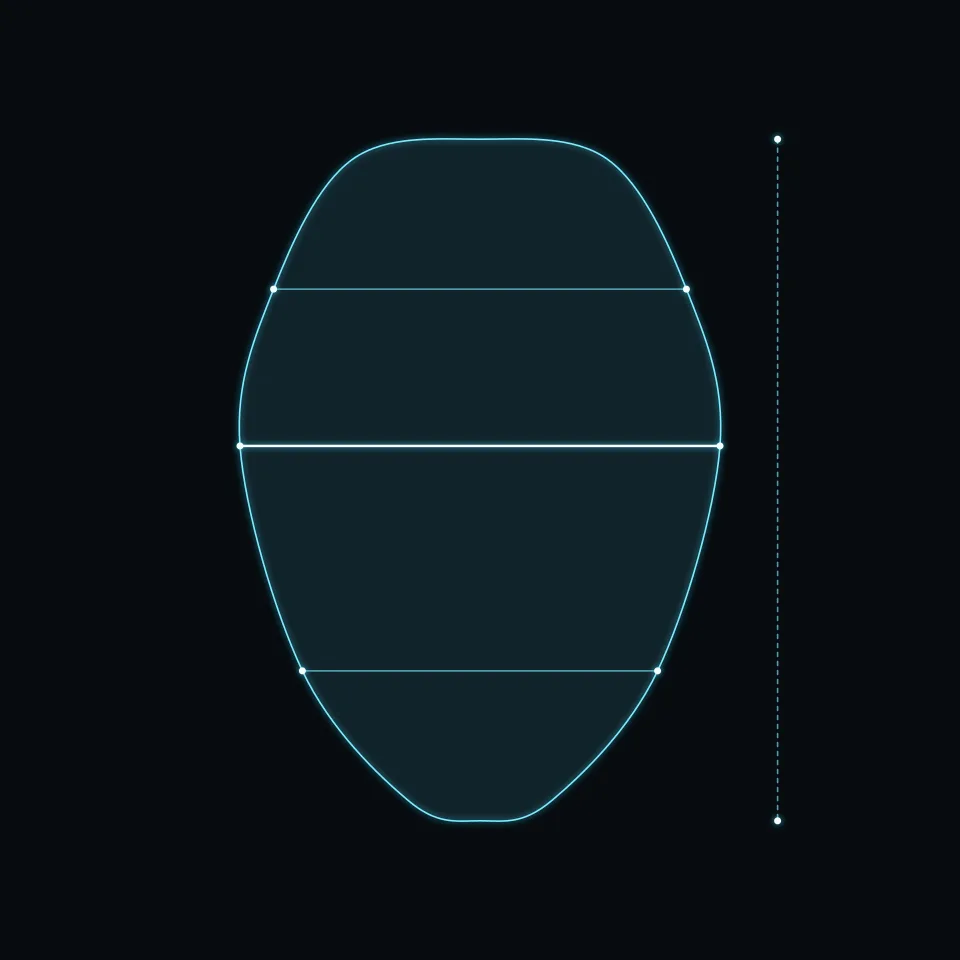
A little longer than it is wide, with a forehead a touch wider than the chin. The jaw narrows evenly and has no clear corners.
Every guide on oval faces: hair, bangs, glasses and contour, in one place.
Is yours an oval face? Start with length, then the jaw
An oval answers “a little” to most questions, so check each one on a front-facing photo before you settle on the name.
- Length: a little longer than wide, so neither close to equal nor clearly long.
- Widths: the cheekbones are the widest line, the forehead is a little narrower, and the jaw is narrower still.
- Jaw: from below the ear to the chin the outline narrows evenly in one smooth curve, with no corner at the jaw angle.
- Chin: rounded rather than sharply pointed.
One guide puts an oval’s length at about 1.24 times the cheekbone width, give or take 0.1; another says about 1.5 times as long as wide, dividing by a different width. A rounded chin or a curved hairline does not decide the shape on its own.
What separates an oval face from a long face and a heart-shaped face
Long face
Length is the whole difference: a long face is clearly longer than it is wide, an oval only a little. One guide’s figures, about 1.24 and 1.34, sit only 0.1 apart, so a face at the long end of the oval range can read as either.
Heart-shaped face
Look at the forehead and the chin together. A heart-shaped face has a forehead about as wide as the cheekbones or wider and closes to a small, pointed chin; an oval’s forehead sits a little inside the cheekbones and its chin stays rounded.
Start the length line at the same point on the forehead every time, since a higher start gives a bigger ratio, and compare the forehead’s width at the sides rather than the shape of the hairline.
Guides for oval faces
Hairstyles for oval faces: how to choose when almost everything works
Hairstyles for oval faces: almost every cut works, so choose by hair type, upkeep and the look you like. A seven-row table. Is yours oval? Check free.
4 min readHairstyles for your face shape: seven shapes, one table
Hairstyles for your face shape come down to two moves: add or go easy. One table covers seven shapes. Find your shape free with one front photo.
5 min readHow to tell your barber what you want: four things to say, in numbers
How to tell your barber what you want: photos, lengths as numbers, parting, styling time, plus a script. Not sure of your face shape? Check it free.
10 min readHow to style your hair in 5 minutes: the order, and where the volume goes
How to style your hair: towel-dry, roots first, cool air to set, a pea of product, and where volume goes. Not sure of your face shape? Check it free.
8 min readBangs for your face shape: one table for length, weight and direction
Bangs for your face shape come down to length, weight and direction. A seven-shape table and where guides disagree. Check your shape free in seconds.
4 min readGlasses for oval faces: any shape, the right size
Glasses for oval faces: almost any shape works, so size is the variable. Eight frames compared. Unsure you're oval? A free face report tells you.
4 min readGlasses for your face shape: a guide to seven shapes
Glasses for your face shape: contrast your outline or echo it. One chart tells seven shapes what to try and skip. Find your shape free in seconds.
5 min readThick glasses lenses: choose the frame first, then the lens
Thick glasses lenses: what frame width, centring, 1.67 vs 1.74 and coatings really change. Unsure of your face shape? Check it free.
6 min readGlasses size: how to read frame width, bridge and temple length
Glasses size starts with three numbers inside the arm: lens, bridge, temple. Read them, run four mirror checks. A free face report shows your shape.
5 min readBeard styles for face shape: where length and width go
Beard styles for face shape: length, width and edges compared across seven shapes. Grow it a month first. Find your face shape free before you trim.
5 min readHow to shave your face: seven steps, then where the edges go if you keep stubble
How to shave your face in 7 steps, plus where stubble edges go. Blades last 5–7 shaves. Wondering about your jawline? Check it free.
8 min readContouring for your face shape: where shading and blush go
Contouring for your face shape is drawing with light. Where shade, highlight and blush go for seven shapes. Which are you? A free face report shows.
4 min readHighlight and contour basics: where each goes, and why
Highlight and contour basics: highlight where light lands, contour where shadow falls. A placement table, spots to skip. Check your depth free.
4 min readFace shape types: the seven shapes in one table
Face shape types are usually seven. One table sorts them by length, widest part and jaw. Which one are you? A free face report shows it in seconds.
5 min readV-shaped face: is it oval, heart or diamond?
V-shaped face is an everyday name, not a textbook shape. Two ratios sort it into oval, heart or diamond. A free face report shows your shape.
4 min readEyebrow shape for your face: echo its lines or contrast them
Eyebrow shape for your face: place the head, arch and tail, then use the table for seven face shapes. Not sure of yours? A free face report shows it.
4 min readHow to trim eyebrows: strays only, and never the head, arch or tail
How to trim eyebrows without ruining the shape: strays only, in 4 steps, plus which tool to use. Curious about your brow gap? Check it free.
7 min readJawline and face shape: two numbers, not one
Jawline and face shape link through two numbers: corner sharpness and jaw-to-cheekbone width. A table of seven shapes. Check yours in a free report.
4 min read
Compare with the other six shapes
Three things people ask about an oval face
Is oval the “ideal” face shape?
No research backs that. Oval is simply the shape most styling advice uses as its reference point, which is not the same as being the best one. A reference point is not a ranking.
Why does one guide say an oval is 1.24 times as long as wide and another 1.5?
Part of the gap is the yardstick: whether width means the cheekbones or the widest point, and where the length starts, at the hairline or higher on the forehead. One face can change names between standards, so measure the same way every time and trust your own ratio over the label.
Can a hairstyle make an oval face look long or round?
A few moves can. Long, heavy, unlayered hair with a centre parting makes one long vertical and leans toward long; volume at the sides over a flat crown adds width and leans round; a heavy blunt fringe shortens the visible face. These ideas come from hairdressing practice, not trials, and if shorter or rounder is the look you want, any of them is a fine choice.