Contents
Hairstyles for your face shape: there are only two movesSeven face shapes in one tableHow hair type changes the same cutBangs and glasses follow the same ruleFirst, know your shapeFAQKey points
- Every tip is one of two moves: add to the outline, or go easy on something.
- Both follow from two numbers: the widest level (forehead, cheekbones or jaw) and length versus width.
- Volume widens its level; height on top lengthens; a blunt edge draws a line at its height.
- Hair type changes where volume ends up, not the logic.
Hairstyles for your face shape: there are only two moves
“What haircut suits my face shape?” Take any shape’s dos and don’ts apart and each item does one of two things: add something to the outline, or go easy on something.
Hair only changes the ring around your face:
- Volume widens the level it sits at. Fullness at the ears widens the cheekbones.
- Hair falling close to the face hides a little width.
- Height on top lengthens the outline; bangs shorten it.
So ask two things: is the face widest at the forehead, cheekbones or jaw, and how much longer is it than wide? Go easy on volume at the widest level, add at the narrow one. Short face: add upward. Long face: add to the sides.
Seven face shapes in one table
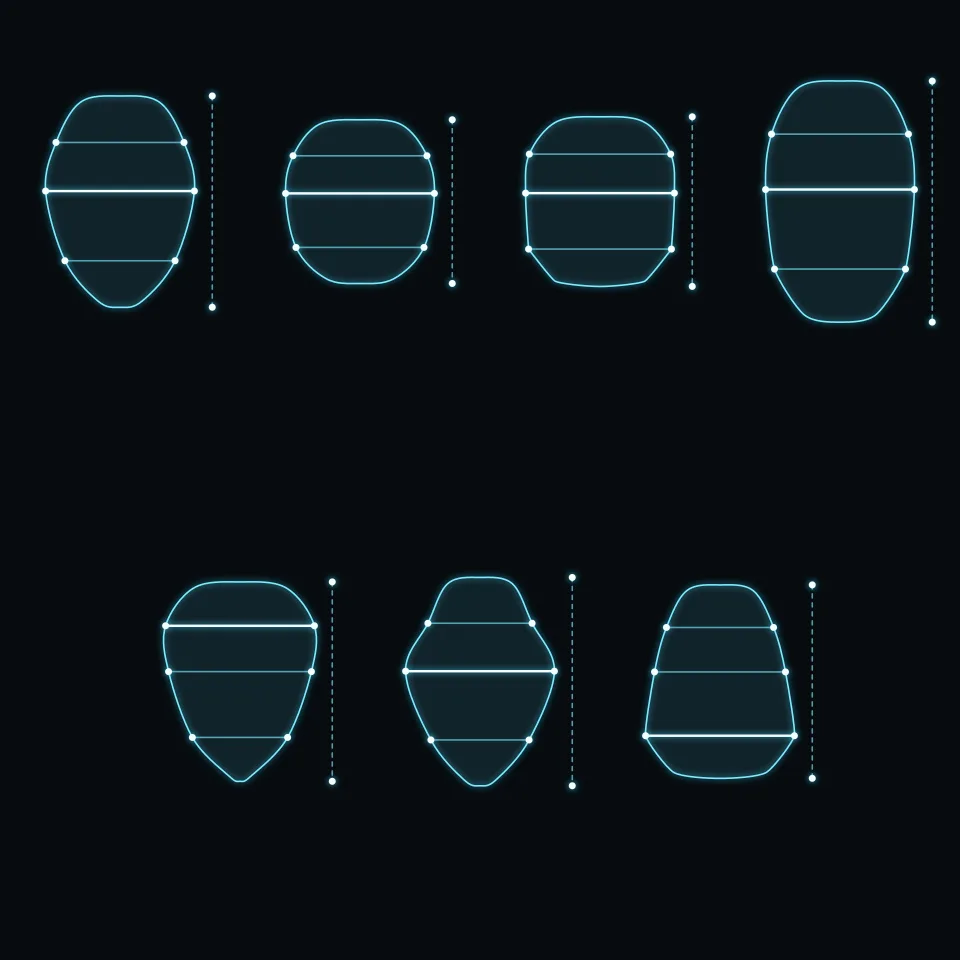
Plug in the two numbers and you get seven rows:
| Shape | Add | Go easy on | In one line |
|---|---|---|---|
| Oval | Lift on top | Long, flat centre parts | Balanced; don’t unbalance it |
| Round | Height on top, slants past the jaw | Blunt chin-length bobs | Wide cheekbones, short: add upward |
| Square | Waves below the chin, side-swept bangs | Heavy blunt bangs, slicked-back hair | Even widths: curves soften corners |
| Oblong | Bangs, side waves | Height on top, long straight centre parts | Long already: add to the sides |
| Heart | Volume at the jaw, curtain bangs | Crown lift, short blunt bangs | Wide on top: move volume down |
| Diamond | Volume at forehead and chin | Volume at the cheekbones | Wide middle: add at both ends |
| Pear | Volume on top | Heavy volume at the jaw | Wide below: move volume up |
No memorising needed; each shape’s page has the details.
How hair type changes the same cut
The columns hold for every hair type; what changes is where volume goes on its own:
- Straight: lies flat and stretches the outline fastest. Height must come from root lift; blunt edges look sharpest here.
- Wavy: the built-in bend helps almost every shape. Start the waves below the cheekbones so the midface stays put.
- Curly: grows width by itself. Helpful on a long face; if you’re widest at the cheekbones, steer volume to the crown and keep enough length for curls to fall below the jaw.
- Fine: collapses, more so when long. A shorter cut with blunter ends looks fuller.
- Thick: holds an angular cut but can become a solid block. Internal layers or thinning put the weight where you want it.
Bangs and glasses follow the same rule
Both are lines across the face, and a line stresses its level.
- Bangs set how much forehead shows, and so how long the face looks: see bangs for your face shape, and facial thirds for how much of the face the forehead takes up.
- Frames are the hardest line mid-face, echoing or contrasting its lines: see glasses for your face shape.
First, know your shape
To find your row, see what is my face shape: one front-facing photo, four numbers. A free face report from that same photo is a quicker way to get your face shape.
- Most people sit between two rows. Go by the strongest feature; mix both.
- People draw the boundaries. One guide puts oval length at about 1.24 times the cheekbone width; another says about 1.5 times the width. Measured differently, one face lands in different rows. Knowing where you’re widest beats the label.
Honestly, these tips come from stylists’ experience, not controlled trials. Try one, compare two photos taken the same way, then decide.
FAQ
Is the approach the same for men and women?
Yes. Hair length and where volume sits shape the outline, not gender. Kept very short, the levers are height on top and tight sides; a beard counts as the lower edge.
My hair is thin and fine. Does the table still apply?
Yes, but fix flatness first. Root lift, a texturising product and a slightly shorter cut look fuller; long wispy ends cling and stretch the outline.
I have a high hairline. Which row should I use?
Your usual one. A high hairline lengthens the forehead but doesn't move the widest point. Bangs or a side parting cover part of it.