Contents
Glasses for round faces start with one question: is it round?Corners, horizontals and weight: what a frame addsEach frame on a round faceWhere the sources disagreeTest it on a photoHow FacialRate does it: get the shape right firstFAQKey points
- Round means three things at once: length ÷ cheekbone width near 1, a jaw nearly as wide, an open jaw angle.
- Corners add break points to a continuous curve; a lens wider than tall adds horizontal line.
- Four sources, four answers on frame width. Judge by where your eyes sit in the lenses.
- It is all convention: in the one survey, preferred frames did not change with face shape.
Glasses for round faces start with one question: is it round?
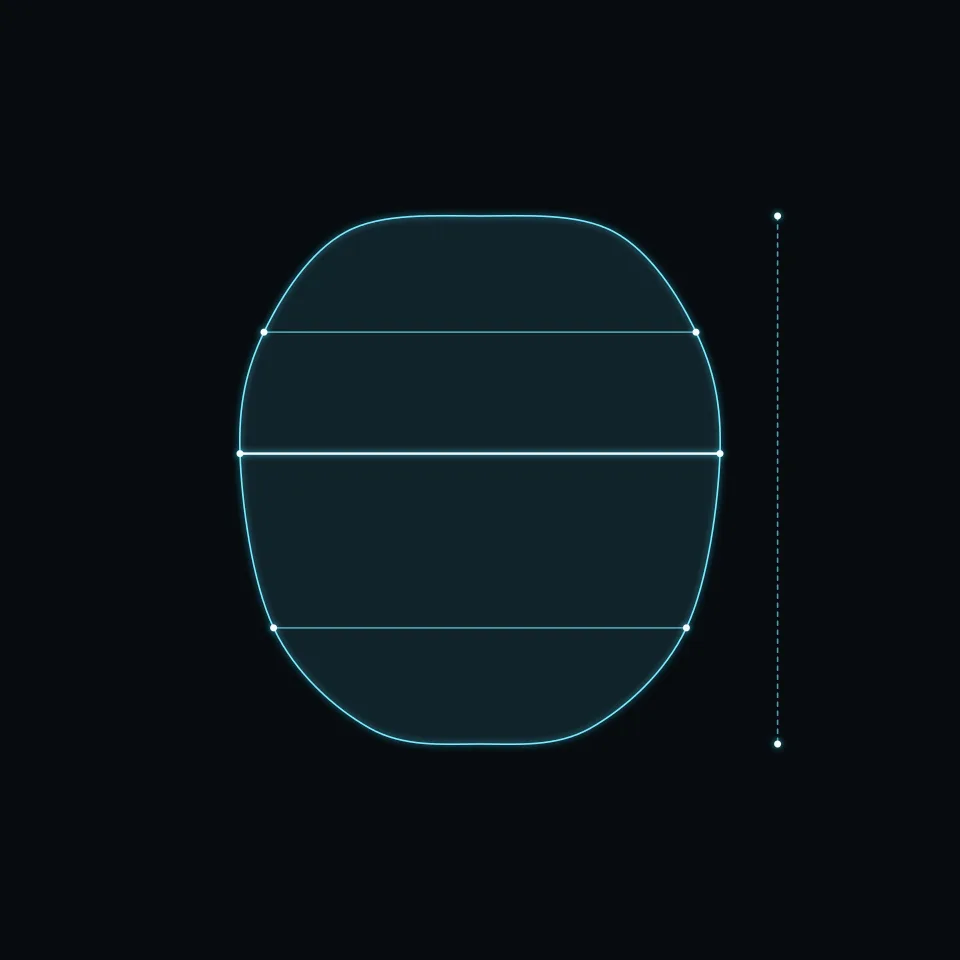
Many people wear square frames because “I have a round face”, judged in a mirror. Round means three conditions, all measurable on one front-facing photo:
- Face length ÷ cheekbone width near 1. One guide puts round at about 1.13, oval at about 1.24.
- Jaw width ÷ cheekbone width near 1. The face barely narrows.
- An open, curved jaw angle: about 141° in the same guide, against about 130° for square.
The sample photo measures 1.19, 0.79 and about 135°. The first number is near round; a jaw at 79% of the cheekbones is not. The four measurements are in how to tell your face shape.
Corners, horizontals and weight: what a frame adds
A round outline is one curve with no break points. A frame can add the lines it lacks:
- Corners. A square or rectangular frame puts break points into the curve. The more open the jaw angle, the stronger the contrast.
- Horizontals. A lens wider than it is tall; one guide says exactly that.
- Weight up top. A Japanese eyewear chain puts the emphasis on top: square frames or shallow wayfarers. Browlines do the same.
Round and oval frames trace the curve again. That is echo, not a mistake.
Each frame on a round face
| Frame | On a round face | Works when / doesn’t |
|---|---|---|
| Rectangle, square | Corners against the curve | At cheekbone width, not smaller |
| Wayfarer | Trapezoid, softer corners | Shallow lenses bring it closer to a square |
| Browline | Heavy top draws the eye to the brows | When the top follows the brow |
| Cat-eye, geometric | Lifted corners, more break points | For a strong look |
| Round, oval | Repeats the curve | To play up roundness |
| Small, narrow | More cheek shows | Several sources say use less |
| Rimless, clear | Contrast nearly gone | Sources disagree; see below |
Where the sources disagree
- Width. About the widest part of the face; slightly wider, just past the cheekbones; equal or slightly narrower (a Japanese optician); equal or slightly wider (another). Four answers, millimetres apart. Check the result instead: eyes near the middle of each lens.
- Rimless and half-rim. An English guide says skip rimless, it adds no contrast. A Taiwanese chain says rimless suits round faces. A Japanese chain likes top-only half-rims, saying the lower face reads longer.
- Colour. One guide wants dark, thick frames; another says go easy on clear ones.
Nobody tested this in a controlled study. In a 2023 Korean survey, 214 students rated face shape as important (4.09 of 5), yet their preferred frame shapes did not differ by self-rated face shape (p = 0.371).
Test it on a photo
Same phone, same spot, 1.5–2 m away, one shot per frame. Compare:
- The outer edge against the cheekbone line: inside, level, or just past.
- Your eyes in the lenses. One Japanese optician wants the pupil within ±5 mm of the lens centre.
- Brow and top edge. The brow just shows above and runs the same way.
Pads, temples and size numbers: how should glasses fit. Hair: hairstyles for round faces. All seven shapes: glasses for your face shape.
How FacialRate does it: get the shape right first
- The face analyzer runs on your device. It finds 478 face landmarks in the browser; neither your photo nor any face image made from it is sent to a server.
- The free face report is more than one number: face shape, strongest feature, three highlights and 11+ dimensions, contour among them. Clearly round, or between two shapes? The face shape detector shows you.
- Free, no limit on tries, so you can see if readings hold.
- It says a reading describes this photo: light, angle and expression change it. Tips cover photography, hair, makeup and skincare only.
FAQ
Can a round face wear round frames?
Yes. They repeat the curve, so roundness reads more strongly. For a bit more line, pick a larger round frame with a flat top edge.
Big frames or small ones?
Nearly every source says use small frames less, since more cheek shows around them. Reaching the outer cheekbones, or just past, is enough.
What face shape do I have if my glasses stay on in photos?
Take them off to check; frames cover the outline near the eyes. Face the camera from 1.5–2 m, hair back, two or three shots.