Contents
Eye spacing: how do you measure it?Measure it on the sample photoWhy the number comes out wrongWhat a wider or narrower gap looks likeCheck the nose while you are thereWhere eye makeup puts its weightFAQKey points
- One number: the inner-corner gap divided by eye width, using the average of both eyes.
- The rule says 1. Across 14,000+ photos the middle value is about 1.24, and exactly 1 is rare.
- Head angle, smiling or squinting, and corners hidden by lids or lashes are the three usual errors.
- Eye makeup weighted to the inner corners makes the gap read closer; weighted outward, wider.
Eye spacing: how do you measure it?
With one ratio: the distance between your inner eye corners divided by the width of one eye, averaged across both eyes.
The rule of fifths says 1: one eye fits between your eyes. Real faces usually fit one eye and a bit.
One face-measurement site pooled 14,144 front photos using this exact ratio. The middle value was about 1.24; the middle half fell between 1.17 and 1.32; fewer than one in twenty came out at 1 or below. It is the site’s own tally, not a peer-reviewed study, but it matches the research: the gap usually exceeds one eye.
So a result near 1.2 is not “wide-set”. It is ordinary.
Measure it on the sample photo
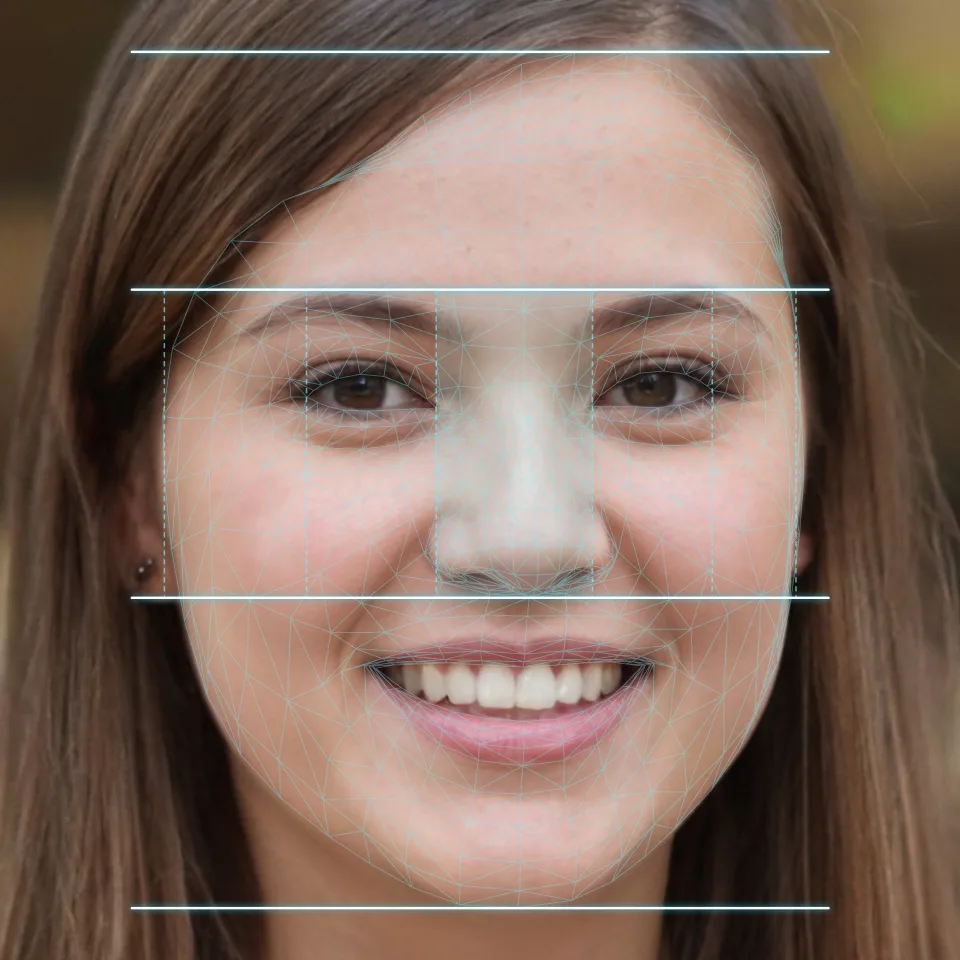
For taking the photo and drawing the lines, see the facial thirds guide. Here we only need the eye row:
- Inner corner to inner corner: 144.
- Left eye 120, right eye 110, average 115.
- 144 ÷ 115 ≈ 1.25.
Right on the middle value: “wide” by the drawing rule, typical by real faces.
Why average? The left eye alone gives 1.20, the right 1.31, a spread wider than between many people. If you would rather not measure by hand, a face report from a front-facing photo shows your eye spacing next to your facial thirds and fifths.
Why the number comes out wrong
- Head angle. A slight turn shortens the eye farther from the lens and shifts the gap. The sample’s eyes differ by 10, and a turn may be part of it; the facial symmetry guide works through that photo.
- Expression. Smiling or squinting pushes the cheeks up, narrows the eyes and blurs the corners. The sample is smiling, so her eye widths may read short and the ratio high.
- Hidden corners. A fold of lid skin can cover the inner corner; lashes and liner smudge the outer one. A medical glossary notes such a fold makes the inner-corner distance hard to pin down. Zoom in, find where the lids meet, and do both sides the same way.
What a wider or narrower gap looks like
- Higher ratio: more space between the eyes; the features look spread out and the mid-face open.
- Lower ratio: the features look gathered toward the bridge of the nose.
Japanese beauty magazines call these spread and centred faces, split at one eye width. By that line, most people are on the spread side.
The medical term “widely spaced eyes” is a different thing. One morphology glossary defines it by measurement only for children, using the distance between the pupils, which must sit far beyond the usual range for that age; adults are described by eye. A photo ratio of 1.3 or 1.1 has nothing to do with that line.
Check the nose while you are there
A related drawing rule says the nostrils are about as wide as the gap between the inner eye corners. On the sample, nostril width is 148 and the eye gap 144, so the rule holds here. Outside idealised drawings it rarely holds exactly.
Where eye makeup puts its weight
Makeup cannot move your eyes, only where people look.
- For a closer-reading gap, weight the inner side: deeper shadow on the half of the lid nearest the inner corner, liner on the inner half only, brow heads filled slightly inward.
- For a wider-reading gap, weight the outer side: light inner corner, deeper outer corner, liner from mid-eye flicked up and out, an extra coat of mascara on the outer third, slightly longer brow tails, soft brow heads.
- Inner-corner highlight is disputed. One brand tutorial says it makes wide-set eyes look even further apart and suggests the outer corners instead; a Taiwanese makeup artist lists it as a move for a wide gap. Try both and compare photos.
FAQ
My two eyes are different sizes. Which one do I use?
Use the average. If they differ a lot, check for a head turn: the eye farther from the lens shrinks. Small differences are normal; see the facial symmetry guide.
Can I measure with my glasses on?
Take them off. Frames can hide the corners, and short-sight lenses shrink the eyes behind them but not the bridge of the nose, so the ratio drifts.
Should I measure in millimetres or pixels?
Either. Both numbers share a unit, so it cancels out. Just take both from the same photo.