Contents
Photos with glasses: what goes missing?What frames cover is exactly what you measureGlare: where it comes from and how to move itBangs, hats and hair over the cheeksA photo for measuring versus an everyday photoFAQKey points
- Glare is light bouncing off the lens at the angle it arrived. Tip the lenses down, or move the light, and it misses the camera.
- Frames sit over the eye corners and brows; take them off to measure the eyes.
- Lenses for short sight make the eyes look smaller; lenses for long sight, bigger.
- Bangs hide where the upper third starts; hair over the cheeks makes the face read narrower.
Photos with glasses: what goes missing?
A few points go missing, and a layer of distortion gets added.
Frames and lenses sit in front of exactly what you would look at: the eye corners, the edges of the eyes, the brows. And a lens makes the eye behind it look bigger or smaller. In everyday photos that is fine; your glasses are part of how you look. But to read features’ positions and proportions, whatever is in front of the face has to come off.
The same goes for bangs, hats and hair over the cheeks.
What frames cover is exactly what you measure
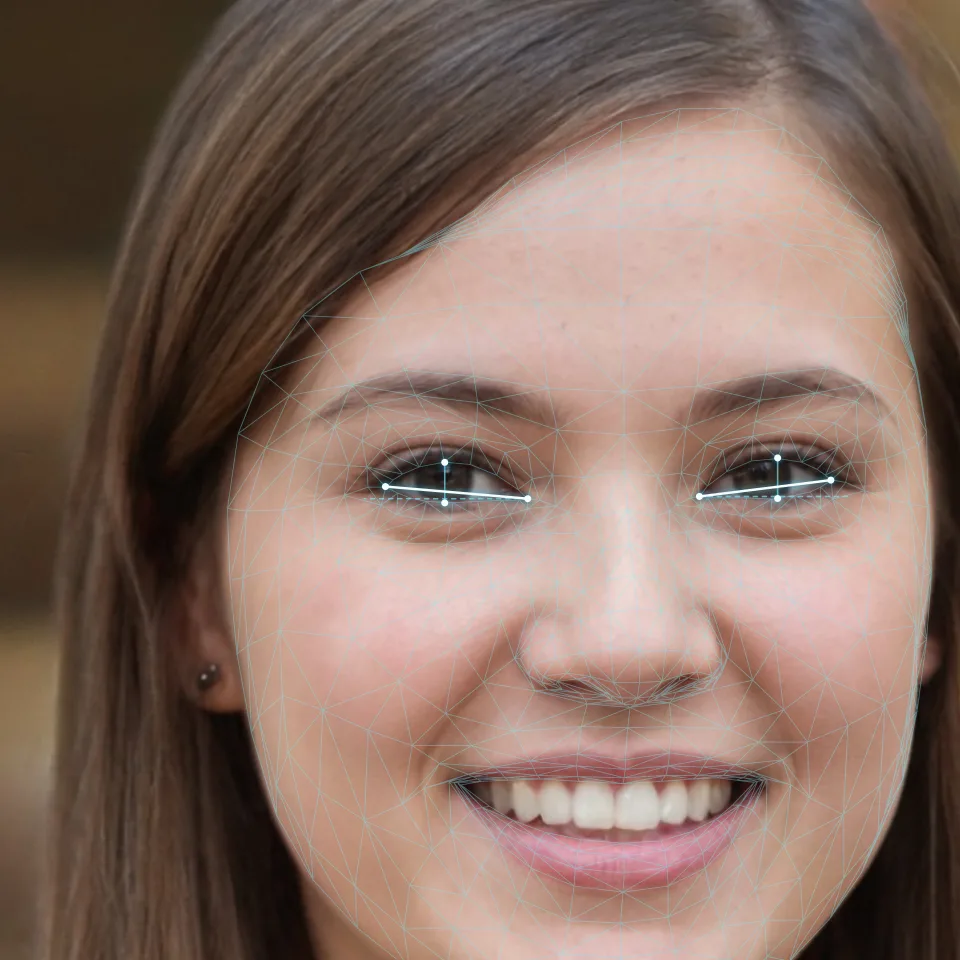
Run the numbers on the sample photo. Eye-tail tilt, the angle between the corner-to-corner line and the level, is +4.9° and +7.1°. The eye is about 120 px long, so misplacing the outer corner by 3 px shifts the angle by about 1.4°. Eye height is only 35 and 34 px; a frame rim or patch of glare over 4 px changes it by more than a tenth. And a rim often runs right beside the outer corner and under the brow.
Lenses change size too. Lenses for short sight (minus power) make the eyes behind them look smaller; lenses for long sight (plus power) make them look bigger, more so with stronger prescriptions. With glasses on, you measure the eye the lens shows you.
Glare: where it comes from and how to move it
A lens is a faint mirror: light leaves at the angle it arrived. A window or lamp straight ahead at lens height bounces right back into the camera. So every fix changes an angle:
- Tip the top of the frame slightly forward: lift the arms a little off your ears so the lenses face down and the glare lands below the camera.
- Lower your chin a touch, which does the same.
- Move the light to the side or higher.
One more trap: portrait mode estimates depth in software, and clear lenses and thin frames confuse it, leaving odd blur inside the lenses or broken frames. With glasses on, use the normal mode and zoom in on the eyes afterwards.
Bangs, hats and hair over the cheeks
Bangs and hat brims cover the hairline. The upper third runs from the hairline to the brows, so with its start hidden it can only be guessed. More in hairstyles for a high forehead.
Hair over the cheeks covers the edge of the face. Widths run from edge to edge; cover the edge and you measure the hair, so the face reads narrower. On the sample photo, jaw 460 px ÷ cheekbones 582 px is 0.79; hair over 20 px on each side of the jaw makes it 0.72. Cover one side only and that side looks narrower; see the note on hair in facial symmetry.
A photo for measuring versus an everyday photo
For measuring: glasses off, hair behind the ears or tied back so the hairline and both face edges show, no hat. It doesn’t need to look good. Clinics prepare standard facial photos the same way. Camera height, distance (1.5–2 m) and light are in front-facing photo.
For everyday photos: keep the glasses, use the glare fixes and zoom in to check both eyes show. Your brows should sit above the frame; for fit, see glasses size, and for shapes, glasses for your face shape.
FAQ
How do I frame the shot if I can't see without my glasses?
Fix the phone on a tripod or books 1.5–2 m away, set up with your glasses on, then take them off and use a 10-second timer.
What if my bangs won't stay back?
Pin them with clips or a headband and tuck loose strands behind your ears. The hairline and face edges just need to show.
What if the glare won't go away?
The light is probably straight ahead at lens height. Switch off the lamp in front and use side window light, or take one photo without glasses.
Can I read my face shape with glasses on?
Roughly, if the frames stay inside the face, and the same goes for a face report built from the photo. Frames wider than the face hide the cheekbone edges.