Contents
Hairstyles for a high forehead: the fringe moves the starting lineHow to measure the upper third when the hairline is unclearFringe length and thicknessCurtain bangs, side-swept bangs and partingsWhere root volume goesWhat to go easy on for a shorter-reading foreheadFAQKey points
- A hairline is a fade, not a line, so the upper third is the least reliable to measure. Use the middle third as a ruler.
- A fringe changes where the visible face begins: the longer and denser it is, the shorter the upper third reads.
- Curtain bangs, side-swept bangs and a side parting break up the forehead with diagonals and shade.
- To make the forehead read shorter, go easy on sleek pulled-back styles and height on the crown.
Hairstyles for a high forehead: the fringe moves the starting line
The most direct tool is a fringe. With a fringe down, the visible face begins at its edge, so the upper third reads as long as the fringe allows, whatever the hairline does.
Bone and features fix the middle and lower thirds. The top of the upper third is hair, and one cut moves it.
It is also the hardest third to measure: a hairline is a fade from sparse to dense, not a line. And forehead height varies; one review of many populations found it differed between groups more than any other measure.
What follows is stylists’ experience, not controlled trials.
How to measure the upper third when the hairline is unclear
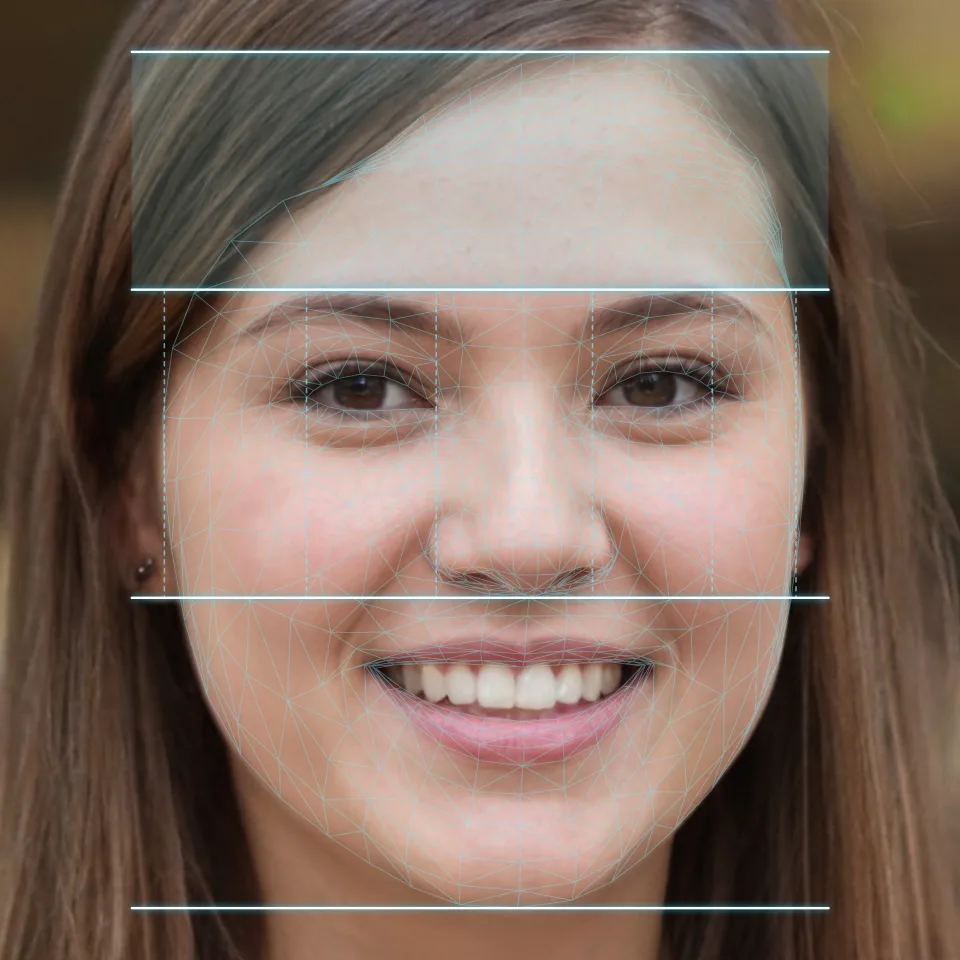
The method is in the facial thirds guide, and a face report built from a front-facing photo shows the thirds side by side. When the hairline is hard to place, use the middle third, brow line to nose base, as your ruler; both its ends are clear.
On the sample photo, middle 284 and upper 219 give upper ÷ middle ≈ 0.77. But that hairline is an estimate. Place it 30 pixels higher or lower and the ratio swings between 0.67 and 0.88, a swing bigger than the conclusion.
A steadier check: mark one middle third up from the brow line and see how far above or below it the hairline sits. If it is close, hold off; the sample’s upper third stays “to be confirmed”.
Fringe length and thickness
The longer and denser the fringe, the shorter the upper third reads. Stopping just above the brows leaves them visible; at the brows, the upper third is almost all covered.
- A heavy, brow-grazing fringe shortens a high forehead most, and draws a strong horizontal across the top of the face.
- Light, airy bangs cover most of the upper third without looking heavy.
- High and wide forehead: section the fringe from further back so it does not split. For a see-through fringe, thin only the end half; sheer roots can show scalp.
- Width: some stylists take the fringe past the outer eye corners to strengthen the horizontal.
Curtain bangs, side-swept bangs and partings
- Curtain bangs cover the top of the forehead and sweep out toward the cheekbones, taking the temple corners with them.
- Side-swept bangs lay one diagonal across the forehead and break up the block.
- Long, curled front pieces shade the forehead corners and hairline edge.
- A side parting shifts the hair to one side and puts shade on the forehead.
Where root volume goes
A little lift at the roots of the fringe and the front pieces softens the forehead edge. The crown is different: height there adds a stretch above the upper third, and the face reads longer. Stylists usually advise crown roots just off the scalp, nothing more.
If fringe roots fall flat, blow-dry the hair against the parting first, then switch back at about 70% dry so the roots lift.
What to go easy on for a shorter-reading forehead
- Sleek, pulled-back styles show the full length of the upper third at once.
- Top knots, high ponytails and pompadours add height above the upper third.
- Long, straight centre-parted hair runs one vertical line from the crown to the chin.
This applies only if you want it to read shorter. For a full, rounded forehead, stylists also suggest showing it all with a side parting. A long upper third is not something to hide. Unsure? Take one photo with your forehead out and one with a fringe, and compare.
FAQ
My hairline is receding or uneven. What fringe works?
Section the fringe from further back so it has more hair and does not split. Curtain or side-swept bangs cover the temple corners; without a fringe, a side parting shades the hairline.
Is a wide forehead the same as a high one?
No. High is vertical, a long upper third: think fringe length and density. Wide is horizontal, close to cheekbone width: think fringe width and covering the corners.
Do I have to have a fringe?
No. It is just the most direct option. A side parting, curled front pieces and root volume also change how the upper third reads.