Contents
Facial thirds vs golden ratio: what is the difference?One face, two rulers, two resultsWhy the two rules cannot both holdFacial thirds and the golden ratio side by sideWhich ruler to use: start from your questionFAQKey points
- Facial thirds ask whether parts are equal, so the target is 1. Golden-ratio checks ask whether a ratio is near 1.618.
- For middle third ÷ lower third the two rules want different numbers, so a face can only be close to one of them.
- On the sample photo, middle ÷ lower is 0.99, right on the thirds rule. Face length ÷ width is 1.36, mouth ÷ eye gap 1.85 and nose ÷ philtrum 4.5: mostly not near 1.618.
- Neither is a beauty score. Pick the ruler that fits the question you are asking.
Facial thirds vs golden ratio: what is the difference?
Facial thirds ask: are these parts close to equal? A golden-ratio check asks: is the ratio of these two lengths close to 1.618?
The first has a target of 1. The three thirds are the same height, and the gap between the eyes equals one eye. The second has a target of 1.618: divide the longer length by the shorter and see how far you land from it.
Different targets give different answers. One face can sit close to one rule and far from the other, and on the middle and lower thirds the two cannot both be met.
Neither number came from measuring real faces. The 1 is an artists’ rule of thumb; the 1.618 comes from geometry.
One face, two rulers, two results
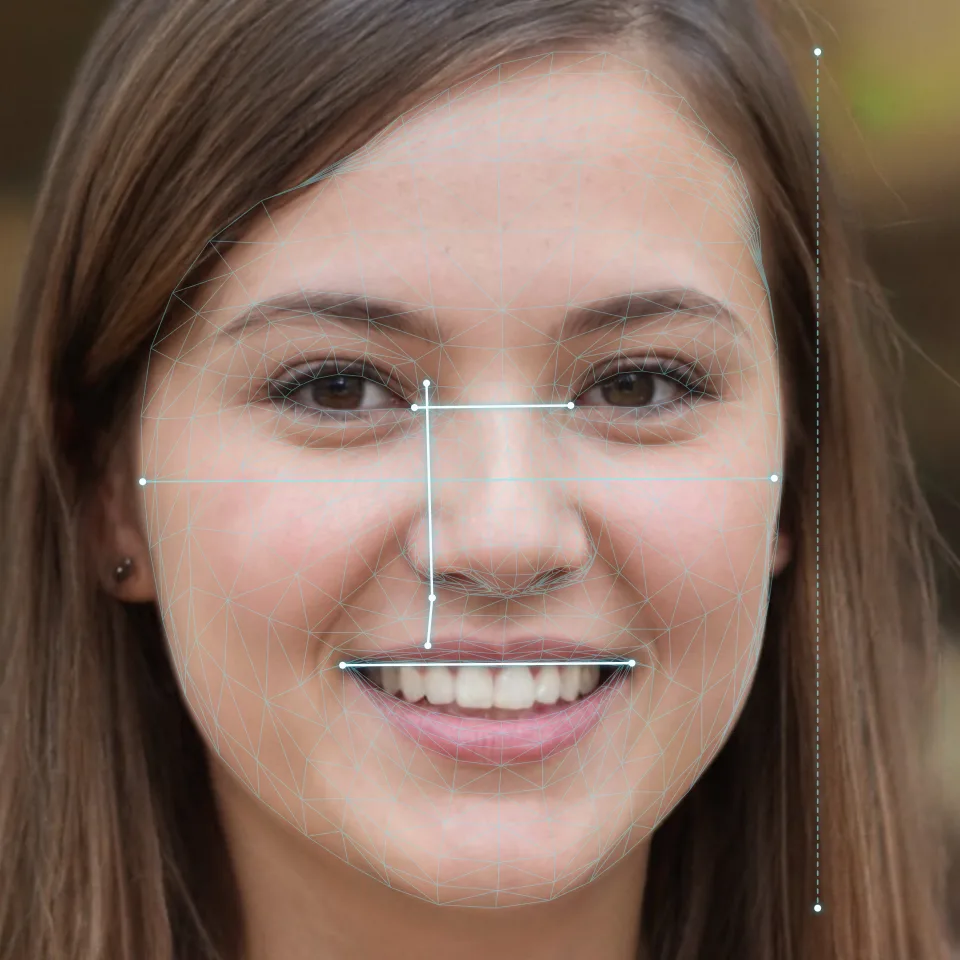
The sample photo, measured both ways, in pixels.
Thirds: middle third 284, lower third 286. Middle ÷ lower = 0.99, almost exactly 1:1. The rule holds.
Golden ratio, using the pairs most guides compare:
- Face length ÷ width: 789 ÷ 582 = 1.36
- Mouth width ÷ eye gap: 267 ÷ 144 = 1.85
- Nose length ÷ philtrum: 198 ÷ 44 = 4.5
- Middle ÷ lower third: the same 0.99
None lands near 1.618. The mouth figure runs high partly because she is smiling, which pulls the corners apart.
On one ruler this face is very even; on the other it mostly misses. The face did not change. The question did.
Why the two rules cannot both hold
The thirds rule wants middle = lower, a ratio of 1. Some golden-ratio guides compare the very same two lengths with 1.618. On the sample photo the lower third is 286, so the golden version needs a middle third of 463, which is 179 pixels longer. Turn it around: a face with middle ÷ lower at exactly 1.618 misses the thirds rule by about 60%.
One number cannot equal 1 and 1.618 at once. The closer a face gets to one rule, the further it sits from the other.
There is a smaller clash too. The neoclassical canons say nose width equals the eye gap and mouth width is 1.5 times nose width, so mouth ÷ eye gap should be 1.5. The golden ratio wants 1.618.
Facial thirds and the golden ratio side by side
| Facial thirds and fifths | Golden ratio | |
|---|---|---|
| What it measures | Whether vertical and horizontal sections are equal | The ratio of two lengths of different features |
| Target | 1 (equal parts) | About 1.618 |
| Where it comes from | Artists’ rules; the Roman writer Vitruvius already split the face in three | A number from geometry, fitted to faces much later |
| Good for | Seeing which section takes more space, for bangs or blush | Comparing features that don’t touch, like mouth and eye gap |
One thing they share: almost nobody matches either exactly. A 1985 study tested nine neoclassical canons, and the one that held most often did so for only 40% of people. For the golden-ratio side, see golden ratio face.
Which ruler to use: start from your question
- Which section is longer? Use the thirds. The middle and lower thirds give the steadiest reading; the method is in facial thirds.
- How much bigger is one feature than another? Use a ratio, such as mouth width ÷ eye gap, and compare it with your own earlier photos rather than with 1.618.
Either way, write down which points you used, and keep the two targets in separate tables. The numbers describe proportions, not looks.
For the photo: lips closed, head level, phone propped at eye height 1.5–2 m away (rear camera, timer), and hair pushed back if you want the thirds. A smile widens the mouth and a lowered chin changes the thirds, so both rulers shift. A face report built from one front-facing photo lists the thirds with your other ratios.
FAQ
Facial thirds or the golden ratio, which one should I trust?
Neither is a beauty score. Use them as rulers. Thirds tell you whether the sections are even; a golden-ratio check tells you how big one ratio is.
Can a face match both?
Not on middle third ÷ lower third. Equal means 1, the golden ratio wants 1.618, so a face can only be near one. Other ratios compare other features.
The fifths and the golden ratio both use the eye gap. What is the difference?
The fifths ask whether the eye gap equals one eye, a target of 1. Golden-ratio checks usually divide mouth width by the eye gap and aim for 1.618.