Contents
Is facial asymmetry normal? Almost every face has someHow much asymmetry can people actually see?How to check facial symmetry on a photoA facial asymmetry test on the sample photoWhy does your face look different in photos than in the mirror?Why your face looks asymmetrical in photos, and how to fix itIs facial symmetry attractive?What to do about a slightly asymmetrical faceFAQKey points
- Almost every face is slightly uneven. Of the asymmetry people can actually see, about three quarters is around the chin.
- A few millimetres go unnoticed. In one study, ordinary people still called a chin shifted by more than 5 mm normal.
- When you measure, look at the direction first. If all seven pairs of points lean the same way, your head was turned; it is not your face.
- Your mirror shows you flipped left to right. You are used to the mirror version; everyone else is used to the photo version.
- More symmetric is not always more attractive. A "perfectly symmetric" face built from two copies of one half often looks odd.
Is facial asymmetry normal? Almost every face has some
Yes. Here is the counterintuitive part: a face that mirrors perfectly from left to right almost doesn’t exist. Fold anyone’s front-facing photo along the middle and the two halves will never line up exactly.
Biologists call this kind of difference fluctuating asymmetry. The two sides are meant to grow the same, but each picks up small random deviations along the way. There is no fixed direction to it: one person is a little wider on the left, another a little higher on the right. Everyone has it.
So how common is asymmetry you can actually see, and where does it show up?
- 1997: Severt and Proffit reviewed 1,460 patients at the dentofacial clinic of the University of North Carolina. About a third (34%) had facial asymmetry that was clinically visible.
- Among those patients, about three quarters showed it around the chin, about a third across the midface (nose and cheekbones), and only about 5% around the forehead.
- Keep in mind these were people already seeking care for jaw and face problems, so the share is higher than in everyday life. But the pattern, more common the lower you go, keeps turning up in other research too.
A common explanation: the forehead sits on the skull and barely changes after puberty, while the chin and jaw keep growing for longer and move the most, with chewing and talking every day. Small left-right differences have more room to build up there.
How much asymmetry can people actually see?
More than most people think.
- 2014: a study used simulated 3D faces, moved the chin a little further to one side each time, and asked different groups to judge them. Ordinary people still called the face normal with the chin shifted by about 5.6 mm on average. Orthodontists were stricter, at about 3.6 mm.
- In other words, the millimetre or two you stare at in the mirror every day is almost invisible to anyone else. Specialists see finer differences because they are trained to look for exactly this.
Asymmetry that people do notice usually shows up against two kinds of reference:
- The midline: whether the centre of the forehead, the bridge of the nose, the groove above the lip and the tip of the chin line up in one straight line. A slightly crooked nose or an off-centre chin crosses this line and gets noticed first.
- Two horizontal lines: the line through both eyes and the line through both mouth corners. One side higher than the other often stands out more than one side wider than the other.
People also look at the eyes, nose and mouth first when they see a face. Small differences there get noticed sooner. Differences along the cheeks and jawline often only show when two images sit side by side.
How to check facial symmetry on a photo
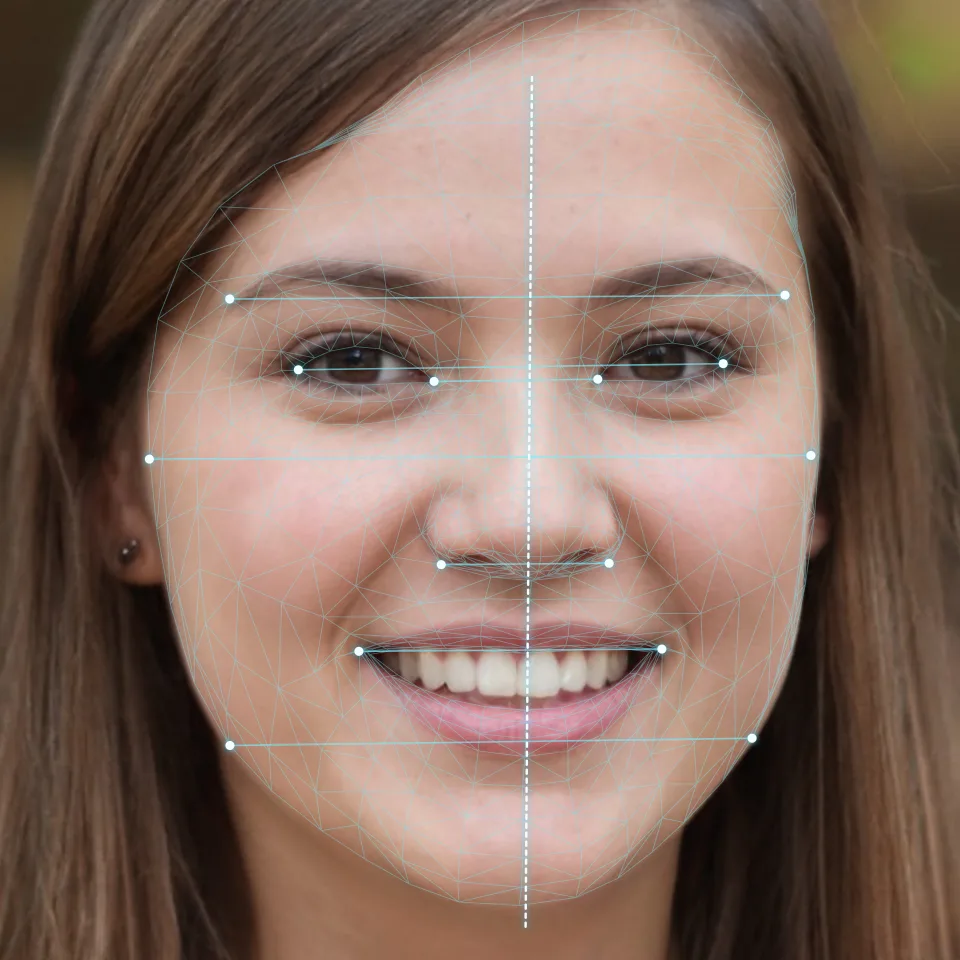
Rather than guessing, run a face symmetry test yourself. All it takes is a straight-on photo and an editing app with a line and a ruler tool, or a face report built from one front-facing photo if you would rather not draw.
- Take a front-facing photo. Prop the phone level with your eyes, 1.5–2 m away (rear camera, 2×–3× zoom if you have it, timer on), with the light straight ahead of you. Tuck your hair behind your ears so both cheek edges show. Relax your face and don’t smile.
- Draw the midline. Use a run of points together: the centre of the forehead, between the brows, the bridge of the nose, the underside of the nose, the groove above the lip and the tip of the chin. Draw the straight line that fits them best. Don’t rely on the nose tip alone: it sticks out the most, so it drifts off as soon as your head turns.
- Find seven pairs of points: the brow tails, outer eye corners, inner eye corners, cheek edges, nostril wings, mouth corners and jaw angles, one on each side.
- Take two numbers for each pair: how far each point is from the midline, and how much higher one point sits than the other.
- Take two more photos from the same spot and repeat. Put the three rounds side by side. Any pair that changes a lot between rounds, don’t trust yet.
Once you have the numbers, don’t jump to which side is bigger. Look at the direction first: do all seven pairs lean the same way? Most guides skip this step, yet it matters most. The next section shows why, using the sample photo.
A facial asymmetry test on the sample photo
Here is that check run on the example photo shown earlier. Values are in pixels, “left” and “right” mean the photo’s left and right, and each pair is written left first, then right.
- Brow tails: 265 · 224
- Outer eye corners: 204 · 170
- Inner eye corners: 84 · 60
- Cheek edges: 334 · 248
- Nostril wings: 77 · 71
- Mouth corners: 149 · 118
- Jaw angles: 261 · 198
At first glance this face looks bigger on the left, and by a lot: 86 pixels at the cheek edges and 63 at the jaw angles.
But look closer at two things:
- All seven pairs are bigger on the left. Real fluctuating asymmetry is random, so some pairs should be bigger on the left and some on the right. Seven out of seven in one direction looks more like the whole face was pushed to one side.
- The further back a point sits, the bigger its difference. The cheek edges and jaw angles are furthest from the camera and differ the most. The nostril wings sit furthest forward and close to the midline, and differ by only 6 pixels.
That is exactly what a slightly turned head looks like. When the head turns, points at different depths move different distances in the photo, and the ones further back move the most. Height tells the same story: on all seven pairs the right point sits 1 to 6 pixels higher, and the line through the eyes tilts by less than a degree, so the head was also tipped very slightly to one side.
So the conclusion for this photo is not “this face is bigger on the left”. It is “this photo can’t measure this face’s symmetry”: the difference the head angle adds is larger than the face’s own. To measure it, you would need a new photo with the head straight.
That lesson matters more than any single number. The “bigger side” you see in your own selfies may well come from the same place.
Why does your face look different in photos than in the mirror?
Because the face you know is the one in the mirror.
Your mirror shows you flipped left to right. Brushing your teeth, washing your face, checking yourself before you go out, you see the flipped version every day. A photo isn’t flipped; it shows the face everyone else sees. The slight asymmetry already in your face, flipped, makes the photo feel “off”, even though it is the same face.
A 1977 experiment shows this neatly. Researchers photographed a group of women students and printed each photo two ways, normal and flipped. The women preferred the flipped print, the one that matched their mirror. Their close friends preferred the normal print. Each person liked the version they saw more often.
Two more things keep the mirror and the photo from agreeing:
- Light. Bathroom lights usually hang overhead and throw shadows under the brows and nose; when you take a photo, the light comes from somewhere else again.
- The front camera. Held close, its wide lens bulges whatever sits in the centre: the nose grows and the sides of the face get pushed out. Some phones flip selfies into a mirror image automatically and some don’t, so two of your own selfies may not even be flipped the same way.
To see what others see, look at a photo that isn’t flipped, in even light, taken from 1.5–2 m away.
Why your face looks asymmetrical in photos, and how to fix it
As the sample shows, a lot of the asymmetry in a photo comes from how it was taken. From the biggest effect to the smallest:
- A turned head. Even a small turn makes the half of your face nearer the camera look wider. An easy check: do both ears show by the same amount?
- A tilted head. If the line through your eyes isn’t level, your chin swings to one side with it. Turn on the camera grid and put both eyes on the same horizontal line.
- Light from one side. The lit side looks wider and fuller, the shaded side narrower. Facing a window works better than standing side-on to it.
- The camera up close. Step back to 1.5–2 m and use the rear camera at 2×, and the stretching mostly goes away.
- Hair and expression. Hair over one cheek makes that side look narrower, and the two mouth corners rarely rise to the same height in a smile. Don’t smile when you measure symmetry; in everyday photos it doesn’t matter.
In one line: face the camera straight on, show both ears equally, keep your eyes level, and have the light in front of you.
Is facial symmetry attractive?
Somewhat, but less than popular wisdom says, and how the experiment is run changes the answer.
- A perfectly symmetric face built from half a face often looks off. Copy the left half of a face, flip it and join it on, and you get a “left-left” face; the other way gives a “right-right” face. In Kowner’s 1996 experiments, people chose between an original photo and one of these composites, and most of the time they did not prefer the symmetric one. The method copies moles and hair partings across and often leaves a seam down the middle, which looks strange.
- Blend a face with its own mirror image and the result flips. In 1998, Rhodes and colleagues used a different method: they averaged a face with its flipped copy, which is symmetric and still natural-looking. This time, the more symmetric versions were rated more attractive.
- Account for averageness and symmetry matters less. A 2009 study in Japan found that for women’s faces, what mattered was how close the features were to most people’s; symmetry added nothing on its own. For men’s faces both helped a little, but neither by much.
- Side by side is not the same as one at a time. When two faces sit next to each other and people pick one, symmetry makes a clear difference. When faces are shown one by one, slight asymmetry rarely gets noticed.
So in the few seconds of an everyday glance, a few millimetres of asymmetry are unlikely to change anyone’s impression of you.
What to do about a slightly asymmetrical face
First, make sure it is real. Retake and remeasure as above. If the difference still points the same way and stays about the same across three rounds, that is your face.
Once you know, most of what you can do is a small visual adjustment:
- Hair: a centre parting draws a line straight down the middle of your face and makes any offset along the midline stand out; a side parting breaks that line. Let your hair cover a little more of the wider side and the two halves look closer.
- Brows: pick one side as the reference and bring the other toward it. Lining up where the brows start does the most for a matched look; a small difference at the arch or tail is fine.
- Contour and blush: use a little more contour on the wider, fuller side, and start the blush at the same height on both sides.
- Eyeliner: if one eye looks smaller, draw its liner slightly thicker or extend the outer corner a little.
- Photos: try turning your head both ways, take one photo of each, and keep the side you like.
How the face divides from top to bottom is a separate question; see the guide to facial thirds.
A perfectly symmetric face doesn’t exist, and there’s no need to chase one. See your own face clearly, then decide. That’s enough.
FAQ
Does facial asymmetry need fixing?
A little asymmetry is in every face, and most people can't see it, so there is nothing to fix. Most of the time, getting the angle and light right in your photos makes the asymmetry in them much smaller.
What causes an asymmetrical face?
As a face grows, its two sides each pick up small random differences. The lower face grows later and moves more, so most of the difference ends up around the chin. People often blame chewing on one side or sleeping position, but there is little evidence either way.
Why do two photos of the same person look so different in symmetry?
Symmetry is the measurement most sensitive to how the photo was taken. Turn your head a little and the half of your face nearer the camera looks wider; side lighting splits the face into a bright half and a dark half. Before comparing two photos, make sure they were taken the same way.
How do I find my better side?
Take two photos, one with your head turned slightly left and one slightly right, with everything else the same, and look at them side by side. It is personal taste with no right answer. Many photographers find a client's "good side" the same way.
What if my face suddenly became asymmetrical?
If the asymmetry appeared recently and suddenly, for example one corner of the mouth drooping or one eye not closing, see a doctor as soon as possible; it can involve the facial nerve. This article is about the slight, lifelong asymmetry everyone is born with.
How is facial symmetry different from facial thirds?
Facial symmetry asks whether the two sides mirror each other. The thirds-and-fifths rule checks whether the face splits into roughly equal parts, vertically and across. They answer different questions and are measured separately.