Start here
Face proportions: start with these five ratios
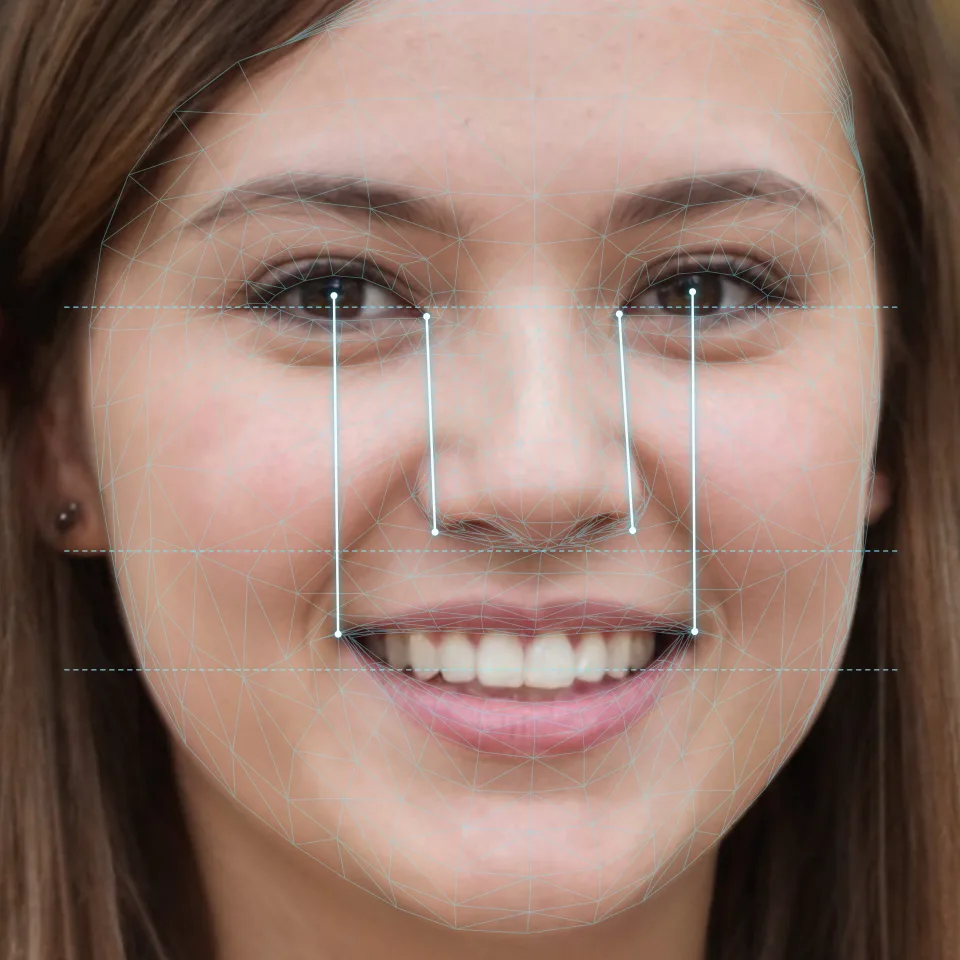
Face proportions in one table: thirds, eye gap, length to width, mouth to nose and placement, with rules of thumb. A free face report shows yours.
Read the overview4 min read
Length to width, eye spacing, mouth to nose and where the features sit: how to measure and read them, and what harmony and averageness mean.
This topic answers a practical question: which face proportions are worth looking at, and what does each one say? It suits anyone meeting facial ratios for the first time, and anyone who has read a pile of rules of thumb and wants to know which ones hold up when real faces are measured. By the end you can use a front-facing photo to say where the eyes, nose and mouth sit, what the main ratios measure, and why no single ratio describes a face on its own.
Start with the face proportions overview, a map of five ratios you can read in one pass. Then read facial feature placement to see which level the eyes, nose and mouth fall on. “The eyes sit halfway down the face” measures the whole head, not the face from the hairline, and that guide explains it. For what “balanced” is supposed to mean, read facial harmony. The average face guide, on why a blend of many faces so often looks pleasant and where that idea stops, can wait until the end.
A reminder: a ratio is a ruler, not a grade. It shows how space is shared out and does not rank one way of sharing it above another, and the five ratios only compare with one another when they come from the same photo taken the same way. Afterwards you will be able to tell which of the old rules of thumb are drawing conventions and which can actually be checked on a photo.
Face proportions in one table: thirds, eye gap, length to width, mouth to nose and placement, with rules of thumb. A free face report shows yours.
Five are common: middle third to lower third, eye gap to eye length, face length to cheekbone width, mouth width to nose width, and the heights of the eye, nose and mouth lines. Each answers one question about how space is shared out; none grades the face.
A composite made by lining up many faces and averaging them point by point; “average” is the mathematical mean, not “ordinary”. In experiments such composites were often rated above most of the single faces that made them, though the highest-rated faces are not the most average.
No. Most of those rules come from drawing and classical canons, and real faces rarely match them exactly. Whether a face looks balanced depends on how its features work together, not on how close one ratio is to a rule.