Start here
Golden ratio face: where 1.618 is measured on a face
Golden ratio face means a few ratios land near 1.618, yet guides disagree on which. The four common pairs and why almost none fit. Test yours free.
Read the overview4 min read
Where 1.618 is measured on a face, how to check it yourself, and what research says about it.
The golden ratio is the number most often treated as a standard for faces, yet there is not even agreement on which two lengths to compare. This topic is for anyone who wants to know what 1.618 is measured against on a face, and for anyone who has just met “what is your golden ratio?” in a quiz and is unsure whether to take it seriously. By the end you can say where the number comes from, work out a few ratios from your own photo, and see why the answer moves with the points you pick and with how the photo was taken.
Start with the golden ratio face overview, which explains what 1.618 means and the four pairs of lengths that guides commonly compare. Next comes the golden ratio face test: one photo, four divisions, so you can watch the number shift when a point moves a little. Finish with whether the golden ratio face is real, which covers how researchers checked ratings against 1.618 and where people’s preferred proportions turned out to sit. Reading it after you have measured makes it easier to judge how much weight the numbers deserve.
This topic does not tell you whether a face “passes”. It does one thing: it shows how the number is produced. Once you know how points and photos change the result, you know what to ask of any golden ratio score you meet, for example whether the two points were fixed in advance rather than picked after looking at the face.
Golden ratio face means a few ratios land near 1.618, yet guides disagree on which. The four common pairs and why almost none fit. Test yours free.
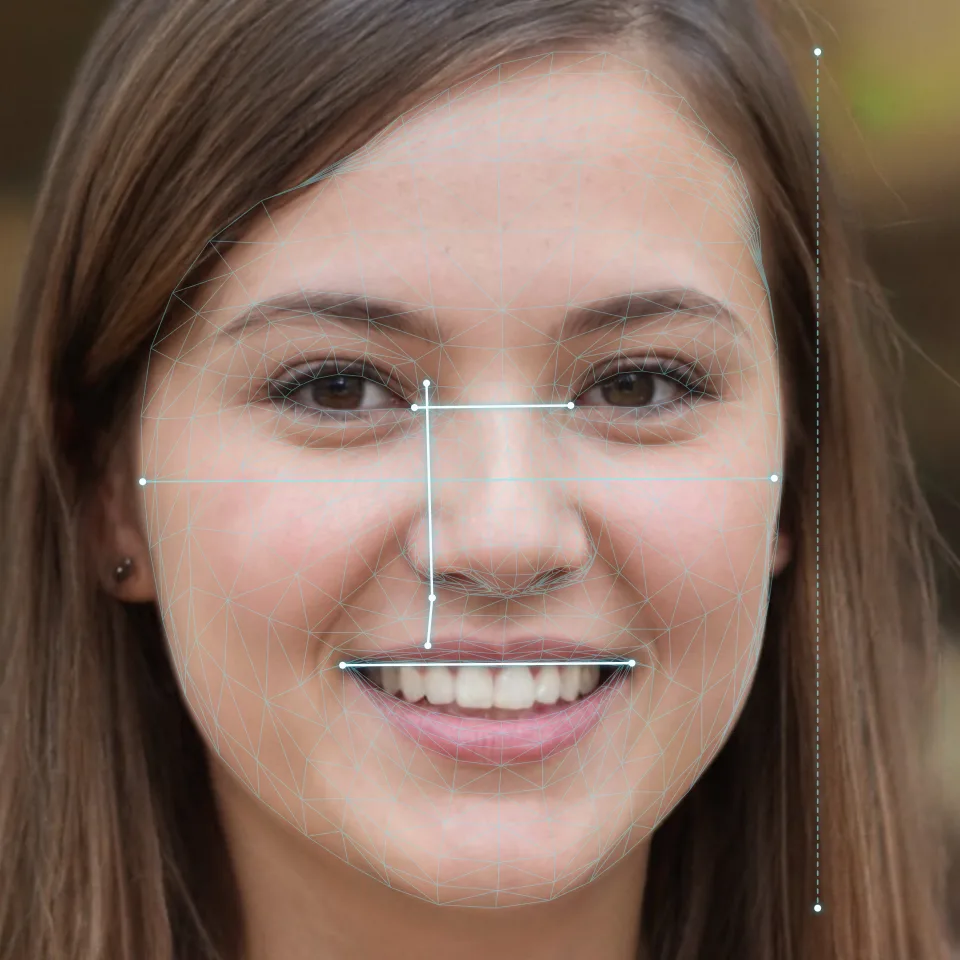
You divide one length on the face by another and see whether the result is close to 1.618, for example face length over face width, or mouth width over the gap between the eyes. Guides do not agree on which pairs to use, which is why one face gets different verdicts from different tests.
The evidence does not support that. When researchers compared ratings with 1.618 the link was weak, and the proportions people liked best sat closer to an average face. It works better as a guide line for drawing and design.
Only that the two points you picked divide to a different number. Where you put the end points, whether you smiled and whether your head was turned all move the result, and hardly any face is near 1.618 on every ratio, so being far from it is the usual case.