Contents
Neoclassical facial canons: where do they come from?The Chinese version: a rule the old text doesn’t containThe European version: Vitruvius, Leonardo and DürerWhat the rules were forMeasuring real people: the 1985 testFAQKey points
- The face-proportion rules began as drawing rules, not measurements of real people.
- The Roman writer Vitruvius described the face in three equal parts; Leonardo restated it beside the Vitruvian Man around 1490.
- A 14th-century Chinese portrait text often named as the source of "three courts, five eyes" does not contain it.
- A 1985 study tested nine neoclassical canons on 153 young adults. The one that held most often did so for only 40%.
Neoclassical facial canons: where do they come from?
Neoclassical facial canons are rules made by artists, for artists. They were never a summary of measured faces.
The hard part of drawing a face is placing the features on an empty page. A rule gives you a start: three equal parts top to bottom, five across. Equal parts are easy to remember and easy to mark out.
Europe and China had almost the same rules. Only in 1985 did a study test them systematically on real people.
This article covers drawing and measurement. Old fortune-telling books also split the face into three zones; that separate tradition is not covered here.
The Chinese version: a rule the old text doesn’t contain
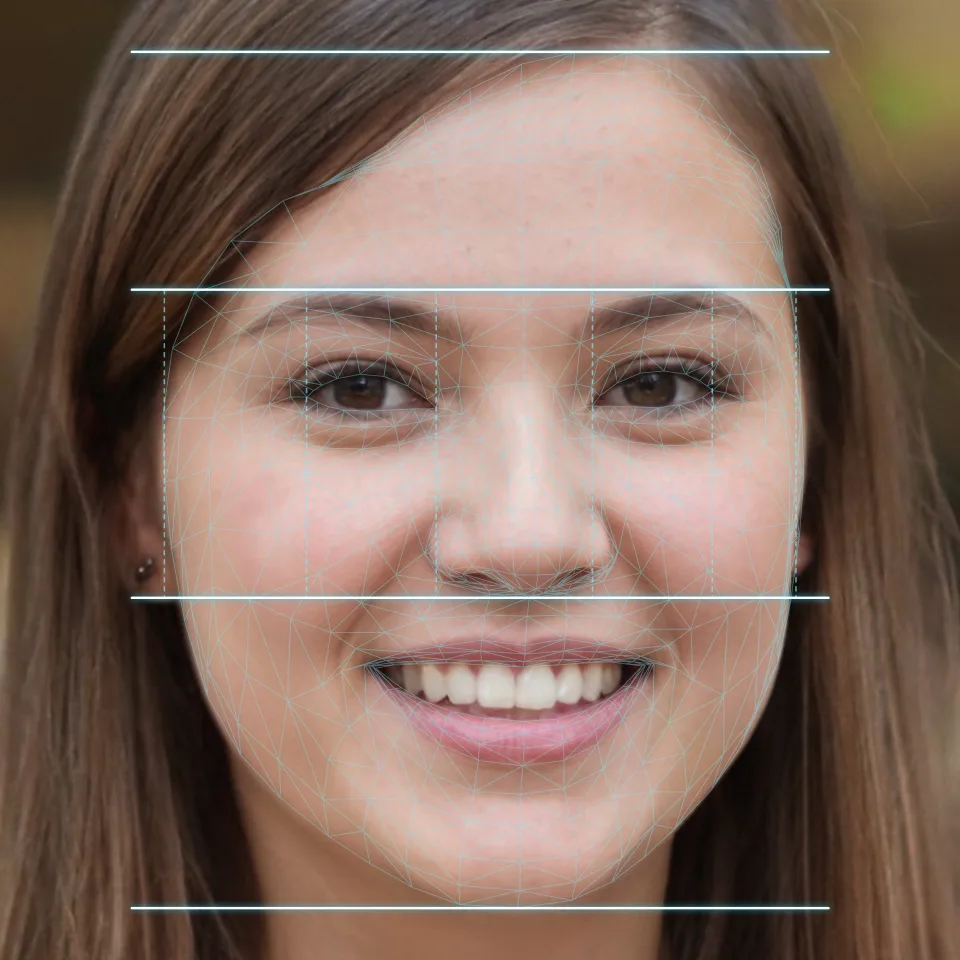
In Chinese the rule is called “three courts, five eyes”. One of the earliest surviving texts on portrait painting is the Xiexiang mijue, the method of the 14th-century painter Wang Yi, written down by Tao Zongyi in his Nancun chuogeng lu.
Oddly, it has no rule about equal thirds or five eye widths. It is about watching: catch the sitter’s expression while they talk, hold it in memory, then start from the nose and add the other features one by one, checking each against the rest.
The name spread later through painting formulas; which book first wrote it down is disputed. Many web pages credit the Xiexiang mijue, but it is not in the text.
The European version: Vitruvius, Leonardo and Dürer
- About 30–20 BC: the Roman architect Vitruvius, explaining proportion in De architectura, wrote that the face from chin to hairline is a tenth of the body’s height, and that chin to nose, nose to brows and brows to hairline are each a third of it. Those are the facial thirds.
- About 1490: Leonardo drew the Vitruvian Man, and his notes beside it restate Vitruvius, thirds included.
- 1528: Dürer’s Four Books on Human Proportion came out after his death. He drew men and women of many shapes and sizes, each with its own proportions, instead of one set for all.
All three wrote about drawing or design, not about people they had measured.
What the rules were for
Teaching people to draw.
A drawing rule has to be simple, memorable and easy to mark out. Equal parts do all three: you can split a face into thirds with a pencil held at arm’s length. Later the rules were gathered into the set now called the neoclassical canons and taught in European art academies. Drawing classes still use facial thirds today.
So the rules describe a face that is easy to draw, not an ordinary face. The artist starts from the rule, then adjusts to the person in front of them, which is why Dürer drew so many body types. And the rules handle placement, not expression; expression takes watching, which is what Wang Yi’s text is mostly about.
Measuring real people: the 1985 test
In 1985 Farkas and colleagues measured 153 young North American adults against nine neoclassical canons.
- The two that held most often were horizontal. The gap between the eyes equalled nose width in only 40% of people; nose width equalled a quarter of face width in 37%.
- The vertical canons fit worst: no more than two sections came out equal.
- Their conclusion: the canons may fit a few people, but they do not describe average proportions and should not be read as a prescription.
A 2012 study of young adults in southern China found much the same. To measure your own photo, see facial thirds or try a face report built from one front-facing photo; for the golden ratio, see facial thirds vs golden ratio.
FAQ
Is "three courts, five eyes" only a Chinese idea?
The name is Chinese; the rule is not. The Roman writer Vitruvius split the face into three equal parts, and Leonardo restated it.
Did artists believe faces really looked like that?
Hard to know. The use is clear, a place to start a drawing. Dürer drew many body types with their own proportions, so he knew real people differ.
Is this the same as telling fortunes from the face?
No. Fortune-telling books use similar zones for a different purpose. This article covers drawing and measurement only, not fortune-telling.