Contents
Long lower third: measure it with your lips closedThe sample photo: lower 286, measured mid-smileA second cut inside the lower third: the lip lineHair: where the ends stopLip colour and light on the chinFAQKey points
- The lower third runs from the base of the nose to the chin. Use middle ÷ lower; only clearly below 0.95 counts as long.
- Smiling, opening your mouth, clenching, tucking or raising the chin all change it.
- The lip line splits it; a drawing rule puts the two parts at about 1:2.
- Where hair ends, volume at the jaw and lip colour all change how long it reads.
Long lower third: measure it with your lips closed
The lower third runs from the base of the nose to the bottom of the chin. To judge it, compare it with the middle third: middle ÷ lower. Measurement guides use 0.95 to 1.05 as the usual range, and only a value clearly below 0.95 counts as a long lower third.
The bottom end of the lower third is the chin, and the chin rides on the jaw. Move your mouth and it moves. So there is one rule: lips lightly closed, no smile, teeth apart, head level, eyes straight into the lens.
The full photo and line steps are in the facial thirds guide, and a face report built from a closed-lips photo shows the thirds side by side.
The sample photo: lower 286, measured mid-smile
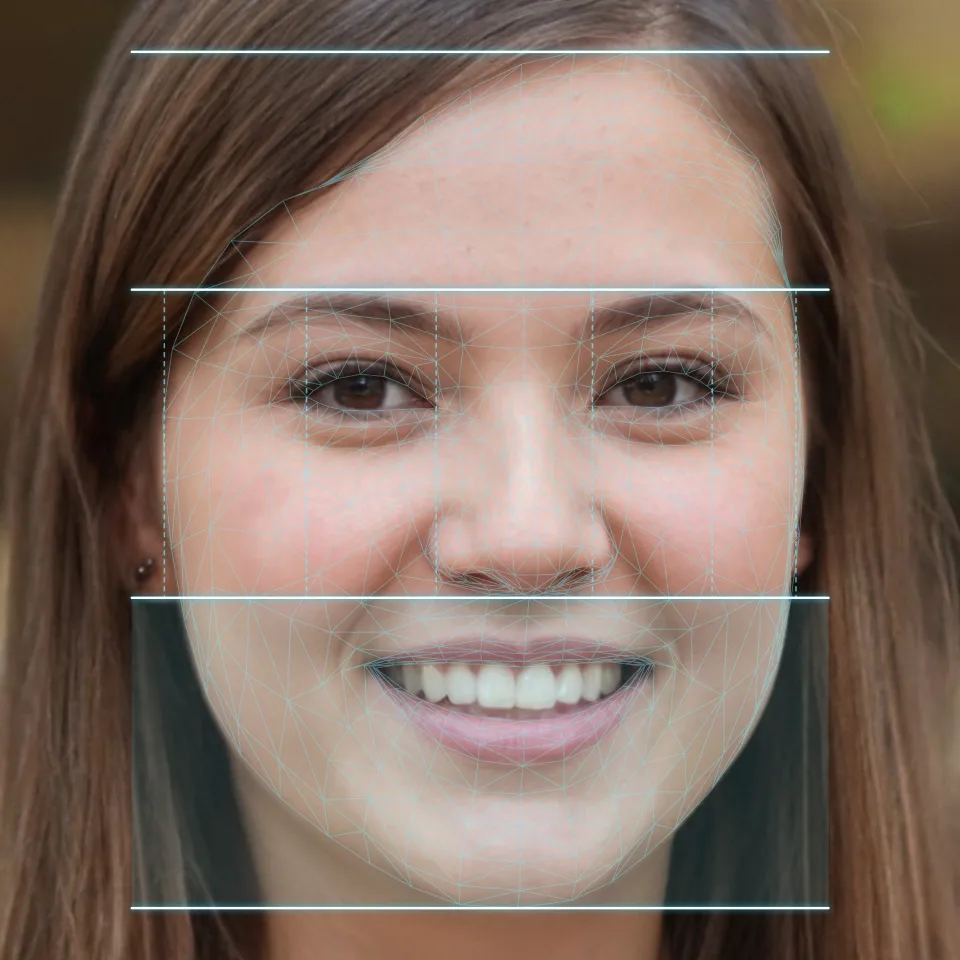
On the sample photo the lower third is 286 pixels and the middle third 284, so middle ÷ lower = 0.99. Not long, by that number.
But put a question mark next to it. She is smiling with her teeth showing. When the mouth opens, the chin travels down with the jaw, so 286 is the lower third of a smiling face. We did not measure her neutral face, and we won’t guess.
Head angle matters too. Tucking or raising the chin both change it, but sources disagree on the direction: some say looking down lengthens it, others the opposite. What is safe to say: a tilted head makes the number unreliable. A beard hides the bottom of the chin, so that end is hard to find too.
A second cut inside the lower third: the lip line
The lip line, where closed lips meet, cuts the lower third again.
- Base of the nose to the lip line: the short top part, with the philtrum and upper lip.
- Lip line to the bottom of the chin: the long bottom part, with the lower lip and chin.
Drawing and measurement rules put the two at about 1:2. That is a rule, not an average. One Japanese makeup artist cuts at the bottom edge of the lower lip instead and gives 1:1. A different cut gives a different ratio.
So a long lower third can come from either part. Her lips are apart on the sample photo, so we did not measure the split.
Hair: where the ends stop
Where your hair ends changes how long the lower third reads. These come from stylists’ advice for long faces, not from tests.
- A chin-length bob with ends that bend inward draws a line at jaw level, and the eye stops there.
- Collarbone length with blunt ends gathers weight and width near the jaw instead of trailing down.
- Skip one-length hair past the chest. The ends lead the eye below the chin.
- Waves that start at jaw level add width there, so the vertical reads less.
With a beard, one stylist suggests short and full with fuller sideburns: width at the lower face, no length at the chin. A long, pointed beard does the opposite.
Lip colour and light on the chin
In makeup, the levers are where colour sits and where light falls.
- Overdraw the upper lip slightly. The philtrum reads shorter, and so does the nose-to-lips part. One artist suggests an upper-to-lower lip ratio of about 1:1.5 or 1:1.
- A lighter lip colour keeps the eye from settling on the mouth and chin.
- No highlight on the chin tip. Highlight there stresses the vertical length.
- A touch of shading at the centre of the chin, blended underneath, softens the bottom edge.
These are artists’ habits too. To check, compare two closed-lip photos taken at the same distance.
FAQ
Is a long lower third bad?
No. It only means a little more space between the nose and the chin, which is common on real faces.
Does smiling change the lower third?
Yes. The sample photo was taken mid-smile with teeth showing. We did not measure her without the smile, so we can't say by how much. Compare closed-lip photos only.
Is a long chin the same as a long lower third?
Not quite. The chin is only the bottom part; a long nose-to-lips stretch also lengthens the lower third. Split it and see which part has more.