Contents
Golden ratio face: what does it mean?The four pairs most guides compareWhy almost no face fitsHow it differs from facial thirdsWhere to start measuring your ownFAQKey points
- Phi (about 1.618) comes from geometry, not from faces.
- A golden ratio face means some ratios land near it; which ratios depends on the guide.
- The common pairs are face length to width, middle to lower third, mouth to eye gap, and nose to philtrum.
- Almost no face is near 1.618 on all of them, and a few pixels shift a ratio noticeably.
- Research has not shown it measures beauty. It describes proportions.
Golden ratio face: what does it mean?
A golden ratio face is one where a few ratios between lengths on the face come out close to 1.618.
The number comes from geometry. Cut a line into a long and a short part so that the whole divided by the long part equals the long part divided by the short part. That ratio is φ (phi), about 1.618. Nobody got it by measuring faces.
Renaissance writers called it the “divine proportion”. Much later it was applied to faces: pick two lengths, divide the longer by the shorter, see how close you get.
So it is not a face shape but a way of measuring. The trouble starts with choosing the ratios.
The four pairs most guides compare
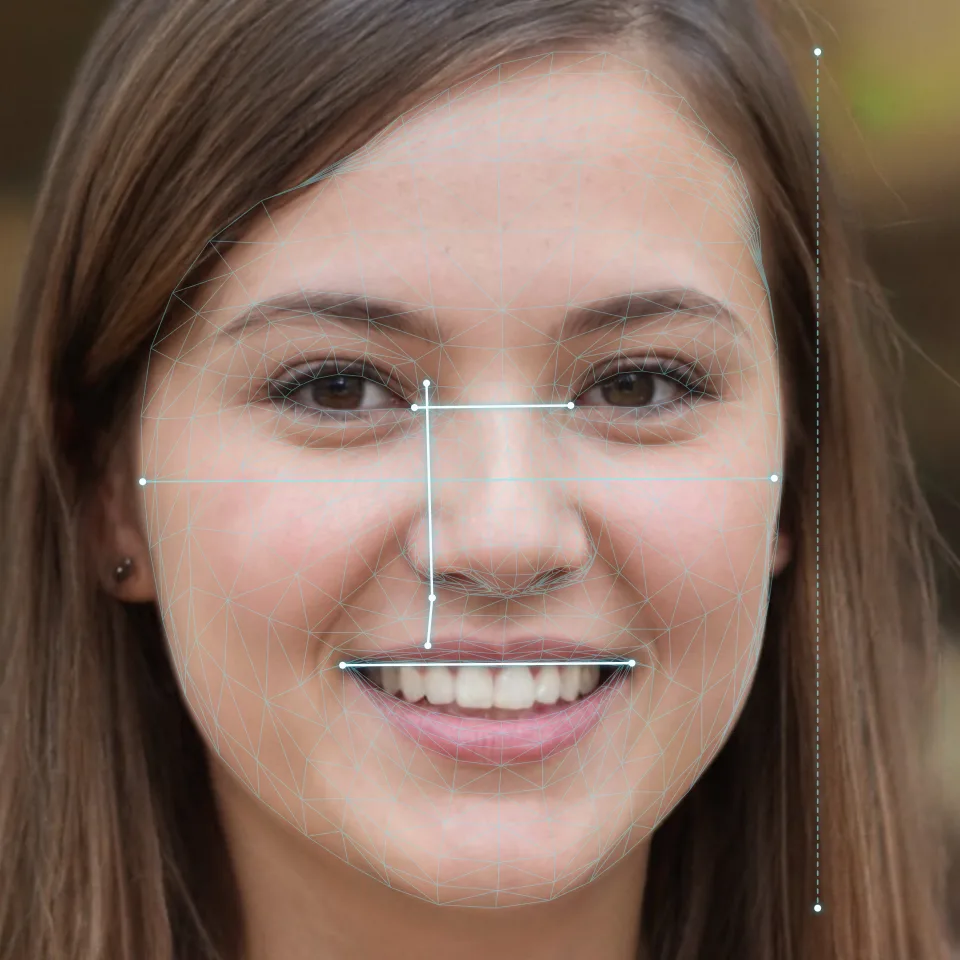
Across golden ratio guides, these four pairs come up most:
- Face length ÷ face width: hairline to chin, against the width at the cheekbones.
- Middle third ÷ lower third: brow line to the base of the nose, against the base of the nose to the chin.
- Mouth width ÷ eye gap: corner to corner of the mouth, against the gap between the inner eye corners.
- Nose length ÷ philtrum: between the eyes to the base of the nose, against the base of the nose to the upper lip.
Even these are not written the same way everywhere. One site’s guide uses “brow to base of the nose”; its home page says “forehead to nose bridge”. A Japanese article lists five “golden ratios of the face”, and none is 1.618: some are equal lengths, others 1.5 or 4 times. Often “golden ratio” just means “pleasing proportions”.
Why almost no face fits
Faces do not grow to a constant. One ratio landing near 1.618 is easy; all four at once almost never happens, as even guides that promote it admit.
Measuring adds error. On the sample photo, face length ÷ width is 1.36. The face edge at the cheekbones is hard to place; 10 pixels off on each side and the result moves anywhere from 1.31 to 1.40. Short segments like the philtrum are the most sensitive.
And beauty? Studies that compared photo ratings with 1.618 found only a weak link, and the best-known golden ratio mask, tested in 2008, fitted only a narrow type of face. The evidence is in is the golden ratio face real.
How it differs from facial thirds
Facial thirds ask whether a few sections are equal. The golden ratio asks whether certain ratios are near 1.618.
The middle and lower thirds show the clash. The thirds rule makes them equal, a ratio of 1. Some golden ratio guides compare the same two sections with 1.618. A face cannot meet both: the closer to one, the further from the other. Both are conventions from drawing and design, not laws a face must follow. So decide which question you are asking: are the sections even, or how large is one ratio? The full comparison is in facial thirds vs golden ratio.
Where to start measuring your own
A front-facing photo and a photo editor that shows pixel positions are enough; a golden ratio face calculator helps only if it shows its points. The points for each ratio, the full sample results and how to read yours are in the golden ratio face test.
Prop the phone at eye height 1.5–2 m away (rear camera, timer on), keep your head level, pull your hair off the hairline and close your mouth gently. A smile widens the mouth, which changes one ratio. A face report built from one front-facing photo is a quick way to see the golden ratio next to your other ratios.
Write down which points you used. The numbers describe proportions; they do not say whether a face looks good.
FAQ
Is a golden ratio face the standard face?
No. It only compares a few ratios with 1.618. Nobody agrees on which ratios, and in studies the link to looks is weak.
Are 1.618 and 0.618 the same thing?
Yes, the same relationship divided the other way. Long over short gives 1.618; short over long gives 0.618.
How is the golden ratio different from facial symmetry?
Symmetry asks whether the left and right sides mirror each other. The golden ratio looks at ratios between lengths. A face can be very symmetrical and far from 1.618.
Why do some articles list golden ratios that are not 1.618?
The term "golden ratio" is often used loosely for "pleasing proportions". Check which two lengths a claim compares and what target it uses.