Contents
Front-facing photo: what makes one usable?Angle: eye level, square on, head levelLight: even, from the frontDistance: step back, use the rear cameraWhat clinics and passport offices agree onFront-facing photo checklistFAQKey points
- Angle: phone at eye level, face square to it, head neither tilted, tipped nor turned.
- Light: even, from the front; not from the side, the ceiling or behind you.
- Distance: step back to 1.5–2 m and use the rear camera (2x to 3x if you have it) with a timer.
- Show your forehead and ears, skip sunglasses, hats and filters, relax your face, and take three shots.
Front-facing photo: what makes one usable?
Three things: angle, light and distance.
A headshot is the wrong model. Photographers turn the head, bring the chin forward and down, and light from one side. That adds shape and moves the distances: a turn widens one side, a lowered chin stretches the upper third, side light narrows the darker half.
A photo for checking thirds or symmetry is taken the other way round:
- Angle: head level, face square to the lens.
- Light: even, from the front.
- Distance: back off; no wide angle up close.
Angle: eye level, square on, head level
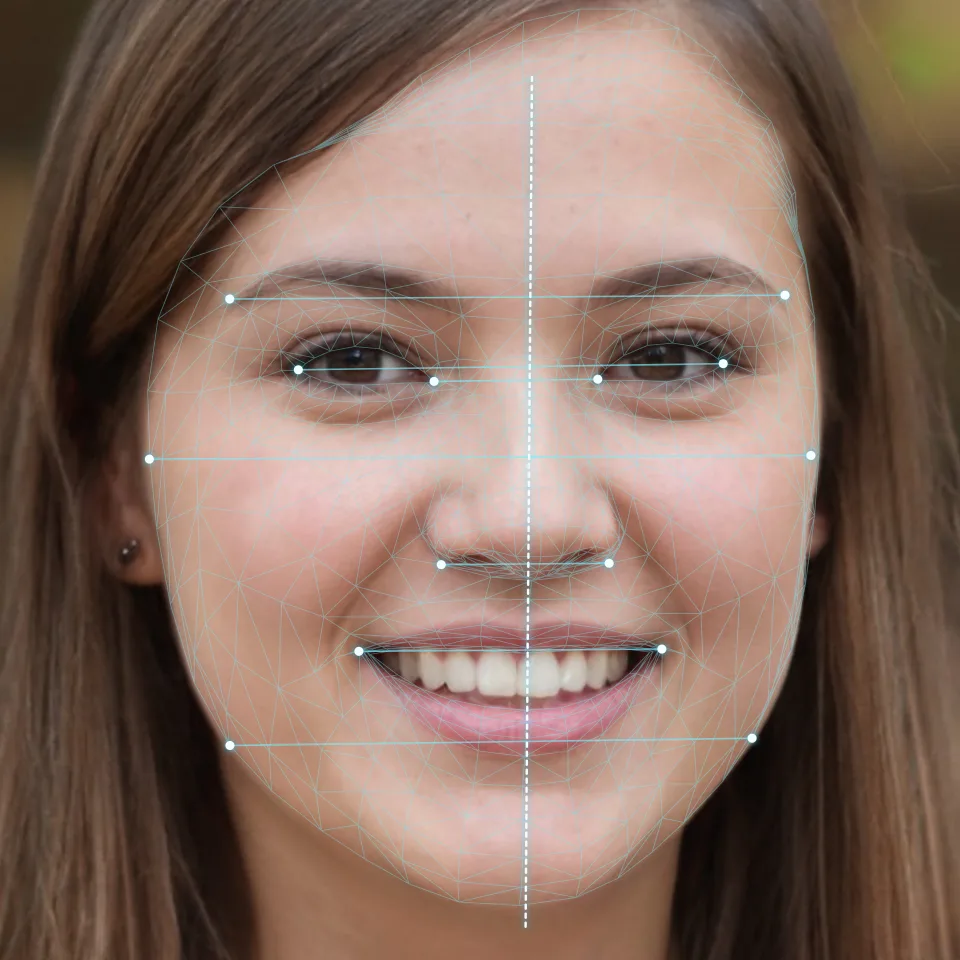
A head can tilt to one side, tip up or down, or turn. Each throws off different numbers; see head angle in photos. Check three things:
- Eye line level. Turn on the camera grid and put both eyes on one line.
- Both ears equally visible. More of one ear means a turn.
- Phone at eye height. Higher acts like a lowered chin.
Clinics use the Frankfort plane: the lower rim of the eye socket and the top of the ear opening sit level.
The sample photo is the counter-example: all seven pairs lean the same way, the trace of a slight turn. The facial symmetry guide works through it.
Light: even, from the front
Clinics use two soft lights behind the photographer, at 45° each side, so there are no hard shadows. At home, facing a large window without direct sun comes close.
Four kinds of light do the most damage:
- Side light: the bright half looks wider.
- Ceiling light: shadows under the brows, nose and chin hide the brow line and nose base.
- Backlight: the face goes dark and its edges blur.
- Mixed colour: window plus lamp turns one cheek yellow, the other blue. Switch room lights off.
More in selfie lighting.
Distance: step back, use the rear camera
The closer the lens, the more the nose is enlarged and the face edges spread. A 2018 modelling study compared about 30 cm with 1.5 m: up close, the base of the nose came out about 30% wider. See selfie distortion.
- Stand 1.5–2 m from the phone and use the rear camera; if it has 2x or 3x, switch to it so head and shoulders fill the frame.
- If your face ends up small in the frame, crop to head and shoulders afterwards so it fills at least about a third of the frame; cropping a photo taken from far is fine.
- Skip the 0.5x ultra-wide.
- Prop the phone up and use a 3- or 10-second timer.
- Leave portrait mode off: it misreads hair, ears and glasses, and its lighting effects repaint the face.
What clinics and passport offices agree on
- Forehead and ears showing. Clinics tuck loose hair behind the ears. A hidden hairline or face edge turns the upper third and outer fifths into guesses.
- No sunglasses or hat. The UK government’s passport rules ban sunglasses and tinted lenses, keep frames and glare off the eyes, and allow head coverings only for religious or medical reasons. Short-sight lenses also shrink the eyes.
- No beauty filter. The same rules forbid editing by software. Filters that reshape the jaw or enlarge the eyes change exactly what you want to read.
- Neutral face. Passports want a plain expression, mouth closed; clinics shoot smiles separately. See smiling and face proportions.
Front-facing photo checklist
| Thing | What to do | If you don’t |
|---|---|---|
| Camera height | Level with your eyes | Upper or lower third stretched |
| Head | Eyes level, ears equal | One side wider, pairs lean one way |
| Light | Face a window, lamps off | Uneven sides, shadows under brows |
| Distance | 1.5–2 m, rear camera, timer | Nose enlarged, edges pushed out |
| Hair | Behind the ears | No hairline or face edge |
| Glasses, hat | Off | Corners hidden, eyes shrunk |
| Filters | Off, portrait mode too | You measure the algorithm |
| Expression | Relaxed, mouth closed | Eyes narrow, corners rise |
| Shots | Three, keep the steadiest | No way to spot an error |
To draw the lines and measure, see the facial thirds guide; a photo that passes this checklist is also the one to give a face report.
FAQ
Can I use the front camera?
Yes, if you step back to 1.5–2 m: phone on a stand, timer on. The rear camera is usually sharper, so use it if you can.
Should I wear makeup?
Clinics prefer a bare face and accept light makeup. Contour and highlight shift the shading at the face edges, so skip them for a measuring photo.
Does it matter if the photo is mirrored?
Not for distances: flipping only swaps left and right. When you compare two photos, flip both or neither.