Start here
What are facial thirds and fifths? Measure your own face
What are facial thirds and fifths? Measure yours in 4 steps, avoid 6 errors, see what the rule is for. Not drawing lines? A free report shows them.
Read the overview10 min read
How to measure the upper, middle and lower thirds and the fifths, and what to do with hair and makeup when one part runs long or short.
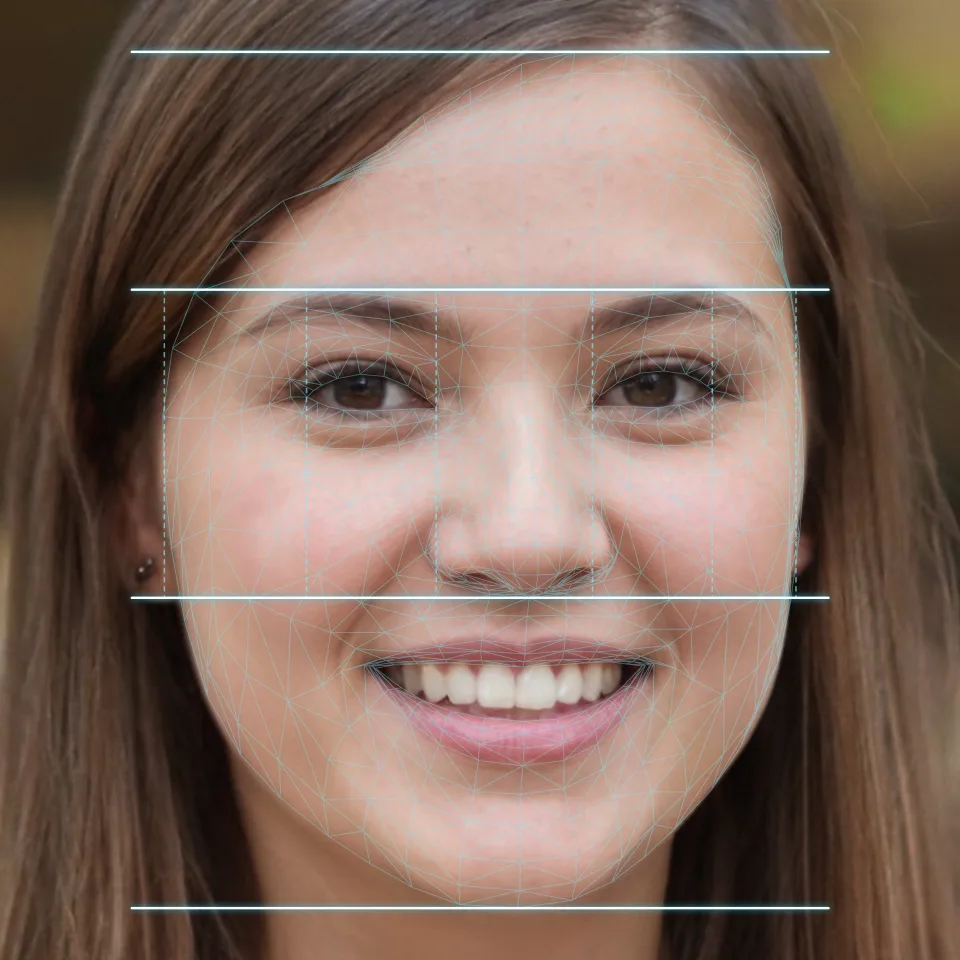
Facial thirds and fifths are the most quoted face proportion and the easiest to overstate. The rule sounds like a standard, yet when real faces are measured almost none split into three equal parts. This topic is for anyone who wants to measure their own photo without being put off by an “ideal”. By the end you can pick out the upper, middle and lower thirds and the five eye widths on a front-facing photo, you know which end points are steady and which are easy to misplace, and you know what hair and makeup can do when one part runs a little long or short.
Start with the overview of facial thirds and fifths, which gives the rule and a four-step way to measure it. If you want to know where the rule comes from and why it so rarely fits real people, read the guide to the neoclassical canons next, then facial thirds versus the golden ratio. After that, choose the part you care about. The middle and lower thirds have the clearest end points, so begin with a long midface and a long lower third; eye spacing covers the fifths. The upper third depends on the hairline, which is the hardest point to pin down, so leave it for last and read it with hairstyles for a high forehead.
One note before you start: these ratios only describe how space is shared out across a face. They do not grade it. A tilted head or a smile changes the numbers, so each guide explains how to take the photo before it says what to do with the result.
What are facial thirds and fifths? Measure yours in 4 steps, avoid 6 errors, see what the rule is for. Not drawing lines? A free report shows them.
Use a front-facing photo with your head level. Mark the hairline, the brow line, the base of the nose and the chin to get three parts, then see how many eye widths fit across the face. Measure three times: how far the three results differ is how precise your ruler is.
No. The rule began as a drawing guide for placing features on a blank page, not as a measurement of real people, and in studies that did measure faces almost nobody had three equal thirds. It only shows which part has a little more room.
The upper third, because a hairline is a gradual fade rather than a clear line. The lower third comes next, since smiling or opening your mouth changes it. Compare the middle and lower thirds first, with your lips closed and your head level.