Contents
Jawline and face shape: how are they related?Where each number sits on a photoSeven face shapes: corner and width at the jawThe two clearest cases: round vs square, long vs shortKeep the two numbers apart when stylingFAQKey points
- The jaw corner (soft, moderate, defined) and jaw over cheekbone width are independent.
- A face-shape label squeezes both, plus length, into one word.
- The same corner appears in several shapes; width and length tell them apart.
- Round and square differ in the corner; square and oblong can differ only in length.
Jawline and face shape: how are they related?
Short answer: the jawline is part of face shape, as two numbers, not one.
Face shape comes down to length against width, which of three widths is greatest, and whether the jaw turns a corner or curves. Two of those involve the jaw:
- The corner: curve, gentle turn or corner, the soft, moderate and defined tiers in jawline types.
- The width: jaw width divided by cheekbone width, or how much the lower face narrows.
Knowing one tells you nothing about the other, so “a defined jawline” alone does not settle a shape. Mixing them up is where mislabelling starts: a defined corner on a narrow jaw gets called square, and so does a soft corner on a wide one.
Where each number sits on a photo
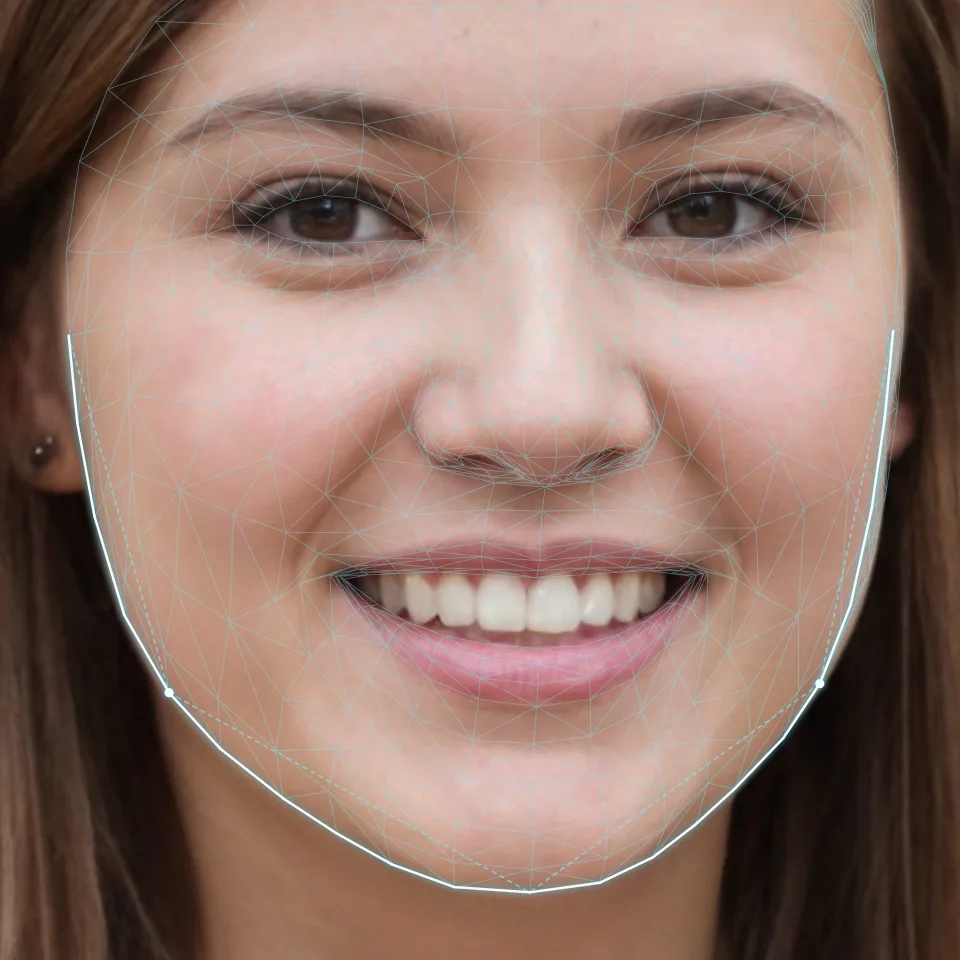
The bold line runs from ear to chin; the dashed lines are the two arms of each jaw angle (the gonial angle, in anatomy terms). The smaller the angle between the arms, the more defined the corner; the closer to a straight line, the softer.
Width runs between the two jaw-angle points, over the widest cheekbone distance. Near 1, the lower face is as wide as the middle; lower, it narrows more.
On the sample photo the corners read about 135° and 138–141°, and jaw over cheekbone width is 0.79. One guide gives the oval face a corner near 137° and cheekbones about 1.26 times the jaw, also near 0.79. This face sits close on both, though a photo corner is skin, not bone, and shifts between photos. A face report built from one front-facing photo is another way to check your own jawline.
Seven face shapes: corner and width at the jaw
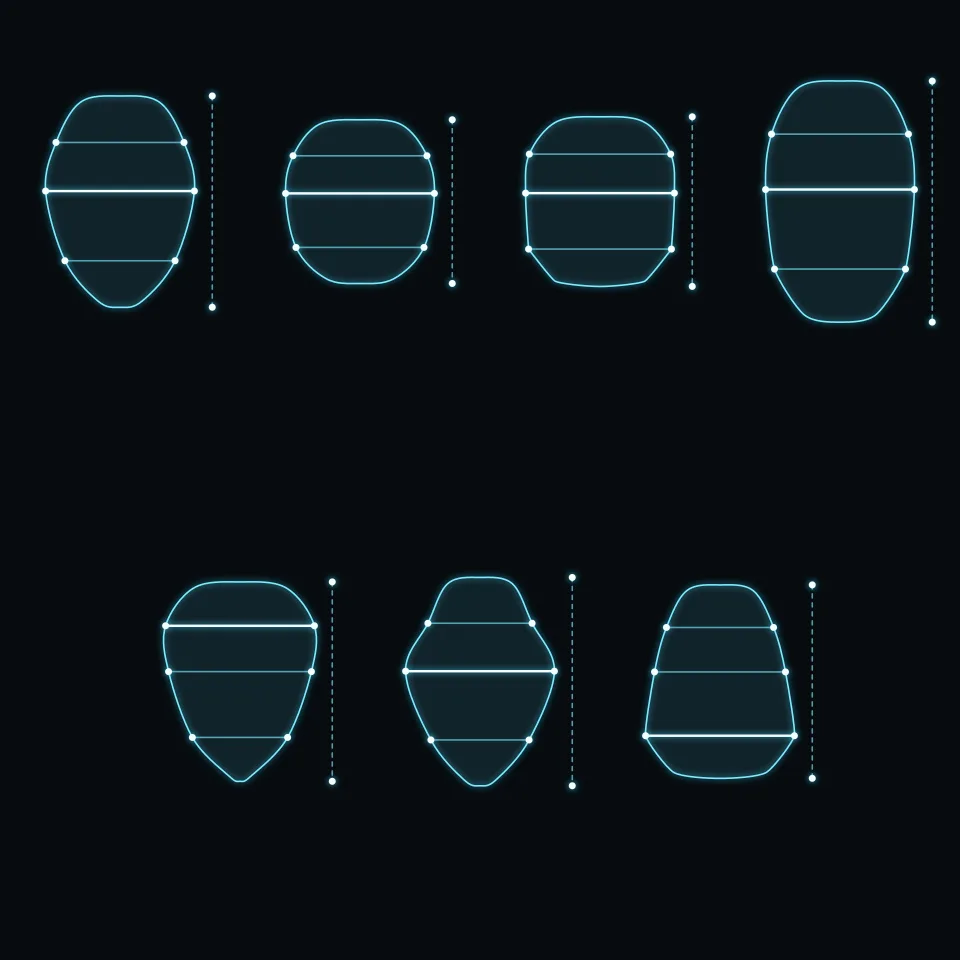
| Shape | Jaw corner | Jaw width vs cheekbones |
|---|---|---|
| Oval | Soft, rounded rather than hard | Narrows some, about 0.79 |
| Round | Soft, one curve, more open | Narrows little |
| Square | Defined, flatter chin | Barely narrows; three widths similar |
| Oblong | Mostly soft; a squarer version is called rectangle | Guides differ: narrows some to little |
| Heart | The line slopes to a pointed chin; no clear corner | Narrows most, about 0.73 |
| Diamond | A more angular outline; the turn sits below the cheekbones | Narrows a lot, about 0.76, forehead narrow too |
| Pear (triangle) | Squarish, often a corner | Jaw widest, wider than the cheekbones |
Figures are converted from one guide’s ratios: rough positions only. Defined corners appear in square, pear and some oblong faces; soft ones in oval, round and oblong. With the same corner, width and length separate the shapes.
The two clearest cases: round vs square, long vs short
Round and square are close in length and width, and neither jaw narrows much. Only the corner is left: a curve reads round, a corner square. Details in round vs square face.
Length changes how a corner reads. A defined jaw angle on a face about as long as wide boxes in with the forehead and cheekbones: square. On a clearly longer face the sides run longer below the cheekbones: oblong or rectangle. So with a defined corner, check length over cheekbone width first; see what is my face shape.
The sample reads the same way: a gentle turn, width 0.79, length over width about 1.19. Together that is a short oval.
Keep the two numbers apart when styling
Two numbers beat one label:
- The corner governs the line at the jaw. Showing or softening it is a hair and contour choice; see jawline hairstyles.
- The width governs whether the lower face narrows. For contour placement by shape, see contouring for your face shape; for hair, hairstyles for your face shape.
- Photos move both: a head turn changes each corner, and a lens too close widens the cheeks. See jawline in photos.
This advice comes from stylists and makeup artists, not trials; a before-and-after photo is the best test.
FAQ
Does a defined jawline mean a square face?
Not necessarily. Square also needs a jaw about as wide as the cheekbones and length close to width. Clearly longer reads oblong; a jaw wider than the cheekbones reads pear.
Is a pointed chin always a soft jawline?
No. A pointed chin is about width narrowing a lot. The corner is separate: the line can slope toward the chin and still turn clearly at the jaw angle.
Which of the two numbers matters more?
It depends on the pair. Between round and square, only the corner. Between oval and heart, mostly width. Between oval and oblong, neither: length against width decides.