Contents
How many face shape types are there? Usually sevenFace shape types at a glanceRectangle, inverted triangle, long: other names, same sevenWhere guides draw the lines, and why they differWhat to do once you know your typeFAQKey points
- The usual seven: oval, round, square, oblong, heart, diamond and pear.
- Three things tell them apart: length against width, the widest part, and the shape of the jaw.
- Other names such as rectangle, long or inverted triangle land on one of the seven.
- The boundaries are drawn by people, and different guides draw them at different numbers.
How many face shape types are there? Usually seven
The usual list of face shapes has seven: oval, round, square, oblong, heart, diamond and pear. Some guides list nine, adding rectangle and an inverted triangle. A rectangle is an oblong face with a squarer jaw, and an inverted triangle is wide on top and narrow at the chin, like a heart. Seven covers them.
Each type is one set of answers to three questions:
- How much longer than wide is the face?
- Which is widest: forehead, cheekbones or jaw?
- Does the jaw turn a corner, run in a curve, or narrow to a point?
One more thing: the list is not a ranking. Oval is often called “ideal”, but no research backs that; it is simply the shape most styling advice uses as its reference point.
Face shape types at a glance
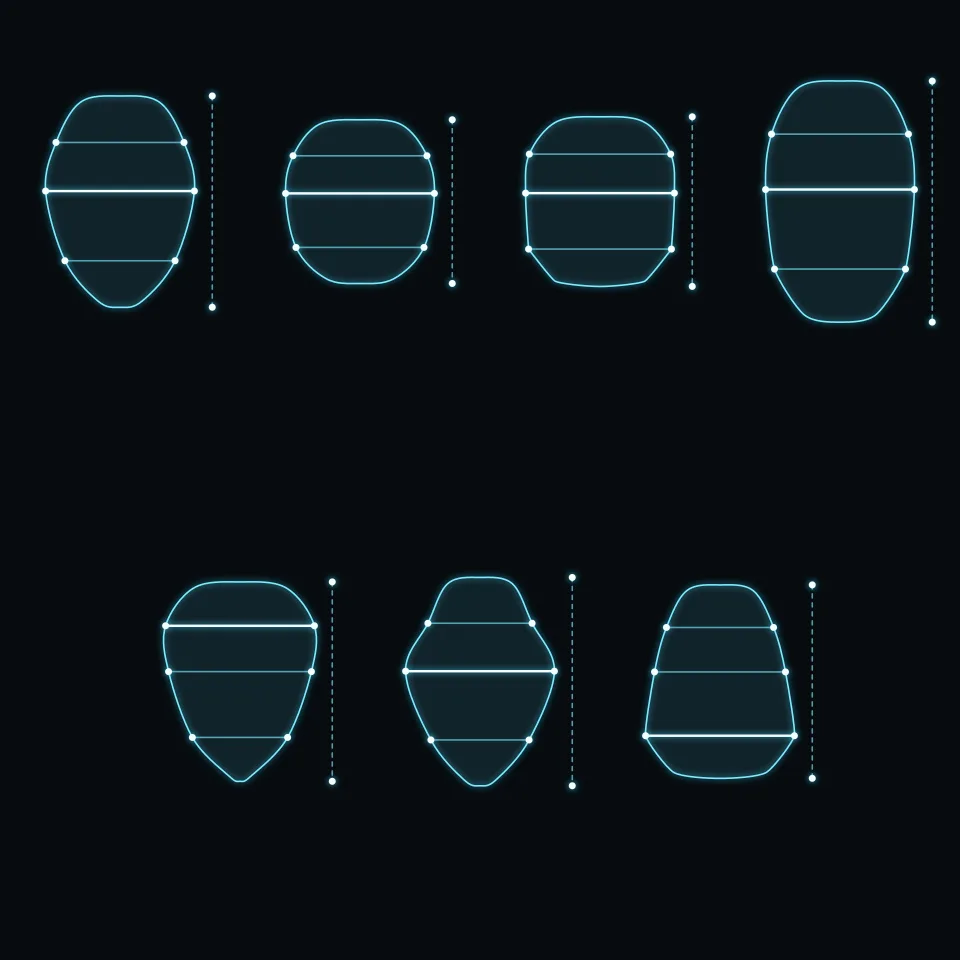
| Shape | Length vs width | Widest part | Jaw | In one line |
|---|---|---|---|---|
| Oval | A little longer | Cheekbones | Smooth, narrowing evenly | Forehead a touch wider than the chin, no clear corners |
| Round | About equal | Cheekbones | Curved, barely narrows | Full cheeks, one curve from cheekbone to chin |
| Square | About equal | All three similar, jaw often widest | Clear corner, flat chin | Defined edges |
| Oblong (long) | Clearly longer | All three similar | Barely narrows | High forehead, long midface |
| Heart | Told by widths, not length | Forehead | Narrows to a slim, pointed chin | Often a widow’s peak |
| Diamond | Close to oval | Cheekbones | Narrows to a pointed chin | Narrow forehead and chin, high cheekbones |
| Pear (triangle) | Told by widths, not length | Jaw | Wide, squarish | Narrowest at the forehead, weight in the lower face |
Read it left to right: length halves the list, the widest part and jaw settle it.
Rectangle, inverted triangle, long: other names, same seven
Names vary between guides and countries, but most land on one of the seven:
- Oblong, long and rectangle: all point to a face clearly longer than wide with similar widths. Rectangle is usually the version with a squarer jaw.
- Inverted triangle: wide forehead, narrow chin. Same family as heart.
- Triangle: careful here. Some guides use it for the pear shape, widest at the jaw; others use it for the inverted triangle, widest at the forehead. Check which way the guide means before trusting its advice.
- Pear: widest at the jaw, narrowest at the forehead.
Names blur at the edges: a pointed chin might be heart to one guide and diamond to another. Where the face is widest tells you more than the name.
Where guides draw the lines, and why they differ
Face shape varies smoothly. Classification draws lines across that smooth range, and every guide puts them in a different place.
- One guide uses face length ÷ cheekbone width: round about 1.13, square about 1.16, oval about 1.24, oblong about 1.34.
- Others say an oval face is about 1.5 times as long as wide, and a round face about 1:1.
- Another puts oval at 1.4 to 1.5 times, with oblong at 1.6 or more.
Part of the gap is the yardstick: whether width means the cheekbones or the widest point, and where face length starts. One face can switch names when the standard changes. That is why the table says “about equal” and “clearly longer” instead of giving hard cutoffs.
What to do once you know your type
A type doesn’t give you answers by itself. It works more like an index, pointing you to the right set of advice.
- First find your row. How to photograph and measure is in what is my face shape, or a free face report from one front-facing photo gives your shape.
- Then look up the styling ideas for it in hairstyles for your face shape.
That advice comes mostly from stylists’ and brands’ experience, not controlled experiments. Trying one idea on yourself tells you more than memorising which shape suits what.
FAQ
Is face shape fixed for life?
Not entirely. Bone changes little, but the outline in a photo moves with weight and hairstyle, and camera distance moves the ratios. It describes a period of time.
Why do different sites give me different face shapes?
They draw their lines at different numbers and measure from different points. One face can change names between standards, even from one face shape detector to the next; your own ratios are more reliable than any verdict.
I seem to be between two shapes. Which am I?
That is common, since shape is continuous. Check where the face is widest and how the jaw turns, then go with the strongest feature.