Contents
How to tell your barber what you want: four things, and a number for eachWhat to bring: two or three reference photos and one of yourselfLengths: one number for the top, one for the sides, one for the backParting, fringe and crown: say where each one sitsStyling time and trims: say how many minutes you will give itIn the chair: repeat it back, say stop, look from four anglesFAQKey points
- Give four things: reference photos, one length per zone (top, sides, back), the position of the parting, fringe and crown, and the minutes a day you will spend styling.
- Say lengths in centimetres, inches or clipper guard numbers, then ask your barber to repeat them back in numbers. Hair grows about 1 cm a month on average, so one centimetre is about a month.
- Bring 2 to 3 photos of different people whose hair type and density are close to yours, with at least one that shows the side. A photo is one angle.
- Your face shape name and the lines on your photo are one input, not the answer. Most of this advice is craft knowledge and training standards; no controlled trial compares ways of asking.
How to tell your barber what you want: four things, and a number for each
The short answer: “a bit shorter” has no unit. One barber hears half an inch, another hears two. To get close to the picture in your head, give four things:
- Something to look at: two or three reference photos, plus one of yourself.
- Lengths in numbers: how long the top, the sides and the back should end up.
- Positions: which side the parting is on, where the fringe lands on your face, where the crown spirals.
- Your routine: how many minutes a day you will style it, and how many weeks between visits.
Numbers matter because small differences show. Hair grows about 1 cm (0.4 in) a month on average, the figure a 2023 review in the Journal of Clinical Medicine works with, though individual rates vary. A centimetre too many or too few is therefore about a month, and a cut that went too far can only be waited out.
What the barber lacks is the part the mirror cannot show. They can see your hair and your face. They cannot see your ten minutes each morning, what you disliked about the last cut, or where “short” stops in your head. Training standards spell out what they should ask. Several Australian hairdressing and barbering units require trainees, before they cut, to check the client’s hair type, density, growth direction (crown, hairline, neckline, cowlicks), facial features and bone structure, to agree the finished look using visual examples, and to get the client’s consent before starting. A good barber does this anyway. Your job is to fill in what they cannot see.
An honest word on evidence. Almost everything below comes from barbers’ and stylists’ experience and from training standards; no controlled trial has compared ways of asking. The only study I found on consultation talk is a 2016 master’s thesis, and I read only its abstract: stylists and clients did not agree about how the consultation went, and the author argues for more communication training. A second study, used below, is a conversation analysis of salon video; it looks at how clients make requests in the chair, not at consultations as such.
Said out loud, a full brief sounds like this (the numbers are examples, so swap in your own):
Short, clippers: Four centimetres on top, layered, long enough to comb back or part on the right. Sides on a number 3, fading down from just above the ear, back the same, neckline tapered naturally. No fringe. I give it five minutes a day with a dryer and a little clay. There is a cowlick left of the crown that falls to the right. I will be back in four weeks.
Longer, scissors: Cut to an inch above the collarbone, ends kept blunt. A little layering at the front, the shortest layer at the chin. Fringe to just above the brows, parted to both sides; do not go shorter than that yet. I blow-dry with a slight outward bend, eight minutes at most. I will be back in eight weeks.
What to bring: two or three reference photos and one of yourself
Photos save the most words. London stylists quoted by Refinery29 add up to this:
- How many: about three, of different people. More than three gets confusing, and a single photo of a single person leaves the barber guessing whether you want the cut or the person. Where all three overlap is probably what you really want.
- Whose hair: people whose hair type, density, colour and everyday styling are close to yours. The same cut behaves differently on different textures and growth patterns, so the more the person’s hair resembles yours, the more the photo tells.
- Which angle: a photo is one angle and a head is three-dimensional. Bring at least one that shows the side or back, or a short video.
- Edited pictures: public photos are often retouched, mostly the colour but sometimes the shape. When a stylist says “you cannot get this”, hear them out.
- One line per photo: “I want this fringe length, not this colour.” Saying which part you like is easier than “this one”.
Add a picture of yourself as you are now, front on. If you have them, add one cut you loved and one you hated. A stylist’s point: the more you spell out what you liked and disliked, the more clearly they see the edges.
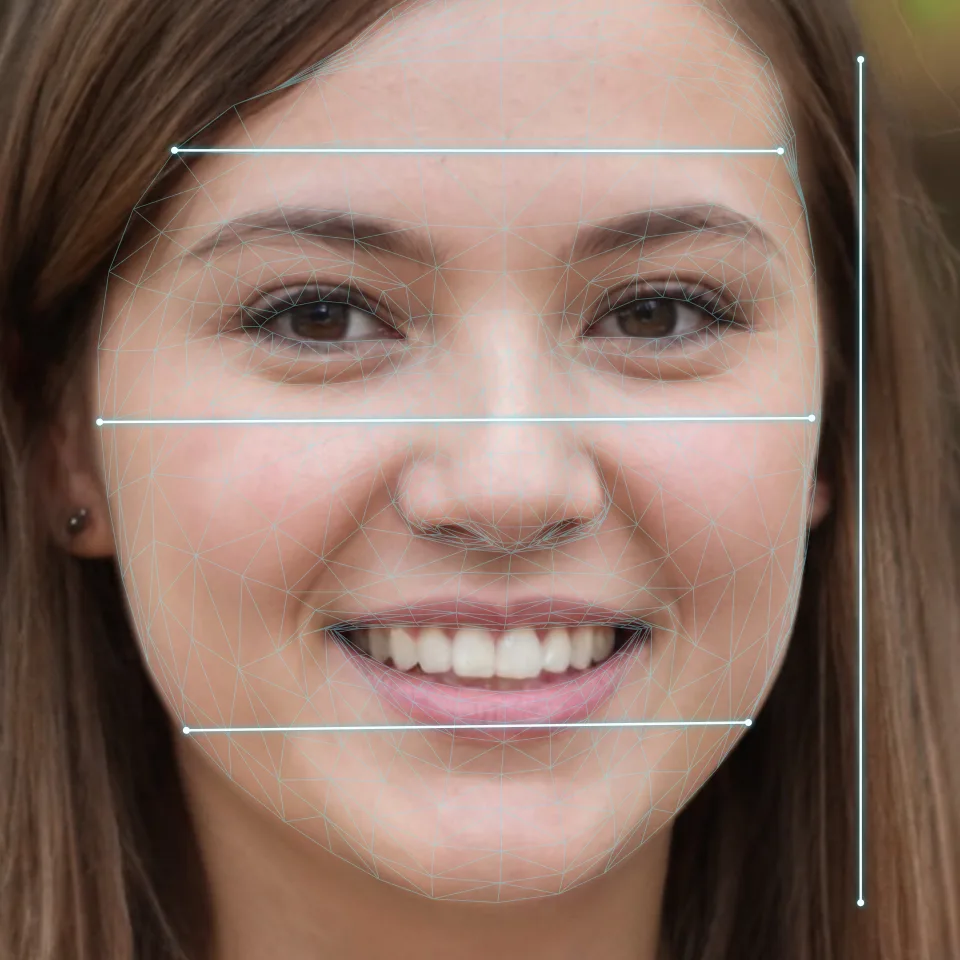
Treat face shape as one input. Assessing face shape and bone structure is already a step in how barbers are trained. The FacialRate face report gives you the shape’s name plus lines drawn on your own photo. Carrying it into the shop gives the first sentence a shared word; it does not decide anything for the barber. Do not ask “I am an [X] face, what should I get?” Ask about positions: “Should the sides stop at the ear or at the cheekbone?” For how cuts follow face shapes, see hairstyles for your face shape and how to tell your face shape. Those pages are about what to add and what to go easy on, not a claim that a cut is right for a shape, and most of what they say comes from stylists’ experience.
Do three things now:
- Save 2 to 3 reference photos: different people, similar hair, at least one showing the side.
- Take two front photos of yourself. One with your hair as you wear it, for the barber. One with your hair tucked behind your ears, forehead and face edges clear, to check your face shape. The method is in how to take a front-facing photo: stand 1.5–2 m back, use the rear camera, prop the phone at eye height and set the timer.
- Check your face shape with the second photo.
Lengths: one number for the top, one for the sides, one for the back
Think of the head as three blocks: top, sides, back. Give each block one number, in a unit that suits the length.
- Anything longer than a couple of centimetres: centimetres or inches, or a body landmark (earlobe, chin, collarbone) plus some centimetres.
- Anything done with clippers: the guard number.
These are the guard numbers on Wahl-style clippers; each step up is about one eighth of an inch:
| Guard | Inches | About mm |
|---|---|---|
| 1 | 1/8 | 3 |
| 2 | 1/4 | 6 |
| 3 | 3/8 | 10 |
| 4 | 1/2 | 13 |
| 6 | 3/4 | 19 |
| 8 | 1 | 25 |
Two cautions. Other brands can number their guards differently, so ask to see the guard, or say the millimetres. And the lever on the clipper head matters: opened one notch, each guard leaves about 1.6 mm (1/16 inch) more, so “a number 2” can be 6 mm or 8 mm.
For the sides and back, say two more things:
- How it steps down: “taper” and “fade” get used interchangeably, and shops mean slightly different things by them, so do not rely on the name. Say where the shortest point stops (which guard, or how many millimetres, skin or not) and where the shortening begins (the top of the ear, or lower).
- The neckline: left natural, squared or rounded.
When you say a length, put your fingers on your own hair and ask what that spot is in centimetres. That is my own view: two fingers held in the air mean different things to different hands, and a fingertip on the head means one thing. In the salon study mentioned above, clients also tended to touch their own hair as they made requests at the start, such as “don’t cut too much”.
Two habits protect you:
- Set length on dry hair. Wet hair hangs longer than dry, and curls spring up as they dry. L’Oréal’s advice for wavy and curly hair is to arrive with air-dried hair, have the fringe cut dry, and say so if you usually straighten.
- Start long. You can take less off and go again; you cannot add back. Ask the barber to start a guard higher, or to stop a little above your number and look.
Parting, fringe and crown: say where each one sits
Beyond numbers comes position. Three places are easy to get wrong.
Parting. Say which side, and how far from the centre (centre, slightly off, a third of the way over), and whether it follows your hair’s natural line or is made. A mirror reverses left and right compared with how people see you; see why you look different in a photo than in the mirror. The safest way is not to say “left” but to point with a finger.
Fringe. Say where it lands on your face: above the brows, on the brows, at the lashes, at the cheekbone. Say how wide and how thick. If unsure, start long and shorten later. For what each fringe does, see bangs for your face shape and hairstyles for a high forehead; this page does not repeat them.
Crown and cowlicks. Crown, front hairline and nape are the places training standards tell a cutter to check before starting. You know your hair’s direction before the barber does: the way it falls when you get up and have done nothing to it is its own direction. With dry hair, point and say: “this part falls to the right.”
One more item people forget: if in recent months you had a perm, straightening, bleach or colour, say so. A London stylist singled these out, because they change the texture and the cut has to change with it.
Styling time and trims: say how many minutes you will give it
The shape a salon blow-dries into often rests on styling nobody explained to you. You wash it once at home, cannot recreate it, and decide the cut was ruined. So state your routine in three sentences:
- “I will give it five minutes a day at most.”
- “I only own a hairdryer, no straighteners.”
- “Please dry it the way I would at home, then let me do it once myself.”
Then ask what products they used, how much, and with which tool. One stylist’s view is that if it matters to you, teaching it belongs in the appointment, and there is nothing awkward about asking.
The second piece is the trim interval. A cut is built around it, so say the interval you will really keep. Rules of thumb from individual shops:
| Cut | One London barbershop’s advice |
|---|---|
| Skin fade, very short clipper cut | every 1 to 2 weeks |
| Clippers on sides and back, length kept on top | about every 3 weeks |
| Scissor-cut medium length | every 3 to 4 weeks |
Another London stylist suggests a trim every 8 to 12 weeks. These are shops’ habits, not standards, and hair grows at different speeds. Use the 1 cm a month figure to check: come every four weeks and each visit takes off about a centimetre.
In the chair: repeat it back, say stop, look from four angles
Before the first cut, ask for it in numbers. “Four centimetres on top, number 3 on the sides up to the ear, fringe above the brows. Is that right?” In training standards, agreeing the finished design and getting consent before starting is a step of its own. If the repeat does not match what you meant, now is the cheapest moment to change it.
During the cut, speak as soon as something looks wrong. In the salon study, words said at the start about what not to do were treated by hairdressers as instructions for what follows, while “not too much” said mid-cut asked them to change what their hands were doing now, and clients looked for the hairdresser’s eyes in the mirror to get an answer. That is two salons’ worth of observation, but the logic carries over: do not save it for the last sentence. Meet their eyes in the mirror and say one short thing: “Stop a second, this side is shorter than I thought, leave the other for now.”
Before you stand up, check four angles. A photo is one angle; a finished head is not. With the hair dry, style it the way you normally do, then use a hand mirror to see the sides and back. Check four things: are both sides equal, does the parting sit where you said, does the fringe land at the point you named, does the crown fall in the direction you expected.
Before you leave, keep a record. Take one photo each from the front, the side and the back, and ask which guard numbers and lengths they used; note them on your phone. Next time, “the same as last time” plus the photos beats starting again. A London stylist’s advice: if the cut is getting close, give the same person up to three appointments in a row, so they learn how your hair responds. A regular barber pays off right here.
If it is still not right, say where: length, position or layers, not “I do not like it”. Write the numbers down, because next time you change the numbers. To preview a cut before the next appointment, take two photos from the same spot, distance and light and compare them; the method is in round face hairstyles, under “Test a haircut with two photos”.
FAQ
Should I bring a photo to the barber?
Yes. Two or three photos of different people whose hair is close to yours, each with a note on what you like about it, beat a single photo. Add one of yourself as you are now. A photo shows one angle, so listen when the barber says what will not carry over.
How do I tell my barber how short I want it?
Give one number each for the top, sides and back, in centimetres, inches or clipper guard numbers, and ask the barber to repeat them back in numbers. "A bit shorter" has no unit, and one centimetre is roughly a month of growth.
What if the barber cuts it too short or gets it wrong?
Say so in the chair, and say where the gap is: length, position or layers, not just "I do not like it". Hair grows about 1 cm a month on average, so shortened lengths are measured in months. Next time, bring the photos and this cut's numbers.
How do I ask my barber to show me how to style it at home?
Say how many minutes a day you will spend and what tools you own. Ask the barber to dry it the way you would at home, then to let you do it once, and ask which products they used and how much.
How often should I get a haircut?
It depends on the cut. One London barbershop suggests every 1 to 2 weeks for skin fades and very short clipper cuts, and every 3 to 4 weeks for scissor-cut medium lengths; a London stylist gives 8 to 12 weeks. Those are individual shops' rules of thumb, so tell your barber the interval you will really keep.