Contents
Eyebrow shape for your face: echo or contrastPlace three points firstUneven brows: match the heads firstBrow shapes for seven face shapesBefore you draw: thickness, length, groomingFAQKey points
- Two routes: echo the face's lines, or contrast them.
- Head above the inner eye corner, arch near a line through the iris, tail past the outer eye corner and no lower than the head.
- Sources disagree on the arch, from the iris edge to above the outer eye corner: a range, not a point.
- If the brows differ, match the heads first. On the sample, one head sits over its eye corner; the other starts 17 px further in.
Eyebrow shape for your face: echo or contrast
The brow is the most visible horizontal line in the upper face. Where the arch sits and how far the tail runs set how long the face reads.
That leaves two routes:
- Echo. Mostly curves: an arched brow. Mostly straight lines: a straight brow.
- Contrast. If you notice width, add a slight angle for lift and keep the tail from dropping. If you notice length, go flatter; a steep angle reads longer.
This is mostly makeup-artist experience. A 2019 study of 300 photos points the same way: rounder faces scored higher with more curved brows, longer faces with flatter ones, as rated by a computer model.
Place three points first
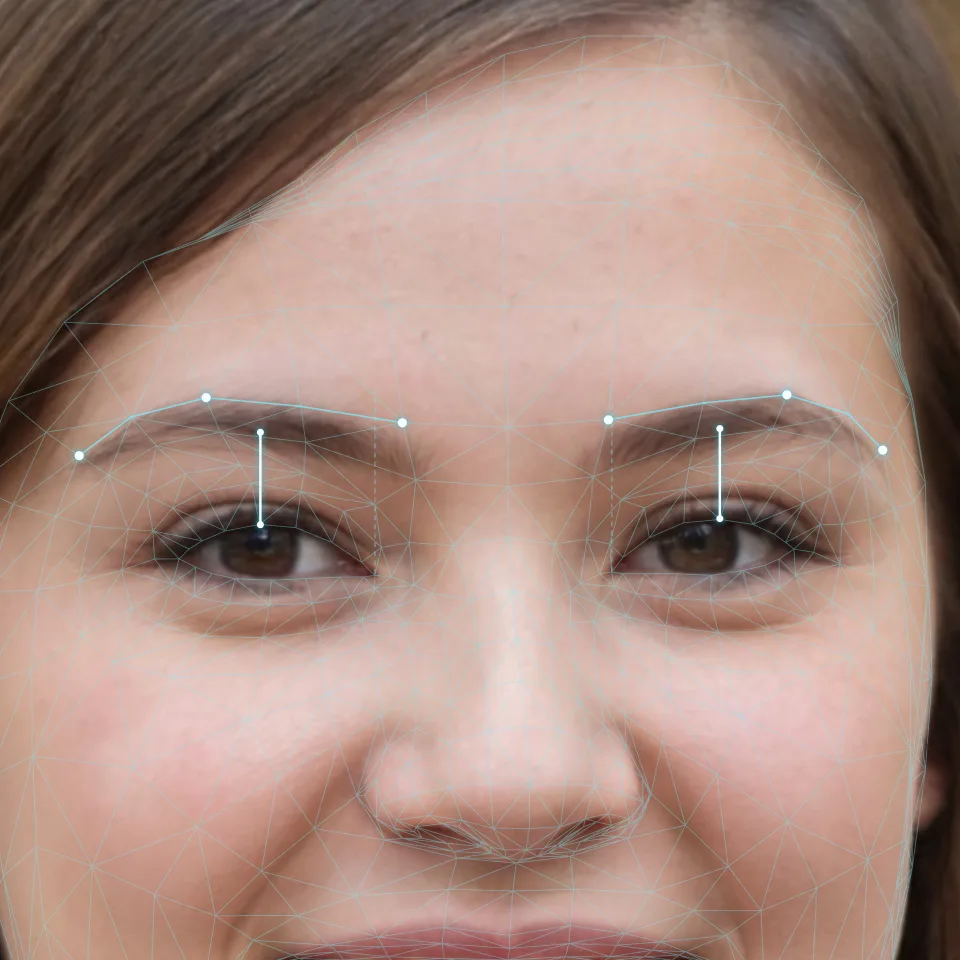
- Head. A classic reference puts it above the inner eye corner; most tutorials use a vertical line from the nostril wing.
- Arch. Somewhere near a vertical line through the iris. Sources differ: above the outer edge of the iris, on a line from the nostril wing past the pupil’s outer edge, or anywhere up to above the outer eye corner. Treat it as a range. An arch too far in reads tense; too far out, droopy.
- Tail. On the line from the nostril wing past the outer eye corner, no lower than the head.
A pencil does it: hold it at the nostril wing, angle it through the iris, then past the outer corner, dotting each point.
Uneven brows: match the heads first
Makeup artists’ reasoning: the arch moves with expression, so small differences hide; the head is where the eye lands first. Match three things at the heads: height, distance from the midline, and angle.
On the sample photo:
- Photo-right brow head at 585, inner eye corner at 587: nearly aligned.
- Photo-left brow head at 460, inner eye corner at 443: it starts 17 px further in, closer to the midline.
- Arch heights 407 and 405: practically equal.
The sides differ at the head, not the arch. Don’t pluck the head to even it up; that widens the gap between the brows. More in uneven left and right face.
Brow shapes for seven face shapes
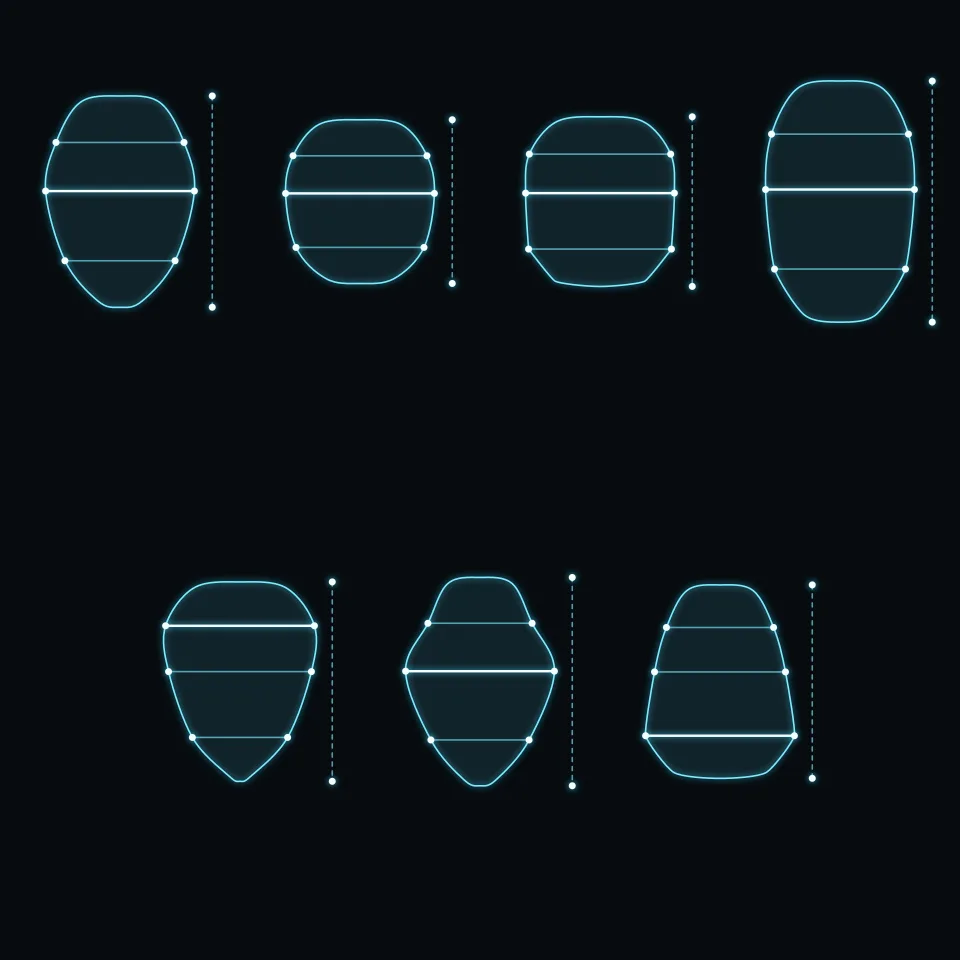
Not sure of your shape? Start with what is my face shape, or get a free face report from one front-facing photo.
| Face shape | Brow | Why |
|---|---|---|
| Oval | Almost any; a slight angle if unsure | Balanced proportions |
| Round | Soft or high arch, not fully rounded | The peak adds an upward line |
| Square | Soft rounded arch, or low and flat | A curve contrasts with the jaw corner |
| Oblong | Flat, gentle peak | A horizontal line breaks up the length |
| Heart | Higher arch, or a soft low one | Echoes cheekbones, or balances the forehead |
| Diamond | Soft curve, or straight with no peak | Softens the cheekbone points |
| Pear | Low and curved, tail not tapered thin | Adds weight to the narrower forehead |
Square, heart and diamond each have two views. The low, flat brow for square faces comes from a study summary; the study itself never separated square faces.
Before you draw: thickness, length, grooming
- Thickness. One makeup artist makes it half to two thirds of the eye height: on the sample, 35 px eyes give 18 to 23 px. Thickness matters less than the arch and tail.
- Length. Smaller eyes take a shorter tail, larger eyes a longer one.
- Grooming. Brush the hairs up, then remove only what falls outside the drawn outline, with tweezers rather than a razor.
For how high the brow sits, see brow-to-eye distance. For blush and shading by face shape, see contour for face shape.
FAQ
Do I have to choose by face shape?
No. It is one reference, and one face can take an echo or a contrast. Eye size and how your brows grow matter as much.
Round face, naturally flat brows. Do I need a high arch?
No. A guide to eyebrow shape for a round face suggests lifting the tail slightly and keeping the line clean; it reads as a soft arch without removing many hairs.
How long should the tail be?
Usually to the line from the nostril wing past the outer eye corner. One makeup artist uses a shorter line for smaller eyes: mouth corner to 5 mm past the outer corner. Keep the tail no lower than the head.