Contents
V-shaped face: what shape is it?Two ratios decide which shape it isHow the three shapes compareTwo things that trip people up on photosWhat it means for hairFAQKey points
- "V-shaped" is an everyday label for a tapering jaw and pointed chin, not a textbook shape.
- A wide forehead leans heart; widest cheekbones with a narrow forehead leans diamond; a gentle taper and a softer chin leans oval.
- Two ratios sort it: forehead ÷ cheekbones and jaw ÷ cheekbones. The three shapes differ by only a few hundredths on each.
- A widow's peak or the shape of the hairline doesn't decide the category. Forehead width does.
V-shaped face: what shape is it?
It isn’t on the textbook list. The usual list has seven shapes: oval, round, square, oblong, heart, diamond and pear. “V-shaped” is an everyday phrase for a face that narrows to a small, pointed chin.
The catch is that textbook shapes are sorted mainly by which of three widths is largest: forehead, cheekbones or jaw. “V-shaped” tells you the jaw is narrow and the chin pointed. It says nothing about whether the forehead or the cheekbones are wider.
The twist: one face-shape guide states that chin shape by itself doesn’t decide the category. The feature the everyday name picks out is the one textbook sorting ignores.
Two ratios decide which shape it is
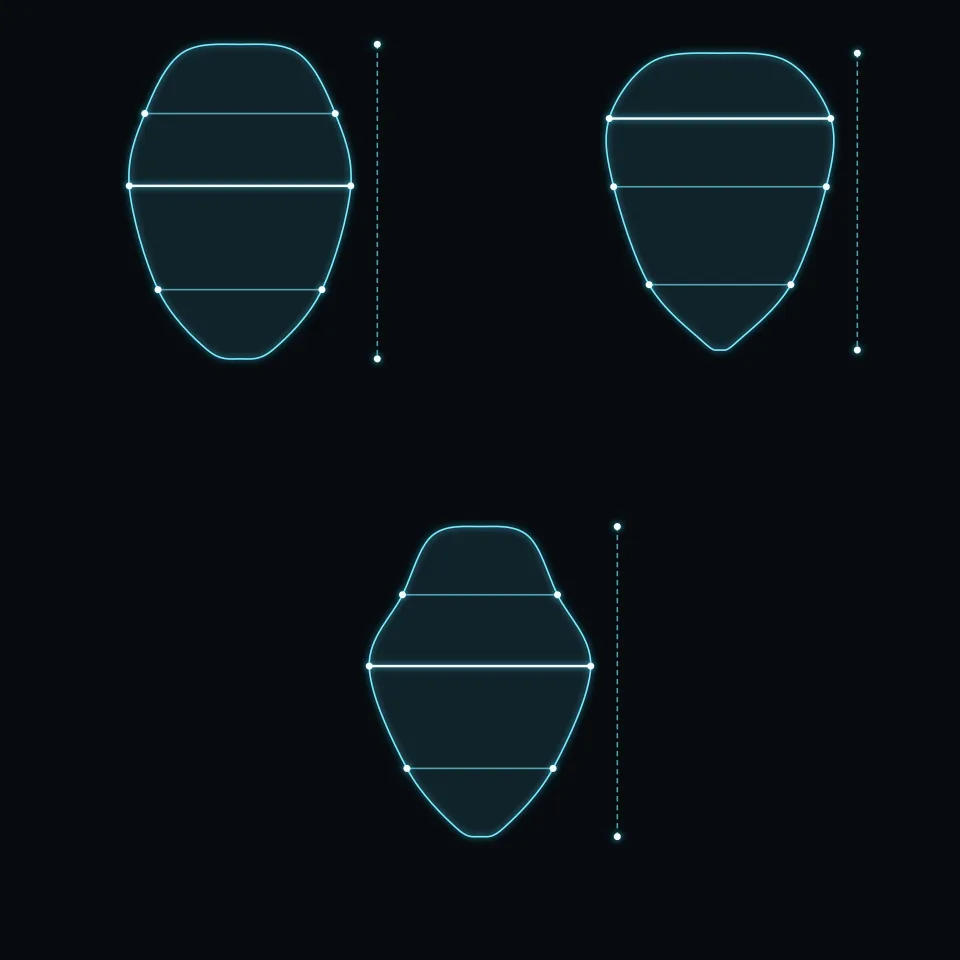
To translate a V-shaped face into a textbook shape, two ratios are enough:
- Forehead ÷ cheekbones: which is wider.
- Jaw ÷ cheekbones: how much narrower the jaw is, so how sharply the face tapers.
One guide gives rough figures. Forehead ÷ cheekbones: diamond about 0.84, oval about 0.88, heart about 0.92. Jaw ÷ cheekbones, converted from its cheekbones ÷ jaw figures: heart about 0.73, diamond about 0.76, oval about 0.79.
These sit a few hundredths apart, so plenty of faces land between two. Your two ratios tell you more than any label.
How the three shapes compare
| Widest | Forehead | Taper | Chin | |
|---|---|---|---|---|
| V-shaped (everyday) | not specified | not specified | narrows down | small, pointed |
| Oval | cheekbones | a little narrower | even, gentle | rounded, not sharp |
| Heart | forehead, or forehead and cheekbones about equal | wide | sharpest | small, pointed |
| Diamond | cheekbones, clearly | clearly narrow | fairly sharp | pointed |
The everyday name fills only the last two columns; the first two decide which row it belongs to. Pointed chin with a wide forehead leans heart. Pointed chin with a narrow forehead, all the width at the cheekbones, leans diamond. A gentle taper with a softer chin leans oval.
Two things that trip people up on photos
Hair over the forehead. Bangs and side hair cover the edges of the forehead, so it measures narrower than it is and a heart face can pass for diamond. Pull all the hair back first.
The widow’s peak. A downward point at the centre of the hairline is common on heart faces, but it’s not a requirement, and hairline shape doesn’t decide the category. What matters is how wide the forehead is at the sides.
Face length is a separate question: it splits oval from oblong, not these three. For how to take the photo and what to measure, see what is my face shape, or get a free face report from one front-facing photo.
What it means for hair
All three taper, but the hair ideas land in different places:
- Leaning heart: add some volume at or below the jaw and use parted bangs over the forehead corners; go easy on lots of height on top. See hairstyles for heart-shaped faces.
- Leaning oval: most cuts work; the thing to watch is creating an imbalance, such as long, flat hair with a centre parting. See hairstyles for oval faces.
- Leaning diamond: side-swept bangs draw the eye away from the cheekbones, and a little volume near the forehead and chin fills in. See hairstyles for diamond faces.
Treat these as stylists’ habits rather than tested findings, and check them against your own photos.
FAQ
Is a V-shaped face the same as a heart-shaped face?
Not exactly. Heart faces, wide at the forehead and pointed at the chin, are often called V-shaped. So are diamond faces and ovals that taper gently.
My chin is pointed but my cheeks are full. Is it still V-shaped?
The label has no hard rule. Fat in the cheeks and jaw changes the widths you see, so one face can read differently after a weight change.
Do other languages have a word for this?
Yes. Chinese says melon-seed face, Japanese often says inverted triangle, and Korean says V-line. Each describes the same tapering lower face.
Is a V-shaped face the same as a long face?
No. V-shaped is about how the width narrows; long is about length against width. A face can be both.