Contents
How to glow up: find what stands out, then pick one or two things to changeStep 1: test your face first, don’t guessBefore you test: fix the photo setupStep 2: read the data, find what stands out, amplify it and don’t cover itStep 3: look at what has “room to grow”, change what can change, don’t fight boneA month’s order: change one thing, then test againWhat FacialRate does in these three stepsFAQKey points
- Skip the twenty-item checklist: test your own face, amplify the one or two features that stand out, then pick one or two changes from what has room to grow. This is a way of working, not a research finding.
- A report describes one photo: different photos of the same person can leave impressions as different as two different people do, so use the same setup before and after.
- Within a month you can move skin condition, sleep, hair and bangs, brows, glasses and photo conditions; bone structure and face shape stay put, and there is no need to fight them.
- Change one thing at a time and test again with the same setup, so you know which change did the work.
How to glow up: find what stands out, then pick one or two things to change
Most articles on how to look prettier are a checklist: skincare, hair, outfit, sleep, smiling, twenty items to start. A checklist assumes every item is worth the same effort. A face is not like that.
Think of a face as a row of dials. A few are already turned up high: the eyes, the jawline, the state of the skin. A few are relatively flat. The same hour spent on a different dial pays back very differently. Glow up, look prettier, become more beautiful, improve your appearance, enhance your beauty: the words differ, the job is the same. Put the limited effort where it pays back most.
The trouble is that you can’t see where the dials are by looking at yourself. So the order is three steps:
- Test your face first. Get the data, then talk about what to change.
- Read the data, find the one or two features that stand out, and amplify them. Don’t cover them up.
- Then pick one or two things from what has room to grow, and change one at a time.
To be straight about it: “amplify what stands out first” is a way of working, not a finding from any study. Each thing you can change below has its own evidence; the order is reasoning.
“Room to grow” only says that on your face this feature doesn’t catch the eye as much as the others. It isn’t a mark against your face.
Step 1: test your face first, don’t guess
You can’t see yourself well. The mirror shows you flipped, and you’re used to the flipped version, while everyone else sees the other one; see why you look different in photos than in the mirror. Reading twenty tips won’t tell you which few to do first either.
So step one isn’t changing anything, it’s one test. With FacialRate: pick a front-facing photo and in seconds get a face report with your face type, your strongest feature and a few highlights, which of the 11+ dimensions are already good and which have room to grow, and one tip to try first. It runs on your device, your photo is never uploaded, and it’s free with no limit.
Before you test: fix the photo setup
A report describes this one photo. A 2014 study compared several photos of the same person and found that the impressions they left can differ as much as impressions of two different people. In an earlier study, from 2011, 20 people each had 20 photos found online, and for any two of them you could pick photos that reversed which one was rated more attractive.
So when choosing a photo, fix these four things:
- Light: daytime, facing a window, every lamp in the room off; see selfie lighting.
- Camera: phone propped at eye height 1.5–2 m away (rear camera, timer), looking into the lens; see the front-facing photo guide.
- Expression: relaxed, mouth closed.
- Obstructions: beauty filter off, hair tucked behind the ears. Filters change shapes, so what gets measured isn’t your face; see what beauty filters change.
When you test again later, use the same setup.
Step 2: read the data, find what stands out, amplify it and don’t cover it
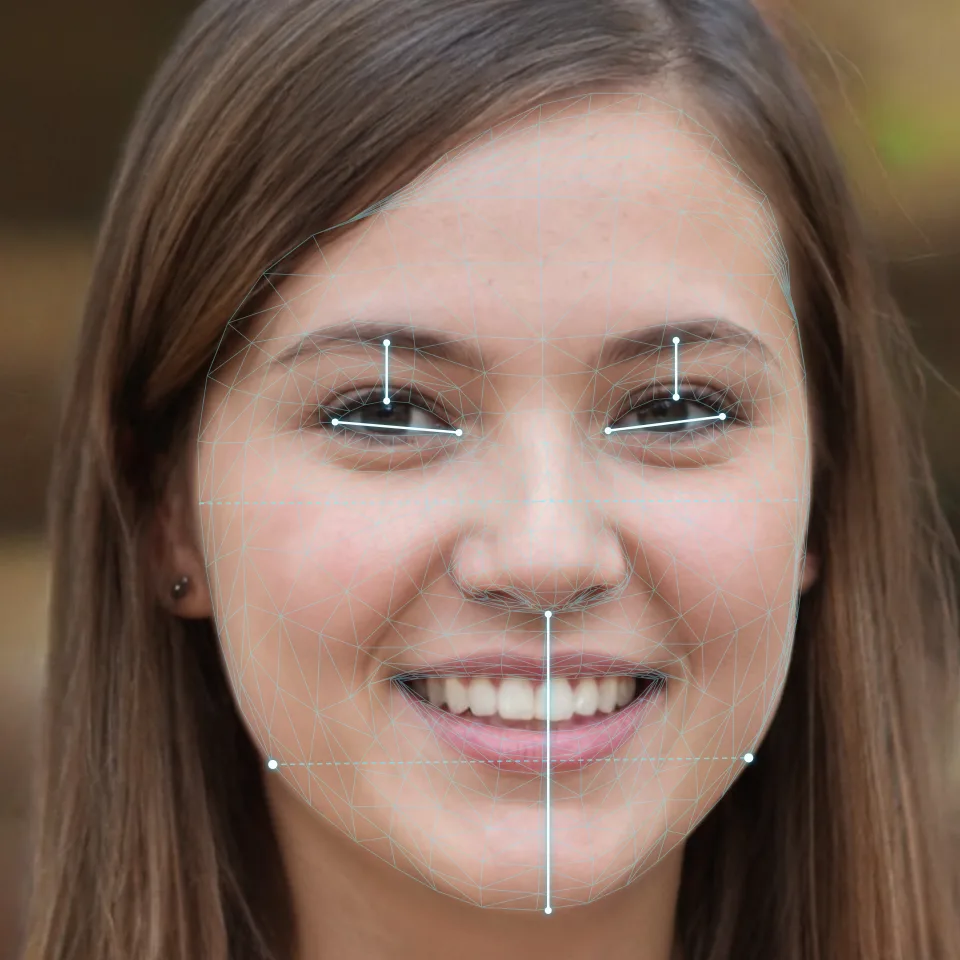
In the report, look at two things first: your strongest feature, and your highlights. Those are where you start amplifying.
To double-check, there are two more ways:
- Ask people near you what they remember about your face on first sight. The answer is often the standout feature.
- Do as the strong vs soft features guide does and split the face into six places: brow-to-eye gap, eye shape, eye tilt, jaw corner, lower-face taper and lower third. Read each on the photo; the figure above is drawn on the sample photo.
Once you’ve found it, the principle is one line: styling should draw the eye toward what stands out, not pile something on top of it. A few common moves; they’re moves, not laws:
- Standout eyes: don’t let bangs press on the brows and eyes, and don’t let the top of a frame cover the brows; see eyebrow shape for your face and eye makeup for your eye shape.
- A sharp jaw and outline: to amplify it, don’t let hair cover the whole jaw; see jawline hairstyles and makeup.
- Clear, even skin: keep base makeup light and let the skin speak. In one study, the more even the colour across the cheeks, the better the faces were rated; see even skin tone.
- Good light and depth: when you photograph, bring the light from the front and to the side; see lighting and facial depth.
Step 3: look at what has “room to grow”, change what can change, don’t fight bone
Each feature in the report is marked “Good” or “Room to grow”, and there’s one tip to try first. The tips cover only photography, hair, makeup, skincare and daily habits. Before picking from what has room to grow, sort it into three kinds, then decide whether to touch it.
What you can move within a month: skin condition, sleep, hair and bangs, brow shape, glasses, photo conditions.
The basics of skin are three things: cleanse, moisturise, protect from UV; see the basic skincare routine. Sleep counts too. In a 2010 experiment in the BMJ, 23 adults were photographed after a normal night and again after being awake for 31 hours, and 65 raters looked at the photos. After the sleepless stretch, faces were rated as more tired, less healthy and less attractive, with “more tired” changing most. The effects were small and the photos were shown for only six seconds; what it shows is that people can see a face that hasn’t slept.
What light and styling can build: depth. See highlight and contour basics and contouring for your face shape.
What won’t change: bone structure, where features sit, face shape. This article doesn’t cover them, and there’s no need to fight them: every face shape has hairstyles and glasses that work with it; see hairstyles for your face shape and glasses for your face shape.
A month’s order: change one thing, then test again
The before-and-after pictures of a “glow up” on social media often change more than the person: light, angle, expression and filters all change the impression a photo leaves.
To see for yourself whether you changed, use the dullest method:
- Day 1: shoot three photos with the fixed setup, test each, and keep the first report as your baseline.
- Weeks 1 to 2: change one thing, picked from what has room to grow: say sunscreen plus moisturiser, or a new fringe.
- Weeks 3 to 4: add a second.
- Every two weeks: shoot three more with the same light, camera and expression, test again, and compare with the baseline.
The gap between the three photos is the noise this setup carries. A change smaller than that tells you nothing; one bigger than that is worth noting, along with which change did it.
Why one at a time? Change three things at once and when it gets better you don’t know which to keep. Control the variables, same as in an experiment.
One more thing: don’t take a retouched photo as your target. In a 2006 study, people who first looked at a set of highly rated faces then rated themselves lower.
What FacialRate does in these three steps
- Step 1 gives the readings of your face: face type and 11+ dimensions.
- Step 2 tells you your strongest feature and a few highlights, the place to start amplifying.
- Step 3 marks the features with room to grow and gives one tip to try first, which falls right in the “can change” kinds above.
From your first report on, every step has something to compare against. It tells you your strongest feature first, so you start from your strengths, and gives you one tip to try now, so you know where to begin. After a change, test again with the same light, camera and expression, and compare the two reports to see what that step did. A report describes that one photo, so with the same setup the before and after are comparable. That way, looking better stops being a feeling and becomes something you can watch happen, step by step.
FAQ
What is the fastest way to look prettier?
Usually the things that need no waiting: light and angle in photos, hair and bangs, expression. Skin condition takes weeks, and bone structure does not change. So test once, then start with the quick change that also has room to grow, one at a time.
Can I glow up in a month?
In a month you can move skin condition, the look that sleep gives you, hair, brow shape and photo conditions. You will not turn one face into another. Online before-and-after pictures may also change more than the person: light, angle, expression and filters all change the impression a photo leaves.
Does this work for guys too?
Yes, with the same steps: test first, find what stands out, then pick what can change. The levers become hair, beard, skin and glasses; for beards, see the guide on beard styles for face shape.
Can AI tell me how to improve my appearance and enhance my beauty?
Not with one answer for everyone. FacialRate reads your one photo: which features stand out in it, which have room to grow, and one tip to try first. Change the light or angle and the reading changes too.