Contents
Why do I look different in photos than in the mirror?Difference one: the mirror swaps your asymmetriesDifference two: the mirror is further away than it looksDifference three: a photo freezes a moving faceFront cameras: two selfies may be flipped differentlyFAQKey points
- A mirror flips left and right, so every small asymmetry swaps sides, and the flipped face is the one you know best.
- In a mirror you see yourself from twice your distance to the glass; an arm's-length selfie is shot from about 30 cm.
- One study found that a video of someone talking is rated more favourably than any still frame taken from it.
- Front-camera previews are mirrored; whether the saved photo is depends on the phone and its settings.
Why do I look different in photos than in the mirror?
Three separate things differ:
- Direction. A mirror flips left and right. A photo doesn’t (front cameras are a special case, below).
- Distance. The face in the mirror is further away than you think; a selfie is very close.
- Movement. In the mirror you are always moving. A photo stops at one frame.
So which one is real? Neither. People see you unflipped, from a conversation’s distance, talking and blinking. The mirror gets one of those right, the photo another, and nothing you use daily gets all three.
Difference one: the mirror swaps your asymmetries
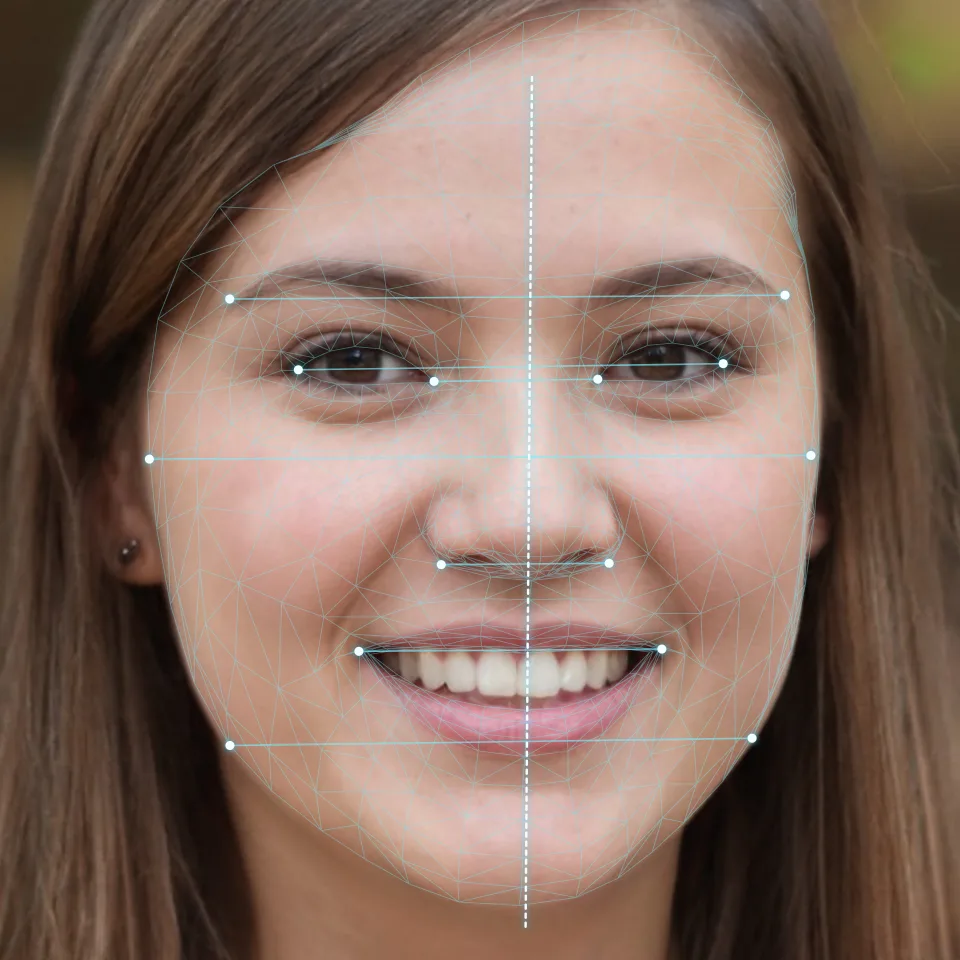
The diagram shows the sample photo’s midline and seven pairs of matching points. The two sides are not equal: from the midline to the cheek edge is 334 px on the photo’s left and 248 px on its right. Part of that comes from a slight head turn. Either way, flip the photo and the 86 px gap does not vanish. It moves to the other side.
Every face has differences like this, and a mirror swaps them all. You see the flipped version daily, so the photo feels off. Only a true mirror, a non-reversing one, shows you unflipped.
The 1977 experiment with normal and reversed prints is covered in facial symmetry. Behind it is the mere-exposure effect. In a classic 1968 study, photos of faces were rated more positively the more often people had seen them. A 2017 re-analysis of 81 articles found liking rises with repetition at first, then falls again after very many.
Difference two: the mirror is further away than it looks
Your reflection appears as far behind the glass as you stand in front of it. Stand 50 cm from a mirror and you are looking at yourself from 1 m.
An arm’s-length selfie is different. The phone is about 30 cm away, with your nose tip closest. Nearer parts come out bigger, so the nose and centre of the face grow while the ears and sides shrink. A 2018 modelling study estimated that at about 30 cm the base of the nose comes out roughly 30% wider than at 1.5 m.
Both are face-on, from very different distances, so the proportions disagree. For how far to step back, see selfie distortion.
Difference three: a photo freezes a moving face
At the mirror you blink, adjust your expression, turn your head. Others see you talk and laugh. A photo keeps one frame, perhaps with half-closed eyes or a word half spoken.
A 2012 study called this the frozen face effect. Viewers rated videos of people talking more favourably than still frames taken from the same videos. Across six experiments, the effect needed continuous, natural motion and was not a memory effect.
So a photo that doesn’t look like you may just be the frame. Take several; pick a relaxed one.
Front cameras: two selfies may be flipped differently
The front camera mixes the mirror and the photo:
- The preview is mirrored, like a bathroom mirror, to make framing easy.
- The saved file depends on the phone and settings. iPhones save the unflipped photo by default. Since iOS 14, a Mirror Front Camera setting saves it to match the preview instead. Other phones and apps vary.
- Video calls usually show your own window mirrored while sending the unflipped image to everyone else.
So two selfies in your gallery may be flipped differently. Check before comparing.
For something close to what others see, use the rear camera, step back to 1.5–2 m, set a timer and take several. The steps are in the front-facing photo guide. A face report built from one unflipped photo like that is another way to look at your face without the mirror’s flip.
FAQ
Do other people see me the way photos do?
Closer to an unflipped photo from the rear camera at 1.5–2 m, plus movement and expression. Neither the mirror nor an arm's-length selfie matches it.
Why do I prefer my mirror image?
Because you see it more. Mere-exposure research keeps finding that familiar things are liked more, and you see your reflection far more often than photos of yourself.
How do I make selfies match the mirror?
Turn on the mirror front camera setting (names vary by brand). The saved photo then matches the preview, but it is the flipped view, not the one others see.