Contents
Eye makeup for your eye shape: what does it actually move?Read the three on the sample photoLength: where the tail and the deepest shade stopOpenness and gap: what shows with your eyes openLiner and shadow by eyelid and eye shapeDraw with your eyes open, check each eye aloneFAQKey points
- Length: the liner tail's length and angle, and where the deepest shade stops.
- Openness: how much lid colour shows with the eyes open. On some lids, about 2 mm.
- Gap: light inside, dark outside reads wider; the reverse reads closer.
- Work with your eyes open, looking straight ahead, and check each eye alone.
Eye makeup for your eye shape: what does it actually move?
Not the eye. Three readings:
- Length: the tail’s length and angle, and where the deepest shade stops.
- Openness: how much lid colour shows with the eye open, and where the lashes point.
- Gap: whether the dark weight sits inside or outside.
Every eye-shape tip is one or two of these. Nearly all of it is artists’ habit, not controlled tests; disagreements are flagged.
Read the three on the sample photo
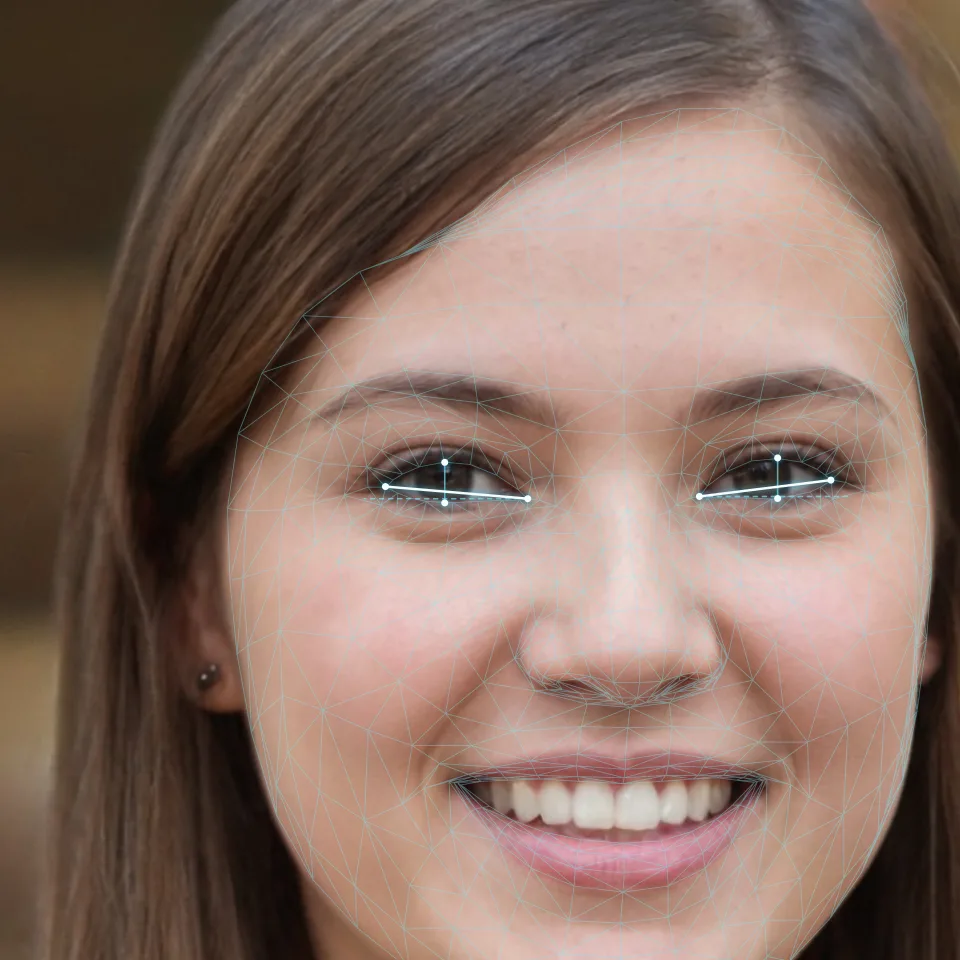
Photo setup: facial thirds guide. Just the eyes here:
- Tilt: the corner lines rise 4.9° and 7.1° against level. The head tilts only 0.4°, so both outer corners really sit higher.
- Openness: height over length is 35 ÷ 120 ≈ 0.29 and 34 ÷ 111 ≈ 0.31. She is smiling, which lifts the lower lids and narrows the eyes.
- Gap: 144, about 1.25 eye lengths, an ordinary value (see eye spacing).
These tails already point up, so a tail that just follows them is enough.
Length: where the tail and the deepest shade stop
A liner tail extends the eye’s outer edge. Longer and more level reads longer; flicked up, the edge reads higher.
- One Japanese magazine gives numbers: 3–4 mm past the corner for monolids, 2–3 mm for hooded lids.
- Upturned and downturned eyes: artists keep the tail short. On a downturned eye a long tail follows the slope.
Shadow works the same way: where the deepest colour stops is where the eye’s edge reads.
Openness and gap: what shows with your eyes open
Openness is the lid still visible with the eye open. Monolids and hooded lids hide a lot.
- One artist keeps monolid colour to the strip that shows when open, about 2 mm; the rest goes to the outer corner and lower lid.
- On hooded eyes, keep dark shades off the fold of skin under the brow, or it reads as sunken.
- Monolid shadow can run vertically: lightest over the lid, darkest at the lashes.
- Lashes are disputed: one Japanese magazine curls monolid lashes hard; another wants a natural curve.
Gap: light inside, dark outside reads wider; the reverse, closer. A long tail spreads wide-set eyes further.
Liner and shadow by eyelid and eye shape
Lid type and eye shape are separate, so one eye can fit two rows; the eye shape guide sorts them.
| Type | Liner: start, tail, thickness | Deepest shade | Artists go easy on |
|---|---|---|---|
| Monolid | Tight to lashes, thick, long; or thicker middle, shorter tail | Lash line, fading up; bold colour on outer corner, lower lid | Wide liner the lid hides; shimmer gradients |
| Hooded | Thin to thick; tail above the open-eye crease | Mobile lid, edge visible when open | Dark shade on the hood |
| Double | Narrow fold: tightline inner half, line outer half | Narrow: outer iris to corner; wide: half the fold | Hard-edged gradients; over-curled lashes |
| Round | Crisp, slightly lifted outer tail | Outer half, blended up and out | One colour all round; full lower liner |
| Almond | Thin for two-thirds, then thicker; medium tail | Outer crease, outer thirds | — |
| Upturned | Follows the lower lash line | Both lash lines, deeper outside | Long tails |
| Downturned | Start high at mid-eye, about 45° to the temple; short | Mid-lid out, pulled up where the eye slopes | Dark outer lash line |
On almond eyes, an English tutorial gives a medium tail; a Taiwanese one says not to extend far. They define almond differently.
Draw with your eyes open, check each eye alone
Several artists’ best tip ignores eye shape: work with your eyes open, looking straight into the mirror. A line drawn with the eye closed can vanish under the lid or kink. Hence the hooded-eye bat wing: a fill from tail to crease looks notched when closed, one line when open.
Second, check each eye alone. The sample’s tilts differ by 2.2°, and one Japanese magazine does uneven lids separately. Check that both tails end level, eyes open; see uneven faces.
Brows join in: on downturned eyes, shadow carried toward the brow shortens the brow gap. To judge your tilt, see upturned or downturned eyes, or look at the eye measures in a face report built from a front-facing photo.
FAQ
Do monolids need eyeliner?
Not always. One artist fills the lash roots if they show from the front; if the lid hides them, skip it and colour the outer corner and lower lid.
Why does my shadow vanish on hooded eyes?
Skin under the brow covers most of the lid. Eyes open, put colour where the lid still shows, or just above the crease.