Contents
Strong vs soft facial features: what do the words mean?Taken apart: what a photo can showReading the sample photo: numbers need a referenceA second ruler: curved or straight linesWhere sources split, and what to read nextFAQKey points
- Strong and soft are stylists' words, not a measurement. No study defines them.
- They describe features, not makeup. Size relative to the face, depth around the eyes, space between features, brow and hair contrast.
- A front photo cannot show depth, but it shows how close the brow sits over the eye. The sample, about 1.6 eye heights.
- One number alone says nothing; it reads compact or long only next to other faces. Most faces mix.
Strong vs soft facial features: what do the words mean?
“Strong” and “soft” features are stylists’ and everyday vocabulary, with no drawing rule behind them. No study defines them, and each article that explains them does so a little differently.
The rough agreement: strong features have presence and catch the eye from a distance. With soft features, people remember the whole face rather than one part.
Two things first:
- Strong is not heavy makeup. Lipstick and lashes change the makeup, not the features.
- Strong is not better, and soft is not plain. Both words describe; neither is “more” anything.
Few faces match one side on every feature. Most mix and lean one way.
Taken apart: what a photo can show
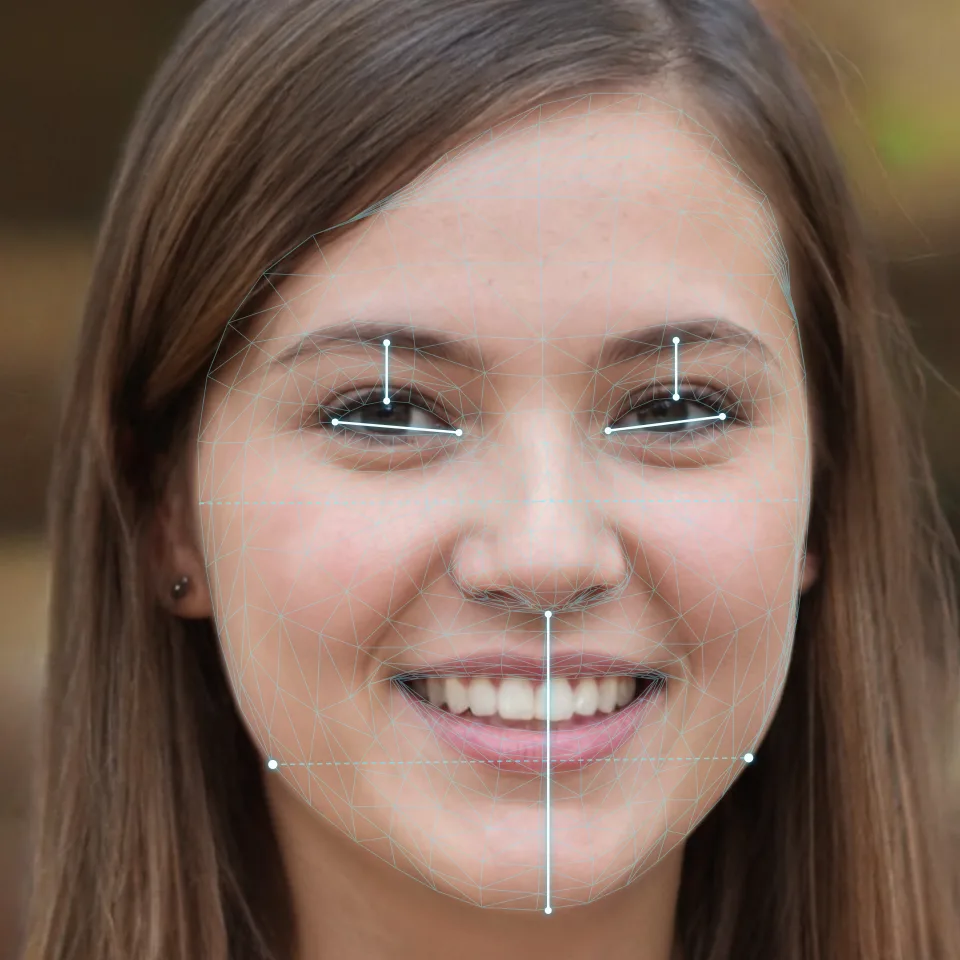
The features sources keep returning to:
| Feature | Reads stronger when | Reads softer when | Where to look |
|---|---|---|---|
| Feature size | Large relative to the face | Small relative to the face | Against face width and length |
| Depth around the eyes | Shadow in the sockets, beside the bridge | Flat, little shadow | Indirectly: how close the brow sits |
| Space between features | Gathered toward the centre | Spread out | Brow to eye, nose to chin |
| Brow and hair contrast | Dense, dark | Light | Unreliable: light and makeup change it |
One cell is our reasoning, not the sources’. They talk about depth, but a front photo is flat. What it can show is how close the brow sits over the eye, the bold gap in the diagram (measured in the brow-to-eye distance guide).
Sources count eye size as strong; height ÷ length on a photo measures shape. Nose height, lip fullness and brow density don’t show in front-photo ratios at all.
Reading the sample photo: numbers need a reference
The sample is front-facing and smiling:
- Brow to eye: brow’s lower edge to upper lid 56 and 55 px, about 1.6 eye heights, 0.47 and 0.50 of eye length.
- Eye shape and tilt: height ÷ length 0.29 and 0.31; tilt +4.9° and +7.1°, outer corners higher. The smile narrows the eyes.
- Jaw: angle about 135°; jaw width ÷ cheekbone width 0.79.
- Lower third: middle third 284 ÷ lower third 286 = 0.99.
Do these make her strong or soft? No. Whether 1.6 eye heights is close only shows next to other faces. Photograph a few friends at the same distance and light, line them up, and “compact” starts to mean something.
A second ruler: curved or straight lines
Japanese stylists sort faces on two axes. Neither is strong–soft.
- Proportion axis: face and chin length, features sitting high or low, eye spacing, nose height, flat or three-dimensional, mouth size.
- Line axis: bone showing at the jaw and cheekbones or not, cheek fullness, long or round eyes, lifted or drooping tails, straight or arched brows, straight bridge or rounded nostrils, thin or full lips.
Straight is not strong. One checklist puts dense brows at the straight end and full lips at the curved end; the large round eyes Chinese articles call strong are curved. Strong features turn up on both sides. Sources even disagree on which end wide-set eyes belong to.
Where sources split, and what to read next
On makeup, one source says both suit light makeup; one says strong can go heavy or light while soft is safer light; a third gives each side two routes, staying put or leaning the other way. All are habits, not tests.
Next in this series:
- How to tell strong or soft features: a step-by-step check on one photo.
- Makeup for strong or soft features: makeup and hair that follow the features, or go the other way.
Single features: brow-to-eye distance, eye shape, upturned or downturned eyes, jawline types and a long lower third.
To see which face type your features add up to, a face report from a relaxed front-facing photo shows the closest one and the features behind it.
FAQ
Does heavy makeup make features strong?
No. Red lipstick and dark shadow change the makeup. The size, placement and depth of the features stay the same.
Can a high-contrast black-and-white photo tell me which I am?
One Chinese article rejects that test. The result follows lighting, makeup and the viewer's taste, so a different lamp can flip it.
I seem to be a bit of both. Is that normal?
Yes. Few faces match every feature on one side. One source says faces in the middle have the widest makeup range.