Contents
Hairstyles for heart-shaped faces: put the volume near the chinWide on top, narrow below: by how much?Why move the volume down?Cuts to try first on a heart-shaped faceCan very short hair still add weight below?Heart-shaped face: cuts to use sparinglyFAQKey points
- A heart face is wide on top and narrow below: one guide puts the forehead at about 0.92 of the cheekbone width and the jaw at roughly 73%.
- Keep the volume low, between chin and collarbone, with weight left in the ends.
- Curtain bangs or a long side-swept fringe soften the forehead corners and any widow's peak.
- Go easy on crown height, scraped-back styles, and very short cuts that show the whole forehead with nothing at the jaw.
Hairstyles for heart-shaped faces: put the volume near the chin
Pick cuts whose fullness lands between the jaw and the collarbone, with a fringe that parts or sweeps aside. Skip cuts that pile volume on top.
A heart face is widest at the forehead and temples, with high cheekbones and a slim, often pointed chin, sometimes a widow’s peak too. Hair can’t change that shape, only the silhouette: wherever hair ends, that level reads a little wider. So, less on top and more below.
Wide on top, narrow below: by how much?
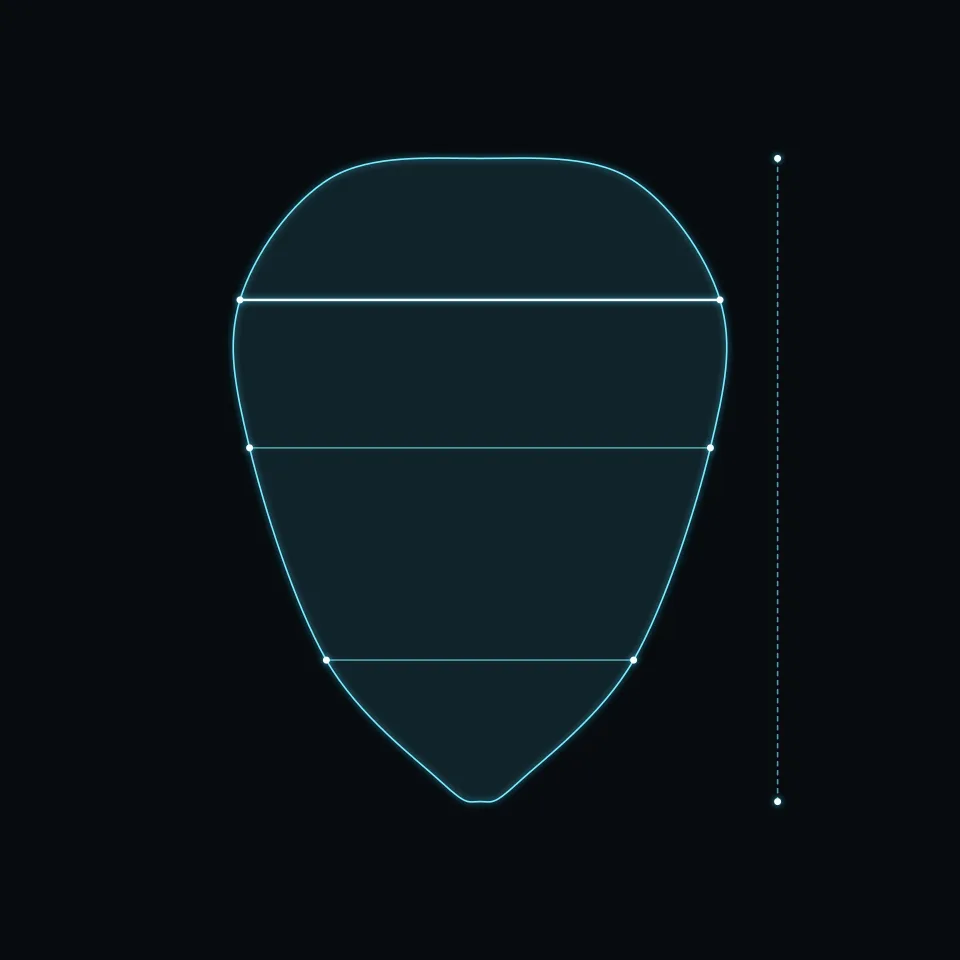
One widely read guide gives forehead ÷ cheekbones of about 0.92 for a heart face, and cheekbones ÷ jaw of about 1.37. Its oval figures are 0.88 and 1.26. The heart forehead is nearly as wide as the cheekbones, while the jaw is only about 73% of them: a steeper drop than on an oval.
Oddly, that guide calls the forehead the widest point yet gives a ratio below 1; where you place the forehead points changes the result. Watch the top-to-bottom gap, not the label. If you want your own numbers, follow the photo-measuring steps, or try a face report built from one front-facing photo.
Why move the volume down?
- Fill the narrowest part. Hair at jaw level widens the bottom of the outline.
- Leave the widest part alone. Crown lift or teased roots pile on breadth up top, the last place a heart face needs it.
- Mind the lines. Short blunt bangs lay a bar across a wide forehead, so the chin below looks narrower. Long, wispy ends point at the chin like an arrow.
All three come from salon practice; nobody has run controlled trials on them. Check them on your own face, for instance with the method laid out in the round-face guide.
Cuts to try first on a heart-shaped face
| Cut | Volume lands at | Detail |
|---|---|---|
| Chin-length bob | Jaw | Ends flicked out, not under |
| Collarbone lob | Jaw to collarbone | Layers start below the cheekbones |
| Long layers | Jaw and collarbone | Waves or an outward blow-dry keep the ends heavy |
| Shoulder-length shag | Jaw and below | Choppy layers sit low, light fringe on top |
| Curtain bangs | Forehead corners | Parted centre or side |
| Long side-swept fringe | Forehead | With a deep side part |
Can very short hair still add weight below?
Yes, if the top stays flat and the hair below the ears isn’t shaved off.
- A forward-brushed textured crop (French crop) softens the upper face with no extra height.
- Medium length with fullness around the ears and jaw pads out a narrow chin.
- A side part with modest lift cuts across the forehead.
With a beard, stubble or a short full beard squares off the narrow chin.
Heart-shaped face: cuts to use sparingly
- Crown height: a tall pompadour, a spiky pixie, teased roots.
- Everything pulled back: slick styles and tight high buns bare the forehead, temples and widow’s peak.
- Very short with a bare forehead and nothing at the jaw.
- Face-framing pieces that begin at cheekbone height or higher.
Some guides still list a classic pixie; whether the top is pushed up usually decides it. Straight, wavy, curly or fine? That’s handled in the series overview. For frames, try a rounded lower edge a touch wider than the forehead; the frames guide has the rest.
FAQ
How is a heart face different from a round one?
Check the two ends. A heart face has a wider forehead, a pointier chin and a jaw clearly narrower than the cheekbones; a round face has a jaw near cheekbone width and a curved chin.
What do I do with a widow's peak?
Curtain bangs or a long side-swept fringe cover the point in the middle of the hairline. Scraped-back styles and tight buns show it fully, which is fine if you like it.
Can I wear straight-across bangs with a heart face?
Guides disagree: one suggests a neat fringe just below the brows, another says skip short, blunt bangs. If unsure, a soft-edged fringe that parts or sweeps aside is safer.