Contents
Head angle in photos: which numbers does it change?Chin up and chin down move the thirdsA tilt slants both level linesA turn widens the near halfHow to check you’re levelFAQKey points
- Chin down: the upper third grows and the lower third shrinks. Chin up: the reverse.
- A tilt slants the eye line and mouth line together.
- A turn widens the near half, and every left-right pair leans the same way.
- No study measures how much each degree changes the ratios. Keep the head level for measuring.
Head angle in photos: which numbers does it change?
A head rotates three ways, and each moves its own set of numbers:
- Nod (chin up or down): the thirds, the heights of the three bands.
- Tilt (toward a shoulder): the level lines and the midline, the height gap within each left-right pair.
- Turn (left or right): symmetry, the distance of each pair from the midline.
On evidence: no study measures how much each degree changes a ratio. What follows is geometry plus photographers’ and clinicians’ experience. One point is documented: a clinical photography review cites a 2004 paper showing that a slightly raised or forward head changes how the jawline looks.
Chin up and chin down move the thirds
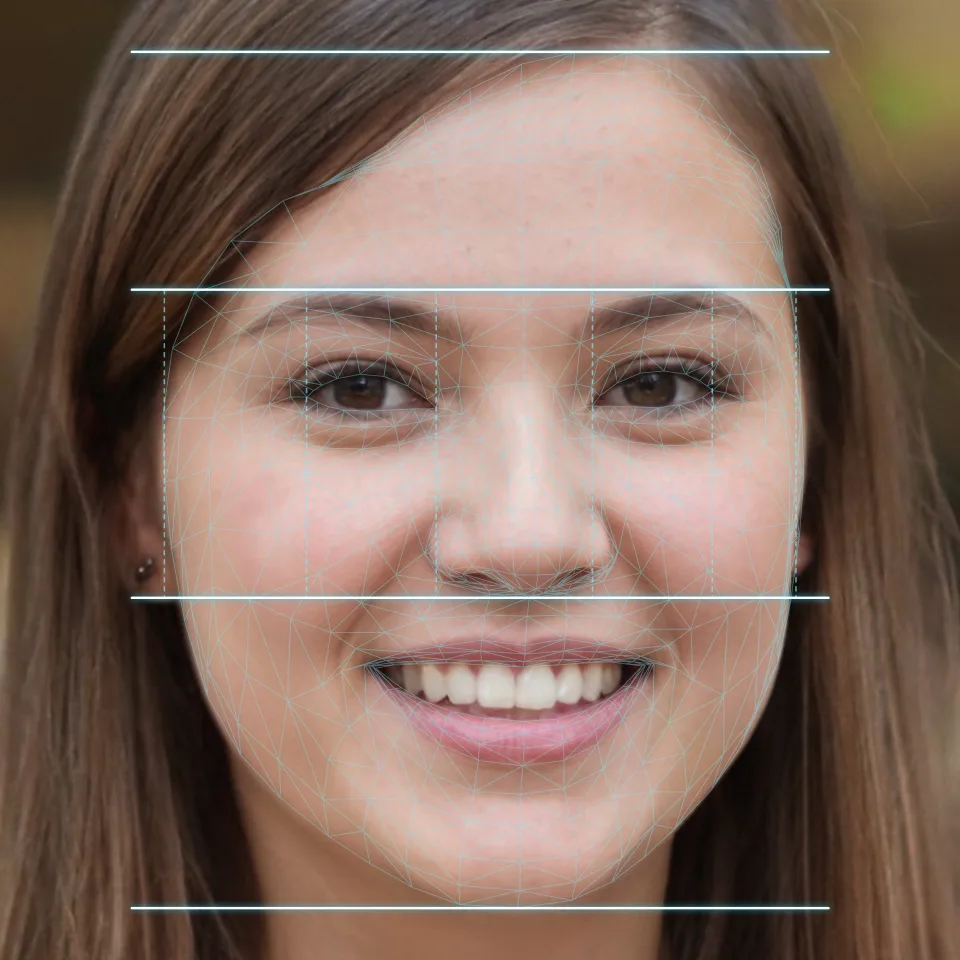
A face is not flat. The forehead slopes back from the brows to the hairline, and the face below the nose slopes back toward the chin.
Lower your chin and the forehead turns toward the lens, so the upper third gets taller; the chin turns away and the lower third shortens. Raise it and you get more lower third, jaw underside and nostrils. Photographers agree: chin too high and the face looks smaller; too low and soft tissue bunches under the chin.
Camera height is a nod by another name: a phone above your eyes acts like a lowered chin.
On the sample the middle and lower thirds are 284 and 286 px, almost exactly 1:1. A small nod could swap them, so check the head is level first.
A tilt slants both level lines
Tilt toward a shoulder and the eye line and mouth line slant by the same angle, while the chin drifts off the midline. Every pair gets one side higher.
The sample head is tilted about 0.4°: all seven pairs sit 1 to 6 px higher on the right. Small, but all one way.
A quick test: if both lines slant equally, the head is tilted; if only one slants, it is more likely the face.
A tilt is the only rotation you can undo afterwards: facing the lens, it is just the image turning in its plane. A nod or a turn changes perspective, which rotation cannot fix.
A turn widens the near half
Turn your head and the half nearer the lens widens while the far half narrows. Points farther back, like the cheek edge and jaw angle, shift the most; the nostril wings barely move. Every pair leans one way; the far eye looks shorter.
The sample shows exactly this: the cheek edges differ by 86 px, the nostril wings by 6. The facial symmetry guide has the full analysis.
Photographers use this: a turned face reads narrower, a straight-on one wider. Fine for everyday photos; avoid it for measuring.
How to check you’re level
| Rotation | What you see | Which numbers move | How to check |
|---|---|---|---|
| Nod | Bigger forehead, or more chin and nostrils | The thirds | Phone at eye level; from the side, lower eye rim level with the ear opening’s top |
| Tilt | Eye line and mouth line slanted | Height gaps in pairs, chin to midline | Camera grid on, eye line level |
| Turn | One side wider, one ear more visible | Pair distances to the midline, outer fifths | Both ears equally visible, nose tip on the midline |
A measuring photo, or one for a face report, must pass all three. Everyday photos differ: photographers bring the chin forward and slightly down, cued as “forehead toward me”, not a hard tuck or a jut. For the full setup, see the front-facing photo guide; for posing the jaw, see jawline in photos.
FAQ
Why does my forehead look bigger with my chin down?
The forehead slopes back. Lower the chin and it turns toward the lens, taking up more height, while the lower third shortens.
Can I straighten a tilted head afterwards?
A tilt, yes: rotate the photo until the eye line is level. A nod or a turn changes the perspective, and no rotation undoes that.
Is a selfie from above the same as chin down?
Close to it. A camera above eye level sees the face tipped down, so the upper third grows.
How do I tell a turn from an uneven face?
Look at direction. Differences that all point one way and grow toward the back of the face suggest a turn; mixed directions point to the face itself.