Contents
Smiling and face proportions: does a smile really change the numbers?The sample photo: readings from a smiling faceWhat a smile changes, feature by featureWhich expression to use for measuringFor a good portrait, keep the smileFAQKey points
- A smile pulls the mouth corners outward and upward, so mouth width and the mouth-to-nose ratio both grow.
- The cheeks rise and push the lower lids up: the eyes narrow, and the eye-tail tilt can read higher.
- The upper lip flattens and thins; open the mouth and the chin drops, lengthening the lower third.
- Measure with a relaxed, closed, neutral face. For a good portrait, keep the smile, just don't measure it.
Smiling and face proportions: does a smile really change the numbers?
Yes, by more than most people expect. Several points actually move.
- Mouth corners travel outward and upward. In one measuring guide’s example, the same face with a broader smile went from 58.0 mm to 65.7 mm wide.
- Cheeks and eyes: researchers who study expressions describe a felt smile pulling the cheeks up, the lower lids rising and the eye opening narrowing.
- Upper lip flattens and thins.
- Chin: open the mouth and the chin drops with the jaw, so the stretch from the base of the nose to the chin gets longer.
The changes chain together: corners pulled outward tug the nostrils wider, and cheeks pushed up shorten the eye’s height while its length barely moves. One movement touches mouth, nose, eyes and chin at once.
The sample photo: readings from a smiling face
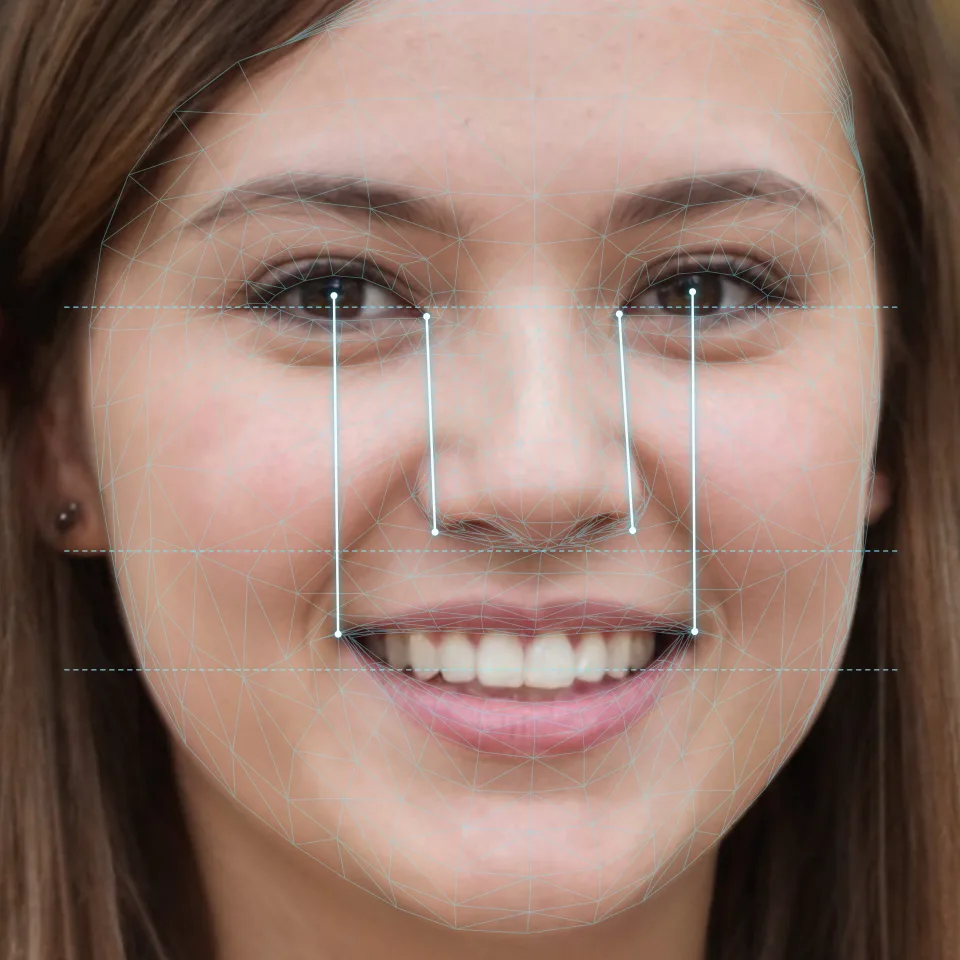
The sample photo is smiling with teeth showing. Several of its readings sit exactly where a smile acts:
- Mouth width 267 is 1.80 times the nose width at the wings, 148.
- Upper lip 20, lower lip 41: an upper-to-lower ratio of 0.49.
- Eye height ÷ eye length is 0.29 for one eye and 0.31 for the other.
- Both mouth corners sit almost exactly below the pupils.
To be clear: we don’t have this face unsmiling. These numbers show which readings a smile affects, not by how much. Relaxed, the mouth would be narrower and the corners would likely fall inside the pupil lines, but this photo can’t confirm it.
One lip guide puts a typical upper-to-lower ratio at 0.7 to 0.8. The sample’s 0.49 is far lower, but it was measured mid-smile, so it doesn’t describe this face’s lips.
What a smile changes, feature by feature
| Feature | What a smile does | Reading it affects |
|---|---|---|
| Mouth corners | Pulled out and up | Mouth width, mouth-to-nose ratio, corners under pupils |
| Nostrils | Tugged wider | Nose width |
| Upper lip | Flattened, less tall | Upper-to-lower lip ratio, lip shape |
| Cheeks and lower lids | Lifted | Eye height ÷ length, eye-tail tilt |
| Chin (mouth open) | Drops with the jaw | Lower third, facial thirds |
When nose width and mouth width grow together, the mouth to nose ratio won’t hold still. Eye-tail tilt compares the outer corner with the inner one, so when the lower lid moves, that line can shift too; see upturned or downturned eyes.
Which expression to use for measuring
Clinics photograph faces with a neutral expression by default and shoot raised brows, frowning and smiling separately. Some passport rules ask adults for a plain expression with the mouth closed. Same reason: fix the expression and photos become comparable.
At home:
- Let your lips rest, lightly closed, teeth not clenched; chin neither tucked nor raised, eyes level with the lens.
- Don’t smile or press your lips. Think of nothing in particular.
- Take three photos a few minutes apart, measure each, and keep the middle value.
If the three disagree, the expression hasn’t settled. The rest of the setup is in front-facing photo. Reading lip shape types or getting a face report from a photo needs the same relaxed expression.
For a good portrait, keep the smile
Measuring and taking a nice photo are different jobs. In everyday photos, smile all you like. Photographers use two tricks:
- Count to three: a smile held too long goes stiff around the mouth and eyes. Look away and relax, then look back on “three” and smile fresh.
- The squinch: a headshot photographer’s signature cue. Lift the lower lids slightly for a more settled gaze, and watch that the forehead doesn’t crease.
Notice that the squinch does what a smile does: it narrows the eyes. Fine for a headshot, wrong for measuring eye height. To get both from one session, take the relaxed, closed-mouth shot first, then the smiling ones.
FAQ
Does a small smile matter too?
Yes, just less. Once the corners move, mouth width changes; once the cheeks lift, the lower lids follow.
I only have smiling photos. Can I still look at proportions?
You can, but note that you were smiling and compare only with other smiling photos. Against relaxed figures, the mouth will read wide and the eyes narrow.
Why do some passport rules ask for no smile?
A fixed expression makes one person's photos comparable from one time to the next.