Contents
Selfie distortion: is the lens to blame?Which widths change up closeWhere the 30% comes fromSelfie distance at a glanceHow to shoot without the distortionFAQKey points
- Distance sets the proportions, not the lens.
- At arm's length, about 30 to 50 cm, the nose and centre of the face grow while the ears and sides shrink.
- A 2018 modelling study: at about 30 cm versus 1.5 m, the base of the nose comes out about 30% wider and the tip about 7% wider.
- Step back to 1.5 to 2 m, use the rear camera at 2x or 3x or a timer, and keep your face centred.
Selfie distortion: is the lens to blame?
No. It is the distance.
Two kinds of “warped” get mixed up. Lens distortion bends lines that should be straight, like door frames. A face that looks different is perspective, and that depends only on how far the camera is from the face.
The geometry is simple: nearer things come out bigger. Your nose tip is several centimetres closer to the lens than your ears. At 30 cm those centimetres are a big share of the distance, so the nose grows and the ears shrink. At 2 m they barely matter.
So from one spot, any lens cropped to the same frame gives an identical nose. Shoot close and crop later, and the distortion stays.
Which widths change up close
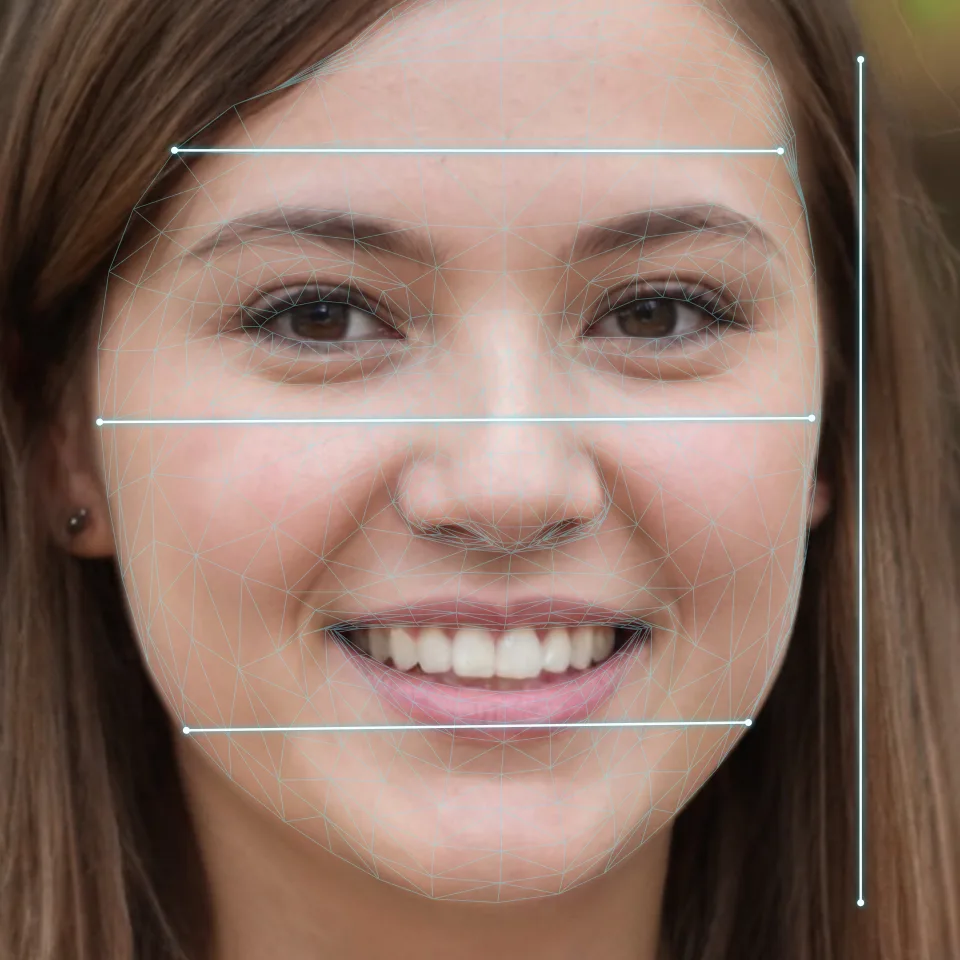
The diagram marks four measurements on the sample photo: forehead, cheekbone and jaw width, plus face length. They shift against each other with distance because they sit at different depths: nose in front, cheekbones in the middle, jaw angles and ears behind.
A 2012 study shot the same face with two cameras at once, at 45 cm and 135 cm, so the expression was identical. Scaled to the same size, the close photo had a smaller width-to-height ratio: the sides fell away and the outline read narrower.
Photography guides often say a close shot widens the face. Both fit: the nose in the middle widens, the sides pull in.
Where the 30% comes from
A 2018 study modelled a typical selfie distance (about 30 cm) against a standard portrait distance (about 1.5 m). At 30 cm the base of the nose came out about 30% wider relative to the cheekbones, the tip about 7% wider. That is a calculation, not real people photographed twice.
On the sample photo, the nose is 148 px wide at the wings and the cheekbones 582 px: about 0.25. We don’t know how far away it was taken, and that is the point: a ratio like this means little until you know the distance. Compare your own numbers only between photos taken from the same distance.
And people can’t see the distance. In the 2012 lab experiments, nobody said afterwards they had noticed it change, and viewers even judged the far photo to be the closer one. So don’t trust your eye; fix the distance.
Selfie distance at a glance
| Distance | Typical setup | In the photo |
|---|---|---|
| About 30 cm | Front camera, arm out | Model: nose base about 30% wider, tip about 7%, than at 1.5 m |
| 30–50 cm | Arm’s length | Nose and centre grow, ears and sides shrink |
| 45 cm | The study’s “near” | Sides fall away, smaller width-to-height ratio |
| 135 cm | The study’s “far” | Sides come back |
| 1.5–2 m | Rear camera at 2x or 3x, or a timer | Front and back closer in size, a natural look |
The figures come from different setups, so don’t convert between them. There is no threshold: closer means stronger.
How to shoot without the distortion
- Step back, then zoom. Stand 1.5 to 2 m away and use the rear camera at 2x or 3x to fill the frame. Zoom only enlarges; your steps change the proportions. Alone, prop the phone up and use the timer.
- Keep your face centred. An ultra-wide camera stretches whatever sits near the edges.
- Lens correction won’t help. This camera setting, on by default on some phones, straightens lines bent by the front and ultra-wide cameras. It does nothing about close-range perspective.
- A crop can’t rescue it. Close and cropped keeps close-range proportions.
Full setup: front-facing photo guide; a photo taken that way is also the one to give a face report. Why the mirror shows yet another face: why you look different in photos.
FAQ
Does portrait mode reduce selfie distortion?
Portrait mode uses a longer equivalent focal length, so the frame is tighter and you have to step back to fit your face in. Those steps are what help, not the mode itself.
My nose looks big in photos. Is it?
Not necessarily. An arm's-length selfie enlarges whatever is closest to the lens, and that is usually the nose. To judge proportions, use a front-facing photo taken from 1.5 m or more.
Is the 0.5x ultra-wide camera worse for selfies?
It stretches whatever sits near the edges. Keep your face centred; the proportions still depend mostly on distance.