Contents
Golden ratio face test: how does it work?The four ratios and their pointsResults on the sample photoMove a point, get a new numberHow to read your own resultsFAQKey points
- Four ratios: face length ÷ width, middle ÷ lower third, mouth width ÷ eye gap, nose ÷ philtrum.
- The sample photo gives 1.36, 0.99, 1.85 and 4.5: close to 1.618 on some, far off on others.
- Where you place the points changes the result: hairline or top of the forehead, smiling or not.
- Record the points you used and how the photo was taken.
- There is no agreed range for how close counts as "close".
Golden ratio face test: how does it work?
A golden ratio face test is four divisions. Measure four pairs of lengths on a front-facing photo, divide the longer by the shorter, and compare each result with 1.618.
Shoot straight on, head level, hair off the hairline, mouth gently closed; the full photo setup is in facial thirds. Any photo editor that shows pixel positions will do.
Measuring by hand, rather than with a golden ratio face calculator, shows you which two points sit behind every number, and so how far to trust it. This page does not grade the result. It asks what the ratios are, and how much they depend on the method.
The four ratios and their points
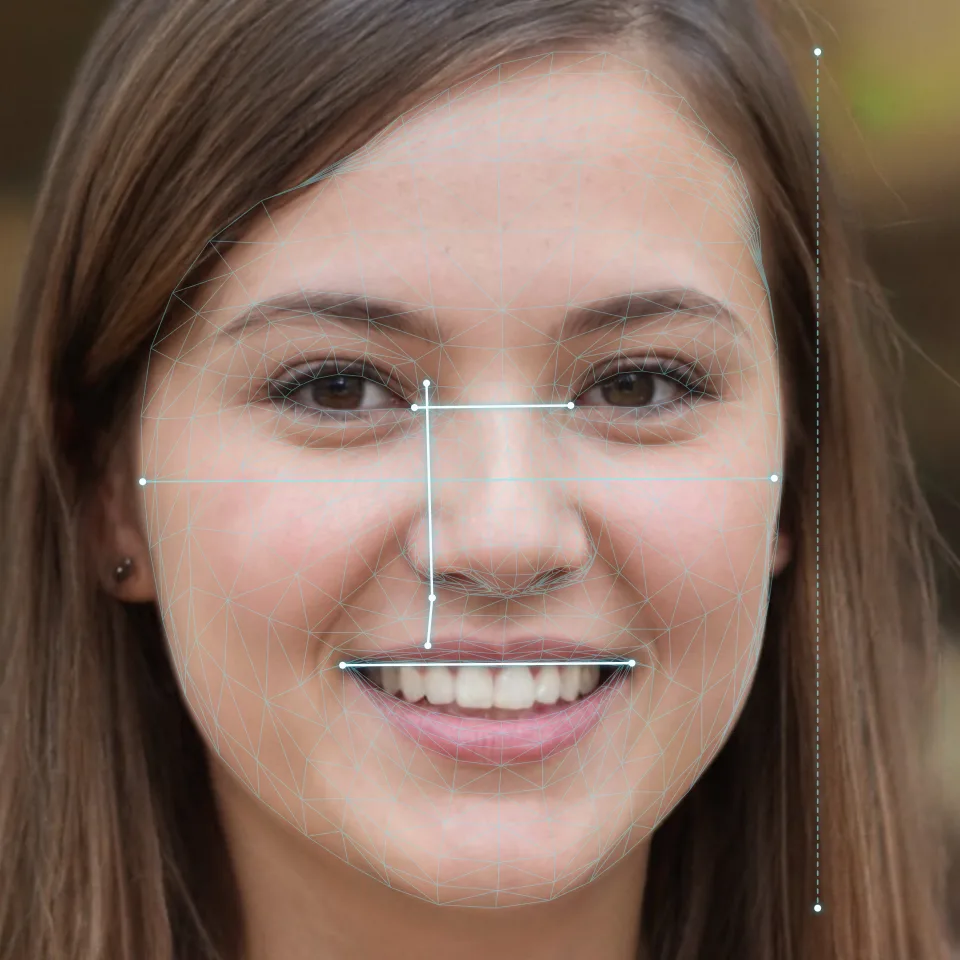
Twelve points in all, with the base of the nose and the chin used more than once:
- Face length ÷ face width: middle of the hairline to the lowest point of the chin; widest points at the cheekbones.
- Middle third ÷ lower third: brow line to the base of the nose; base of the nose to the chin.
- Mouth width ÷ eye gap: corner to corner of the mouth; inner eye corner to inner eye corner.
- Nose length ÷ philtrum: deepest point of the bridge between the eyes to the base of the nose; base of the nose to the top of the upper lip.
Some guides write “eye gap ÷ mouth”. Flip the division and the target becomes 0.618. Here the longer goes over the shorter; middle ÷ lower is divided as written.
Zoom in and put each point on an edge, not in a shadow. Eye and mouth corners are the clearest; the hairline and face edge are the hardest.
Results on the sample photo
Numbers are pixels on the photo.
| Ratio | Lengths | Result | Against 1.618 |
|---|---|---|---|
| Face length ÷ width | 789 ÷ 582 | 1.36 | 16% lower |
| Middle ÷ lower third | 284 ÷ 286 | 0.99 | 39% lower |
| Mouth ÷ eye gap | 267 ÷ 144 | 1.85 | 14% higher |
| Nose ÷ philtrum | 198 ÷ 44 | 4.5 | about 2.8 times |
None of the four lands on 1.618. Two are a little over 10% off, one is almost exactly 1:1, and one is nearly three times the target. So “is this a golden ratio face?” has no one-line answer. It depends on which ratio you look at.
Middle ÷ lower is 0.99: nearly even by the thirds rule, far off by the golden ratio. Different ruler, different reading.
Move a point, get a new number
- Where face length starts. Some guides measure from the hairline, others from the top of the forehead. The sample’s hairline is estimated anyway; move the start up 30 pixels and 1.36 becomes 1.41.
- Smiling or not. The woman in the sample is smiling, teeth showing. A smile pulls the mouth corners apart, so 1.85 runs high; with a closed mouth it would be smaller.
- Short segments. The philtrum is only 44 pixels. Place the top of the lip 5 pixels lower and 4.5 becomes 4.0.
So when you write down a ratio, write down the method too: which points, mouth open or closed, hairline seen or estimated. Without that, two people’s numbers cannot be compared.
How to read your own results
- No agreed meaning of “close”. Guides that promote the golden ratio say “reasonably close” and give no agreed range. If you see a cut-off, ask where it came from.
- Check your own consistency first. Measure again a little later. If the two attempts differ by more than you differ from 1.618, you are mostly measuring error.
- Retake photos the same way. Same phone, same spot 1.5–2 m away, same light and expression.
- The numbers only describe. Being far from 1.618 is not a problem, and in studies the link between closeness and looks is weak; see is the golden ratio face real. If you would rather not measure by hand, a face report built from one front-facing photo shows the golden ratio alongside other ratios.
FAQ
Which of the four ratios matters most?
There is no agreed answer. Guides pick different ratios, and in studies the golden ratio's link to looks is weak overall. Record and read them separately.
Why do apps give different golden ratio results?
They use different ratios and points, on photos with different angles and expressions. One summary of over ten thousand face scans left out its golden ratio numbers as too noisy.
Can I use a smiling photo?
You can, but the mouth comes out wider, so mouth ratios will not match a closed-mouth photo. Note the expression and use the same one next time.
Eye gap ÷ mouth gives 0.54. Is that close?
It is the same pair divided the other way. Compare 0.54 with 0.618, or 1.85 with 1.618; both are a little over 10% off.