Contents
Large pores: what a pore is, and what sets its sizeWhy pores look so different in the mirror and in a photo from 2 mWhat a blackhead is: not dirt, and not the same as a large porePore strips, steam, ice and clay masks: what has evidence and what is only on the labelOil and pores: how much can oil control doFour small daily things, and when to see a dermatologistMaking pores less visible in a photo: technique beats retouchingHow thin the evidence isFAQKey points
- Pore size is mostly set by follicle size, oil and the firmness of the surrounding skin, and it changes slowly. One dermatology reference rates treatments aimed at shrinking pores as not very effective.
- How big pores look depends on light and distance. Side light and close-ups throw shadows into them and magnify them; soft front light and 1.5–2 m flatten them. A bathroom mirror at 20 cm is not a fair view.
- A blackhead is an open follicle plugged with oil and dead skin, not dirt. Do not squeeze, pick or scrub. Strips help only briefly and steam only softens the plug; a clay mask cut oil in one study while pore area did not change.
- What you can do is small: warm water and a gentle cleanser, products labelled non-comedogenic, sunscreen every day, hands off the face. See a dermatologist if it stays inflamed or hurts.
Large pores: what a pore is, and what sets its size
Pore size is mostly a factory setting and it changes slowly. What you can change is whether the pore is clogged, and what light and distance you judge it in. Separate those two before you buy anything.
First, what a pore is. It is the opening of a hair follicle at the skin surface, with an oil gland at the base of the follicle. What your eye calls “a pore” is really a small dip in the skin, about 0.25 to 0.5 mm across, that holds several follicle and sweat-duct openings. A 2015 cheek-imaging study by researchers at a cosmetics company cites figures for the openings themselves: a follicle opening is about 0.04 to 0.08 mm and a sweat opening is finer still, so alone they are too small to see.
Three things set the size. A 2016 review put the main causes of enlarged pores into three groups: high oil output, less elastic skin around the pore, and a bigger hair follicle. Recurrent acne, hormones and skin care also play a part, and another dermatology reference adds sun damage and comedogenic products. Follicle size and oil output are largely inherited. One hospital dermatologist put it bluntly: genetics mostly determines pore size, you cannot permanently shrink them, and you can only make them look smaller.
Is there a way to shrink them? Not in anything I read. One dermatology reference rates treatments aimed at shrinking pores as not very effective overall, and a 2016 review calls them hard to treat because the causes are several. The AAD, the US dermatologists’ academy, sounds more upbeat, but its claim is that pores can look less noticeable, not that they get smaller: clear the clog, avoid irritation, wear sunscreen. Those two statements do not contradict each other, and the sections below take them apart. This article covers no procedures, lasers or prescription drugs; those are for a dermatologist.
Why pores look so different in the mirror and in a photo from 2 m
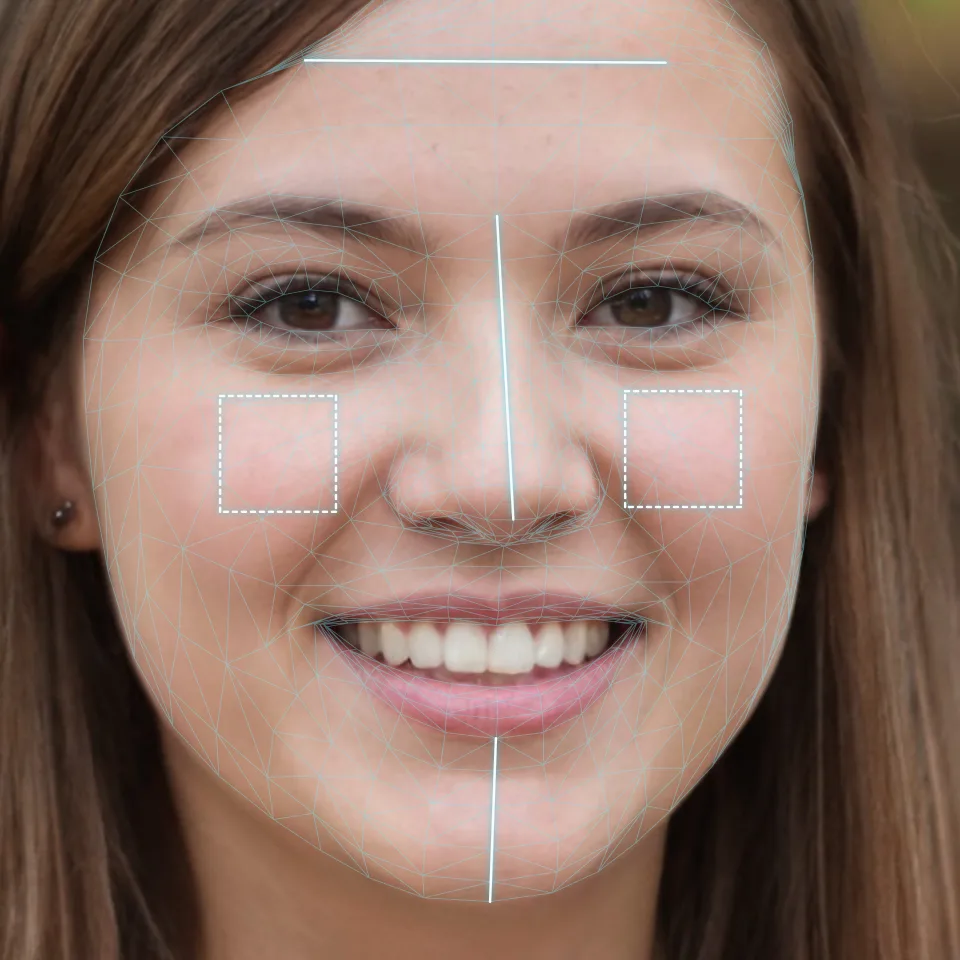
Start with distance. A normal eye resolves detail down to about 1 arcminute. A pore 0.3 mm wide spans about 5 arcminutes at a bathroom mirror 20 cm away, which is plain to see. At 1 m it spans about 1 arcminute, right at the edge. At 2 m it is about half that, below the line. What you see best in the mirror is what the person across the table barely sees.
A phone camera behaves the same way. This is my own rough arithmetic, not a measurement, and your phone will differ: take a typical 12-megapixel phone with a main lens of about 26 mm equivalent (a 2x lens is about 52 mm). The photo is about 4,000 pixels wide. At 1.5–2 m, one pixel covers about 0.25 to 0.7 mm of your face, as wide as a pore or wider, so a pore cannot show up as a pit and survives only as a slight shade of tone. At 25 cm, one pixel covers about 0.08 mm, a pore is three or four pixels across, and it is a clear pit.
Now light. A pore is a dip. When light grazes the skin from the side, the near rim of the dip catches it and the far side drops into a small shadow, and a row of dips is drawn in. When light comes from the front, the dip is lit as well and its shadow falls where the camera cannot see it. That is my inference from the shape, not something a controlled test showed, but photographers agree with it: skin texture is shaped more by the direction of light than by how hard it is, side light emphasises it, front light suppresses it, and even a softbox set to the side is unforgiving. A company that makes clinical skin-imaging systems says directional raking light reveals surface texture and closed, diffusely lit set-ups can reduce its contrast. I found no controlled study that tests pore visibility against the angle of light.
Bathroom lights are usually above the mirror or beside it, small and hard. Twenty centimetres, hard light, from the side: that is the strongest magnifier of pores you will meet. So a bathroom mirror is not a fair view of your skin. One dermatologist-founded skincare brand even tells readers to put the magnifying mirror away and stop searching for pores up close.
Try it. On one day, with bare skin, a while after washing, take two photos.
- A, the fair view: daytime, facing a window, every lamp in the room off. Phone propped at eye height, rear camera, 1.5–2 m from your face, 2x or 3x, 3 to 10 second timer. How to stand at the window is in selfie lighting, and why the distance matters is in selfie distortion.
- B, the deliberate counter-example: window to one side, or only the ceiling lamp on, front camera about 30 cm from your face, which is how most selfies are taken. B is only for comparison; do not use it for a measured photo.
Zoom both to 100% and look at the same patch of cheek and nose wing side by side. The difference is made by light and distance: the same face, on the same day. If a patch in A still bothers you, that is the part worth putting effort into, and A is the photo to use for a skin reading.
What a blackhead is: not dirt, and not the same as a large pore
A blackhead is a follicle opening plugged with oil and dead skin that stays open at the surface. Dermatologists call it an open comedo. It is not dirt: dermatology bodies and hospital health pages both say the dark spot is not dirt. A plug that sits under closed skin and keeps the skin’s colour is a closed comedo, or whitehead.
Why it is dark, sources do not agree. One Cleveland Clinic page says the contents react with oxygen; another page from the same clinic says it is an irregular reflection of light off the clogged follicle. I will not referee, and what matters is the line both agree on: it is not dirt.
A blackhead and a large pore are different things that get mixed up. A clogged pore gets stretched and looks more noticeable, and inflammatory acne can weaken the follicle opening so it clogs more easily. So where blackheads are many, pores often look big too. Blackheads are most common on the nose and chin, sometimes the cheeks. They are the mildest form of acne, and they do not hurt.
Some of the tiny dots on the nose may not be blackheads at all but sebaceous filaments, a normal lining of the pore; one dermatologist-founded brand says they sit in the same places. The eye can hardly tell them apart, and the rule is the same: do not dig.
Do not squeeze or pick. A hospital health page lists three problems: you may leave part of the plug and push it deeper; your hands and nails carry in bacteria and oil, so it can grow or spread; and pressing hard inflames and scars. The AAD’s advice for pores fits in one line: never scrub, rub, pick at or squeeze. A deep blackhead is removed by a dermatologist or trained professional with a comedo extractor, not at home.
Pore strips, steam, ice and clay masks: what has evidence and what is only on the label
First, “pores open and close”. The dermatology reviews I read describe no mechanism for a pore to open or shut, and a clinician-reviewed health site and a dermatology education site both say outright that pores do not open and close. Heat and cold change how soft the plug is and how tight the skin feels, not the width of the opening. Washing with warm rather than hot water is not about keeping pores closed either: the AAD says hot water irritates skin and can make pores look larger.
The table sorts each method by what it does and how strong the evidence is.
| Method | What it can do | How strong the evidence is |
|---|---|---|
| Pore strips | Lift the loose plug from the surface; the nose is clean for a while, usually refills within weeks, may irritate and dry | Thin. A clinician-reviewed health site says there is not much research; a hospital dermatology resident says they only clear the skin temporarily |
| Steam, hot towel | Soften oil and dead skin; do not open pores, and nobody has shown they shrink them | One aesthetician’s experience, no controlled study found; too hot worsens redness |
| Ice, cold water | Skin feels tighter for a few minutes | A dermatologist says the effect lasts minutes; cold water does not change pore size |
| Clay mask | Soaks up surface oil, less shine | One brand-funded, 4-week study compared with baseline only: oil and comedone counts fell, pore area did not change significantly |
| Scrubbing hard, gritty scrubs | Irritate, so pores look more noticeable | AAD: inflamed skin shows pores more |
| Squeezing, picking | May inflame and scar, and the pore looks worse | AAD and hospital pages agree: do not; extraction belongs to professionals |
| Serums and toners labelled “pore-shrinking” or “refining” | The maker says so | Only on the label and in the maker’s own tests; I found no independent controlled study |
| Antioxidant serums to stop blackheads darkening | The maker says so | Same: only brand claims seen |
These methods share one thing: they clear the plug and leave the width of the pore alone. Clearing the plug does make the pore look less noticeable, since the AAD says clogging stretches it; it just comes back after a few weeks.
Oil and pores: how much can oil control do
People with oilier skin tend to have bigger pores, but only moderately so. A 2006 study imaged pores under magnification and measured oil output with an instrument. Among 60 volunteers, oil output was the factor most related to pore size, with a correlation of 0.47 for men and 0.38 for women. Squaring a correlation tells you how much it explains, so by my rough arithmetic oil explains about 14% to 22% of the differences in pore size, and the rest is something else. In the same study women’s pores grew significantly around ovulation, and the dermatology reference mentioned earlier says they are largest then. A pore that looks especially big today may just be that day in the cycle.
The 2015 study of over two thousand women looked more cautiously: its authors read their cheek data as saying that the pore look to the eye depends less on sebaceous gland function than you would expect. The two studies do not fully agree, and each has limits: one has only 60 people, the other comes from a cosmetics company. My view: oil is one factor, not all of it.
On oil control, the AAD’s advice is a little counterintuitive: do not strip the oil off with a harsh cleanser, because a harsh wash irritates skin and can raise oil output. Use a gentle foaming cleanser, still moisturise afterwards, and press a blotting paper on when it shines instead of rubbing. The three basics are in the basic skincare routine, and how to work out your type is in how to know your skin type. Shine in photos is a different matter, covered in uneven skin in photos.
Four small daily things, and when to see a dermatologist
The four below all come from the AAD’s two pages on large pores and oily skin. None promises smaller pores; they only keep them from standing out more:
- Warm water and a gentle cleanser, morning and evening, no scrubbing.
- Skin care and makeup labelled non-comedogenic or oil-free, and remove it all before bed.
- Sunscreen every day. Sun damage builds up, skin loses firmness, and pores show more.
- Hands off your face. No squeezing, no picking.
See a dermatologist if blackheads or spots have not improved after a few weeks of this, if there are red, swollen or painful bumps, or if something you put on stings, burns or brings out a rash (stop using it first, then ask).
The same AAD page also lists exfoliating, retinol-type products and a salicylic acid cleanser. They are active ingredients that dry or irritate some skin, so I do not recommend them here; if you want them, ask a dermatologist first.
Making pores less visible in a photo: technique beats retouching
Switch off the mirror’s magnifiers one at a time when you shoot:
- Light: face the window, not with the window to one side, and turn the room lamps off. Overcast daylight works too. No direct on-camera flash.
- Distance: 1.5–2 m away, rear camera at 2x or 3x. A close-up turns pores into clear pits, as explained in selfie distortion.
- Filters: off. Smoothing wipes out texture, so a pore that disappears is the slider’s work, and it may change the shape of the face too; see beauty filters.
- Before and after: if the two photos were shot differently, the change in how the pores look is light and distance, not skin. Compare from the same window, the same spot and the same time of day.
How thin the evidence is
- What sets pore size: a few reviews and a few small studies. The causes are several, and the studies do not fully agree.
- How to make pores look smaller: the one clay-mask study I found was small, had no control group and was funded by the maker; there is even less on strips.
- How light and distance change what you see: the optics are clear, and my arithmetic agrees with what photographers say, but I found no controlled study that tests it directly.
- Claims only from brands: serums and toners labelled pore-shrinking, and antioxidant serums to stop blackheads darkening.
FacialRate’s face report has a skin dimension. It reads how the skin looks in this one photo, and it does not count pores or report their size. A soft-light photo taken from 1.5–2 m could not show pores anyway. What you can compare is the skin reading from one photo to the next, shot the same way.
FAQ
Can large pores be made smaller?
Pore size is set mostly by follicle size, oil and the firmness of nearby skin, and a lot of that is inherited. I found no home method shown to shrink them. What you can do is keep them from clogging, avoid irritating them, and judge them in fair light.
Is it true that hot water opens pores and cold water closes them?
No. A clinician-reviewed health site and a dermatology education site both say pores do not open and close. Heat softens the plug inside, and cold tightens the skin for a few minutes; the opening stays the same size.
Do pore strips work?
They lift the loose plug from the surface of the nose, but only for a while, and it usually comes back within weeks. They can also irritate and dry the skin. There is little research, and none I found shows they make pores smaller.
Are blackheads dirt?
No. A blackhead is an open follicle plugged with oil and dead skin, which dermatologists call an open comedo. Dermatology bodies and hospital health pages say outright that the dark spot is not dirt.
Why do my pores look huge in the bathroom mirror but not in photos?
In the mirror you are about 20 cm away, so a pore spans five times the angle it does at 1 m. Bathroom lights also tend to be small and hard, sitting above or beside the mirror, and they shadow every dip. A photo from 1.5–2 m in window light has neither.