Contents
How to apply sunscreen to your face: fix the amount, then go on in two layersOrder and waiting: moisturiser, sunscreen, wait, makeupThe spots people miss: inner eye corners, ears, hairline, jaw to neck, lipsPilling and white cast: different causes, different fixesStinging: first where it lands, then what it isReapplying over makeup: first ask whether you need toFAQKey points
- For the face, the floor is about three peas, a blob roughly 2 cm across. Sources quote anything from about 0.6 mL to about 5 mL; the gap is margin, not principle. Two layers beat one thick one.
- Order: moisturiser, sunscreen, makeup. Wait about 15 minutes before going out; the few minutes before makeup is craft advice, not a measurement. If you use a moisturiser with SPF, apply it like a sunscreen.
- The most missed spots are the inner eye corners and eyelids, shown by UV-camera studies; ears were also missed a lot in one experiment. Hairline, jaw to neck and lips are on every expert list.
- Pilling mostly comes from rubbing and stacking; white cast from amount, texture and tinted formulas; stinging from where it lands. Move it off the lash line, and try a stick or a mineral formula.
- No trial has tested reapplying over makeup, only dermatologists’ experience: powder, stick and spray are top-ups, not a replacement for the morning layer.
How to apply sunscreen to your face: fix the amount, then go on in two layers
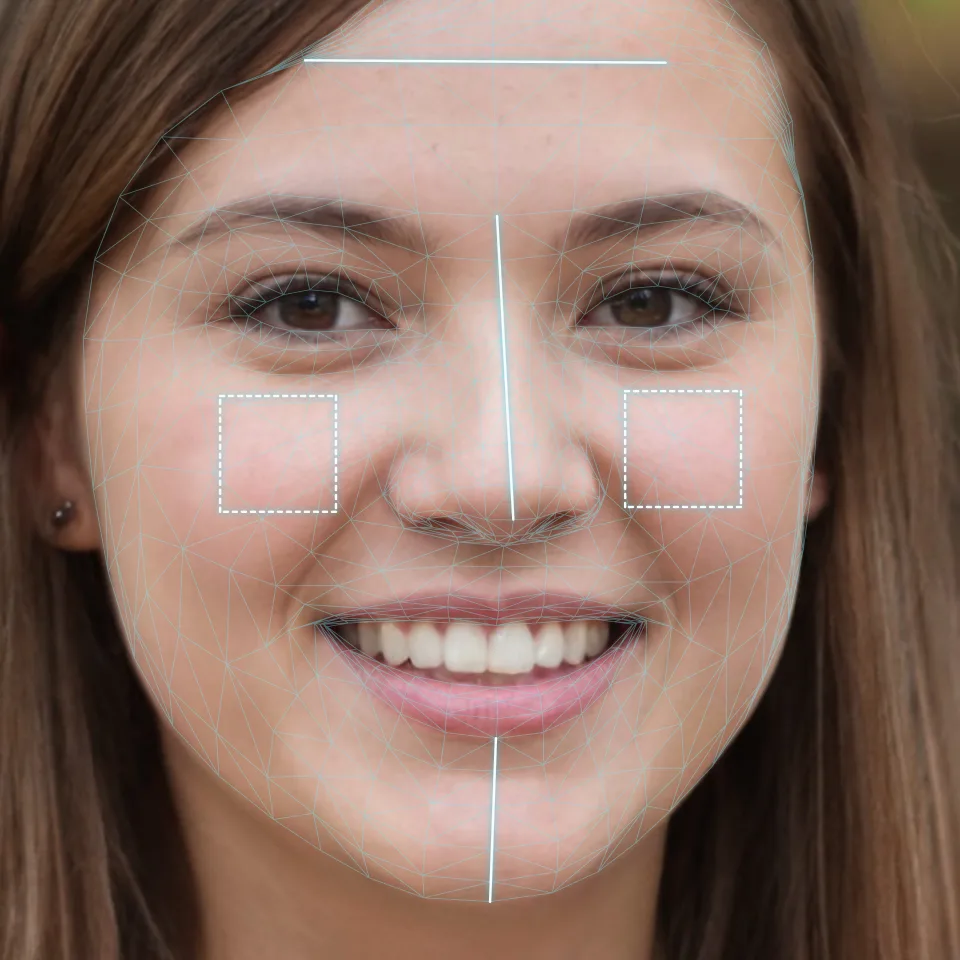
For the face, start from about three peas, a blob roughly 2 cm across, and put it on in two layers rather than one thick one.
The reason is on the bottle. SPF is tested at 2 mg per square centimetre of skin, and for a face that comes to roughly 0.6 to 1 mL. Put on less and the number on the label is not delivered. The general rules, every day and every 2 hours, are in the basic skincare routine; this article is only about the face.
The sources do not agree on a face amount, so here they are side by side:
| Source | Amount for the face | How it measures |
|---|---|---|
| Skin Cancer Foundation | About three peas; its Q&A says a dollop the size of a US nickel (about 2 cm across) | A phone-sized patch of skin needs about one pea (about 0.2 mL); the face counts as three: forehead, and one for each cheek |
| American Academy of Dermatology | At least 1 teaspoon, about 5 mL | About the length of the index and middle fingers |
| Japanese Dermatological Association | About two pearl-sized drops | Tested at 2 mg per cm²; in surveys people apply at most about 1.3 mg |
| NHS (UK) | No face amount | Whole body only: 6 to 8 teaspoons |
| A trial of indoor workers | 1 g | The trial treated 1 g on the face as 2 mg/cm² |
| One beauty blogger’s own test | About 0.8 mL | He estimated his face area and weighed two products; 1/4 teaspoon, about 1.2 mL, was around half again more than he needed |
Where does the gap come from? The lowest is the foundation’s phone arithmetic, about 0.6 to 0.75 mL. The highest is the dermatology academy’s teaspoon, about 5 mL, six to eight times more. Three unrelated routes, the foundation’s area arithmetic, the blogger’s own test and the trial’s 1 g, all land between 0.6 and 1 mL. That is the lab dose. The teaspoon end is margin: its page does not say whether it also covers neck and ears, and one beauty site’s version of the same rule counts face, head and neck together as one teaspoon. Finger lengths are looser still. The blogger weighed his own: three finger lengths came to about 1.5 mL of a thin lotion and about 3 mL of a thick cream, twice as much.
I think three peas is the base, and a little extra is the safer side: palms and sponges keep some. If it goes white or greasy at that amount, that is a texture problem, covered in section 4; it is no reason to cut below the floor.
A quick check: a 50 mL bottle used only on the face at 0.75 mL a day lasts a bit over two months. If yours has lasted three months, you are using about 0.55 mL a day, below the lowest estimate above. That is arithmetic, not a study.
Two layers has data behind it. In a 2018 lab experiment, volunteers in swimwear applied twice with 20 minutes between. The face’s missed area fell from a median of 3% to 1%, and the amount on the forehead rose from 1.12 to 2.21 mg per cm². The second layer covered what the first missed and added amount. After one layer nobody reached 2 mg; after two, only about a fifth of volunteers did, counted over the whole body. The face was the best-covered area; the larger misses were elsewhere, below.
How to do it: after washing and moisturiser, put on about half, dotted on the forehead, cheeks, nose and chin, then spread. Get dressed, brush your teeth, then put on the other half, aimed at the places the first layer tends to miss. The study’s gap was 20 minutes, about the length of a morning routine.
Order and waiting: moisturiser, sunscreen, wait, makeup
The order is wash, moisturiser, sunscreen, then makeup. In the American Academy of Dermatology’s order, moisturiser and sunscreen share one step before makeup; it does not rank the two. One beauty site’s guide puts moisturiser first and sunscreen last in skincare.
If you use a moisturiser with SPF instead of sunscreen, apply it like sunscreen. In a 2019 study, 84 adults used an SPF 30 moisturiser and an SPF 30 sunscreen lotion in their usual way. The share of the face missed was 16.6% with the moisturiser and 11.1% with the sunscreen. The moisturiser was thicker, and imaging suggested people used less. Only two products were compared, but the warning is ready-made: apply it the way you apply moisturiser and you probably under-apply.
SPF does not stack. One dermatologist says an SPF 30 moisturiser under an SPF 30 foundation is not SPF 60; you roughly get the highest one. Do not treat makeup with SPF as the main protection either; another dermatologist says it may give about half the labelled protection, because people apply less than the test dose.
There are two waits. Before going out: the American Academy of Dermatology says about 15 minutes for the skin to absorb it; the Skin Cancer Foundation says 15 to 20 minutes for sunscreens with organic filters to dry and bind; the NHS tells people who will be in the sun long enough to burn to apply 30 minutes before going out and again just before. Before makeup: a beauty site suggests 3 to 5 minutes so the sunscreen can set. That one is craft advice, nobody has measured it, but it costs nothing.
Put makeup on by pressing, not wiping. In the 2024 pilling study, linear rubbing caused the most pilling events.
Now do one round, and check it on your own photo:
- Wash, moisturise, and put on the first half of the sunscreen.
- A few minutes later, put on the second half, aimed at the inner eye corners, ears, hairline, jawline and tip of the nose.
- After about 15 minutes, face a window, switch off the room lights, prop the phone at eye height 1.5 to 2 m away, use the rear camera with a 3 to 10 second timer, and take a front-facing photo; see how to take a front-facing photo and selfie lighting.
- Zoom in on those five places: a white edge, a grey-white patch, a crumb of pilled product, a patch that is shinier than the rest.
This photo checks only how you applied it. A white sunscreen shows where you missed or did not blend; a clear one that was missed does not show in an ordinary photo, which is why the studies in the next section used a UV camera. It is also not a photo for reading bare skin: sunscreen adds shine to skin, so to read bare skin, wash it off and shoot again; see even skin tone.
The spots people miss: inner eye corners, ears, hairline, jaw to neck, lips
The inner eye corners and eyelids are missed most, with photographic proof; ears come next; hairline, hair part, jawline and lips are regulars on expert lists, but nobody has measured them region by region on the face.
Inner eye corners and eyelids. In a 2017 University of Liverpool study, 57 volunteers applied sunscreen in their usual way and were photographed with a UV camera before and after. The median share of the eyelid region missed was about 14%, against about 7% for the rest of the face. The patch between the bridge of the nose and the inner eye corner was not covered by 44 of the 57. In the 2019 follow-up, 78% of 84 people missed it.
They were not doing it on purpose. Before seeing their UV photos, 77 of 84 said they had covered the whole face (the sunscreen lotion session); after seeing them, 46 changed their answer. Asked why they skipped the eyelids, 8 of the 20 who gave a reason said it stings; the rest saw no risk, relied on sunglasses, found it awkward or feared smudging eye makeup.
How: go up to the brow bone and down to the lower edge of the lower lid, but not into the lash line; dab the inner corner with a fingertip. For stinging see section 5.
Ears. In the 2018 experiment, the median share of ear skin missed was 80% in women after one layer and still 44% after two; in men, 8% and 4%. Cover the whole ear, including the folds.
Hairline and hair part. The Skin Cancer Foundation says to go right up to the hairline, and lists the scalp and hair part among the often-missed. The American Academy of Dermatology and the NHS tell people with thinning hair to put it on the scalp or wear a wide-brimmed hat. There are no region measurements here, only lists.
Jawline, neck and tip of the nose. In the same experiment the neck was covered fairly well: the missed median at the front of the neck fell from 6% to 2%, the back from 4% to 1%, and the whole face from 3% to 1%. So do not treat “the neck is often missed” as settled; it is on lists because the Japanese Dermatological Association names the nape, earlobes and neck as easy to forget. Go past the jawline and down onto the neck so there is no edge between face and neck; a Skin Cancer Foundation beauty article also names the tip of the nose.
Lips. Use a lip balm with SPF, at least 30 according to the American Academy of Dermatology; the Skin Cancer Foundation says to reapply after eating or drinking.
The second layer is for these places.
Pilling and white cast: different causes, different fixes
Pilling first. In a 2024 clinical study, 528 women aged 20 to 49 had a base product, sunscreen and foundation layered on, and researchers graded pilling after each step. 41% pilled at some point; with sunscreen over the base product, 12.4% of applications pilled, against 0.66% for foundation on top. People who pilled with sunscreen had lower sebum and hydration and smoother skin. Linear rubbing caused the most pilling.
Two things to keep in mind: the study was funded by a skincare company and two authors are its employees; and it covered one ethnic group. The authors also say the mechanism is unclear and they did not test individual ingredients.
What you can change, from most to least supported:
- Press, do not rub. Spread with the pads of your fingers, then press with your palm; this is the one the data supports most directly.
- Let each layer set. Let the moisturiser sink in, give the sunscreen a few minutes before makeup. The few minutes are craft experience, not measured.
- Stack fewer layers. Ingredient suppliers and beauty sites often blame what is underneath: silicones, film formers and polymers that do not get along with the sunscreen’s film. The mechanism is plausible, but nobody has tested single ingredients; change one thing at a time to find the clash. The people who pilled had drier skin, which is only a correlation, and nobody has tested “more moisturiser fixes it”; still, moisturiser before sunscreen, given time to sink in, is the natural first step.
- Leave the amount alone. More product does make pilling and greasiness more likely, as the blogger found; but cut the amount and the number on the bottle goes down with it. Change the points above first.
Now white cast. The mineral particles that block UV (zinc oxide, titanium dioxide) scatter light, and a thick layer looks pale. The Japanese Dermatological Association says these products used to turn white easily and are much better now; DermNet NZ also says very fine particles cut the white residue.
Three ways to work on it:
- Check the amount. The blogger’s experience is to judge cast at the real dose: his cream at three finger lengths was greasy and strongly white; at about 0.8 mL he saw no cast. So two thin layers, blended, are less likely to look white than one thick coat.
- Try a tinted formula. A dermatologist says tinted mineral sunscreen gives broad-spectrum protection and evens the skin tone in one product. The American Academy of Dermatology adds that tints with iron oxide also screen visible light, which is worth a look if your skin gets dark spots.
- Try an absorber type. That is the kind that does not block light with mineral particles, so the source of the cast is gone; but the Japanese Dermatological Association says absorbers occasionally cause discomfort, so see section 5 before switching.
A window-light photo is the most honest judge: look at the cheekbones, the sides of the nose and the edge of the jawline. Shine is not all sunscreen; for the oil shine on forehead and nose see uneven skin in photos, and for choosing a texture by skin type see how to know your skin type.
Stinging: first where it lands, then what it is
There are two kinds of sting; do not treat them as one.
One is sunscreen put near the eyes that follows sweat into the eye. In the UV-camera study above, “it stings” was the most common reason for skipping the eyelids. So stinging turns into eyelids that are missed.
The other is stinging, heat or itch where it is on the face. The Japanese Dermatological Association says absorber filters occasionally cause skin discomfort; if you itch or redden afterwards, switch to a product labelled free of absorbers, scatterer-only. Test a new product on the inner forearm for a few days first; how is in the basic skincare routine, so it is not repeated here.
Near the eyes, try these in order, moving on if one does not work:
- Keep it off the lash line. Go up to the brow bone and onto the bone under the eye, not onto the lid edge.
- Use a sunscreen stick. A Skin Cancer Foundation dermatologist says a stick does not melt and run around the eyes and is less messy. The American Academy of Dermatology’s method is four passes back and forth over each area, then a gentle rub-in.
- Switch to a mineral formula. The foundation’s doctor says it suits sensitive skin and is less likely to sting as you sweat; an ophthalmologist also says mineral types stay on the skin better and are less likely to drift into the eyes.
- Wear sunglasses. The study’s authors recommend sunglasses along with tear-free formulas; the foundation also says sunscreen should not be your only line of defence.
If it gets in your eye: the foundation says it is not dangerous, and to rinse with water as soon as you can; if the eye stays red or painful, see an eye doctor.
Reapplying over makeup: first ask whether you need to
Ask whether you need to before asking how.
Whether. The general rule is every 2 hours outdoors; the intervals are in the basic skincare routine. Indoors is different: a dermatologist on the Skin Cancer Foundation’s site says to reapply every 2 hours if you sit by a window, and every 4 to 6 hours if you are all day away from windows. Window glass stops UVB but not all UVA: a university associate professor relaying studies says home windows let 45% to 75% of UVA through. In a 2019 trial, 20 indoor workers put 1 g on the face in the morning; after 8 hours, a fluorescent tracer showed about 28% less sunscreen, nearly six-tenths of it in the first two hours. The authors say that for indoor workers one adequate morning layer may be enough. It was a small trial, and it measured whether sunscreen was still there, not protection. So: on an indoor day away from windows, one full morning layer; by a window all day, or if you are going out at lunchtime, reapply.
How. The evidence first: I found no study that directly tests reapplying over makeup. What can be cited is dermatologists’ experience and beauty-site craft:
- Mineral powder. One dermatologist says mineral powder is great for reapplying and takes down shine; another on the foundation’s site says powder suits going over makeup, but is not to be relied on as the only protection. My inference: the amount of powder that goes on is far thinner than the lab dose, the same problem as makeup with SPF.
- Sunscreen stick. Overlap each stroke slightly, dab, do not drag. The American Academy of Dermatology’s “four passes” suits bare skin; over makeup the back-and-forth itself smears the base.
- Spray. The American Academy of Dermatology and the foundation both say not to spray straight at the face but into your hands first, and not to breathe it in. Pressing it onto makeup will lift a little base.
These are top-ups, not a second full application. The American Academy of Dermatology’s line is that no sunscreen blocks 100%, so for long stretches outdoors you also lean on shade, a hat and clothing.
FAQ
Does sunscreen go on before or after foundation?
Before. The American Academy of Dermatology’s order is wash, moisturiser and sunscreen, then makeup. Give the sunscreen a few minutes to set, then press the foundation on rather than rubbing it.
Why does my sunscreen pill?
Rubbing is the first suspect: in a 2024 clinical study, rubbing motions produced the most pilling. Let the moisturiser sink in, press the sunscreen on in two thin layers, and if you stack many products, change one at a time to find the clash.
How do I reapply sunscreen over makeup?
No study has tested it directly. Dermatologists’ experience points to a mineral powder or a sunscreen stick dabbed on, and a spray mist into your hands first and pressed on. These are top-ups, not a replacement for the morning layer.
Why does sunscreen sting my eyes?
Sunscreen travels with sweat into the eye, and some filters irritate the eye surface. Keep it off the lash line, use a stick on the brow bone and under the eye, or try a mineral formula. If it gets in, rinse with water, and see an eye doctor if redness and pain do not fade.
Do I need sunscreen indoors or at the office?
By a window all day, yes: ordinary glass blocks UVB but lets part of the UVA through. Away from windows, one good morning layer is usually enough; in a trial of indoor workers, about 28% of the sunscreen on the face was gone after 8 hours.
Is mineral or chemical sunscreen better?
The Japanese Dermatological Association splits filters into absorbers and scatterers (minerals). Scatterers block widely and used to look white, which has improved; absorbers occasionally irritate, and if yours itches or reddens, switch to a scatterer-only product. Applying enough matters more than the type.