Contents
Hairstyles for long faces: why do the round-face rules flip?Why bangs do the most workPut volume at ear and cheekbone levelLength: start between chin and shouldersWhat to go easy onFAQKey points
- Two features: a high length-to-cheekbone ratio and three similar widths. How high depends on the guide.
- Bangs are the most direct move. Cover some forehead and the visible face gets shorter.
- Put volume at ear and cheekbone level; let the ends stop between chin and shoulders.
- Go easy on height on top and on very long, sleek straight hair.
Hairstyles for long faces: why do the round-face rules flip?
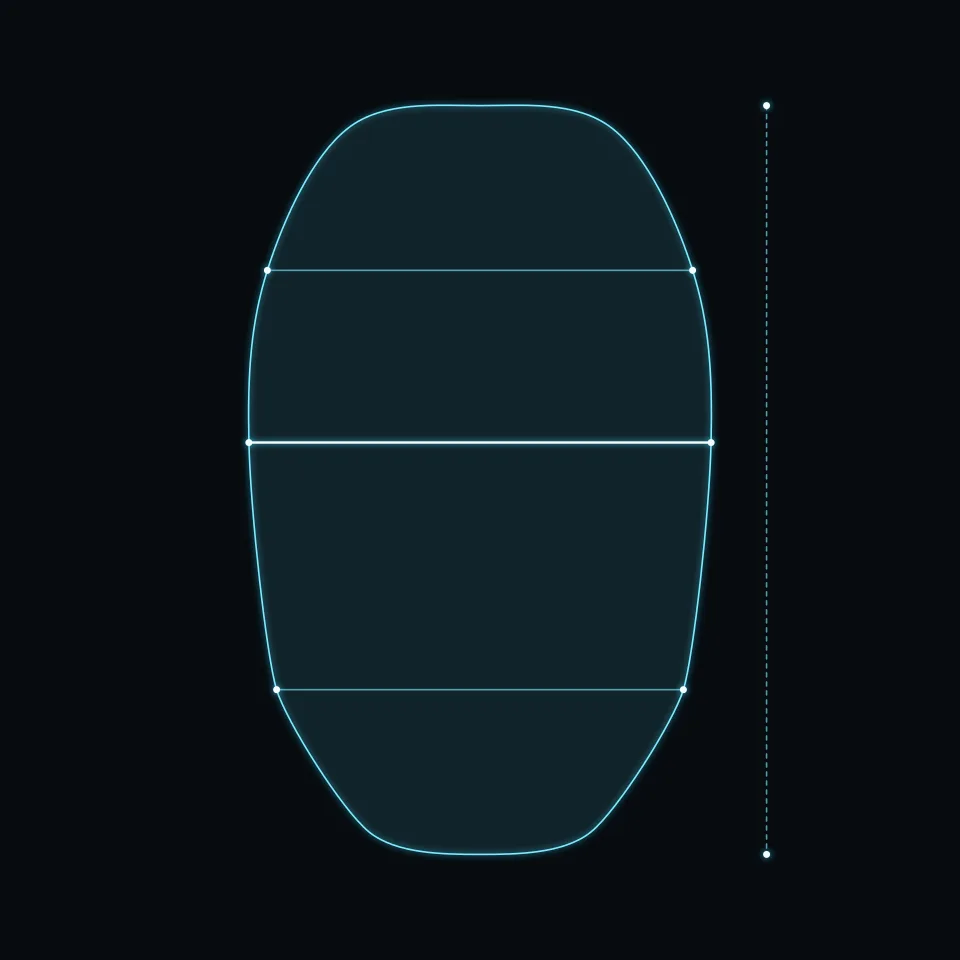
Two features describe an oblong face. First, a high ratio of face length to cheekbone width. One guide puts oblong at about 1.34 and oval at about 1.24; another puts oblong at 1.75 or more and oval near 1.5 to 1.6. They measure differently, so the numbers don’t match. Knowing which way you lean is enough.
Second, forehead, cheekbones and jaw are similar in width, so the sides run nearly parallel instead of narrowing to the chin. With a squarer jaw it is sometimes called rectangular; the approach is the same.
A round face shows little length for its width. An oblong face shows the reverse, so the moves reverse: add width, interrupt the vertical. To measure, see how to tell your face shape, or get a free face report from one front-facing photo.
Why bangs do the most work
On a long face the forehead is often the longest stretch. Cover part of it and the visible face loses that much length.
A fringe’s lower edge is also a horizontal line. Near the brows, it stops the eye sliding from hairline to chin in one sweep.
- Heavy, brow-grazing fringe: covers the most forehead, draws the strongest line.
- Wide bangs: cut out to the temples for a longer edge.
- Curtain bangs: cover the upper forehead, then sweep toward the cheekbones, adding width where the face is narrowest.
Slicked-back styles and a wide-open centre parting do the opposite. More fringe shapes: bangs for your face shape.
Put volume at ear and cheekbone level
An oblong face lacks width, so volume belongs at the sides, not on the crown, ideally between the ears and the cheekbones.
- Waves that crest beside the cheekbones: the fullest point widens the middle.
- A diamond silhouette: full at the cheekbones, ends tucked in below, so the outline never becomes a column.
- Mid-length hair flipped out: fullest just below the cheeks.
- Face-framing layers with a deep side part: if you keep length, they break the straight sides with a diagonal.
Getting side volume from curly or fine hair is covered in hairstyles for your face shape.
Length: start between chin and shoulders
The outline ends where the ends stop. Between chin and collarbone, they frame the lower face; past the chest, the eye follows them down.
| Length | Try | Why |
|---|---|---|
| Very short | Crew cut with a low fade, French crop with a fringe | No height on top, full sides |
| Short | Rounded mushroom cut | Volume runs sideways |
| Chin | Bob with ends bent inward | The vertical stops at the jaw |
| Collarbone | Lob with blunt ends | Weight sits low |
| Past the shoulders | Face-framing layers, waves, side part | Breaks the straight sides |
What to go easy on
These stretch the vertical or take width away:
- Height on top: high buns, a tall quiff or pompadour, shaved sides with a standing top. On very short hair with little height, the effect is small.
- Sleek long straight hair, centre-parted: one unbroken line from crown to chest.
- One-length hair past the chest: pulls the eye below the chin.
- Flat cuts with no side volume: narrower sides, longer face.
With a beard, keep it short and full on the cheeks and jaw to widen the lower face; a long, pointed beard adds length.
These recipes come from people who cut hair for a living, not from controlled trials. To see whether it works for you, try the photo comparison in hairstyles for round faces.
FAQ
How is an oblong face different from an oval one?
Both are longer than wide. One guide says only the length-to-width ratio separates them; another adds that an oval narrows toward the chin while an oblong face keeps straighter sides.
Does short hair work on a long face?
Yes, if the top stays low and the sides stay full, as with a mushroom cut or a French crop with a fringe. Go easy on high fades with a standing top.
What glasses suit a long face?
Wide or square frames, or ones with detail along the top, add something horizontal. Narrow, shallow frames make the length more obvious.