Contents
Hairstyles for wide faces start with a ratio, not a shapeWhere is your face widest? Three casesWhy covering the sides and adding height worksDon’t overdo itFind the width, then cutFAQKey points
- A wide face means a low length-to-width ratio. It doesn't say where the width is.
- The width sits at one of three levels: forehead, cheekbones or jaw. Go easy on volume there; hair can cover a little of its edge.
- Add length or height somewhere else, on top or at the level furthest from the width.
- Don't cover every level at once. Overdoing it creates a new imbalance.
Hairstyles for wide faces start with a ratio, not a shape
“Wide face” sounds like a shape. It’s really a ratio: face length ÷ width, and the number is low.
One guide puts length ÷ cheekbone width at about 1.24 for an oval face, 1.16 for a square and 1.13 for a round. The lower the number, the wider the face reads.
But the ratio says “wide”, not “wide where”. There are three places:
- Forehead: forehead and temples widest, narrowing below.
- Cheekbones: widest in the middle, as on round and diamond faces.
- Jaw: widest low, with a clear jaw angle, as on many square and pear faces.
The moves differ, sometimes in opposite directions: follow round-face advice with a wide forehead and the extra crown height lands on your widest level. Follow heart-face advice with a wide jaw and you pile volume right where you’re widest.
Where is your face widest? Three cases
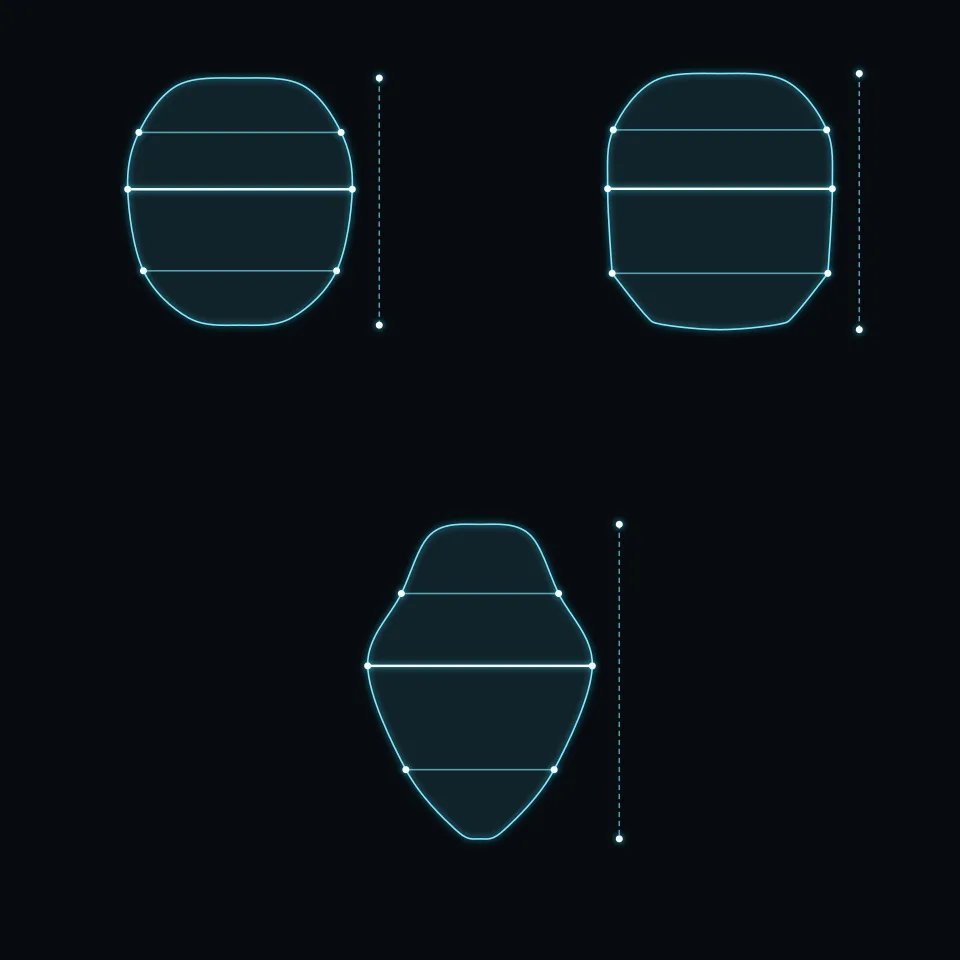
Compare the three widths on a front-facing photo and use the row for the longest one. For how to measure, see what is my face shape, or get a face report from one front-facing photo.
| Widest at | Try | Go easy on |
|---|---|---|
| Forehead | Curtain or side-swept bangs over the corners; volume at jaw level | Height on top, tight slicked-back hair |
| Cheekbones | Pieces falling outside the cheekbones; a little height on top; volume at forehead and chin level | Big curls at the ears, short cuts ending at cheekbone level |
| Jaw | Volume on top and at the forehead; side pieces skimming the jaw, mixed in- and out-curls | Blunt chin-length bobs, volume piled at the jaw |
One rule covers all three: go easy on volume at the widest level, let hair cover a little of its edge, and add height or volume far from it.
Why covering the sides and adding height works
Hair falling outside the widest level shows less face across; lift on top makes the outline taller. Both raise the ratio. Keep blunt ends away from the widest level, or they draw a line there. For the full mechanism with long, short and bangs examples, see hairstyles for round faces.
Don’t overdo it
The common mistake isn’t doing too little. It’s doing too much.
- Covering every level. Forehead, cheekbones and jaw all hidden leaves a slit of face, and the outline gets more noticeable. One level is enough.
- Too much height. With a wide forehead, crown volume adds to the widest level.
- Long straight hair, centre-parted, for “length”. Past a point, flat sides push the face toward a different imbalance.
- Treating width as a problem. It’s a ratio on the low side. If you like your outline, pull all your hair back.
Find the width, then cut
The order: check the ratio really is low, find the widest level, then pick a style. Hair type changes how a cut lands, and curls easily build width at the cheekbones; see hairstyles for your face shape for each type.
These tips come mostly from stylists’ experience, not experiments. Start with the cheapest change, a new parting or one piece let down beside the cheekbone, and photograph it.
FAQ
Can I wear short hair with a wide face?
Yes; check where the width is. At the cheekbones or jaw, keep height and texture on top and the sides close. At the forehead, keep the top lower and sweep texture forward over part of it.
Can I tie my hair up?
Yes. A high ponytail or bun moves volume up; keep the crown soft. With a wide forehead, tight slicked-back hair shows all of it, so leave a few pieces out.
Does a centre parting work?
It can. Just don't let flat, straight sides hang against the widest level. Add root lift, or start the face-framing layers below the widest point.
My face looks very wide in selfies. Is it?
Not necessarily. A phone held close enlarges the middle of the face and changes the ratio. Check with a photo taken from 1.5–2 m first.