Contents
Upturned or downturned eyes: one angleMeasuring the sample photoWhy this angle is so easy to get wrongHow to measure it honestlyWhat liner and shadow can changeFAQKey points
- Eye-tail direction is one angle: the corner-to-corner line against level, positive when the outer corner is higher.
- The average already tilts slightly up, so perfectly level is not the middle.
- Head roll, chin angle, a turned head, camera height and lens all shift it; near 0° the sign flips.
- The two eyes rarely match: +4.9° and +7.1° on the sample photo.
- Liner and shadow change the line the eye reads as, not where the corners are.
Upturned or downturned eyes: one angle
Join the inner and outer corner, then draw a level line from the inner corner. The angle between them is the answer: outer corner above level is upturned (positive canthal tilt), below is downturned (negative canthal tilt), flat is about 0°.
A medical glossary is stricter: level is the line joining the two inner corners, not the photo edge, with the head upright and the gaze straight ahead.
- It is a continuous number, not three boxes. +1° and −1° are closer than +1° and +8°.
- Level is not the middle. The same glossary notes the average tilts slightly upward at every age.
This angle is one of three scales; the other two are in What is my eye shape.
Measuring the sample photo
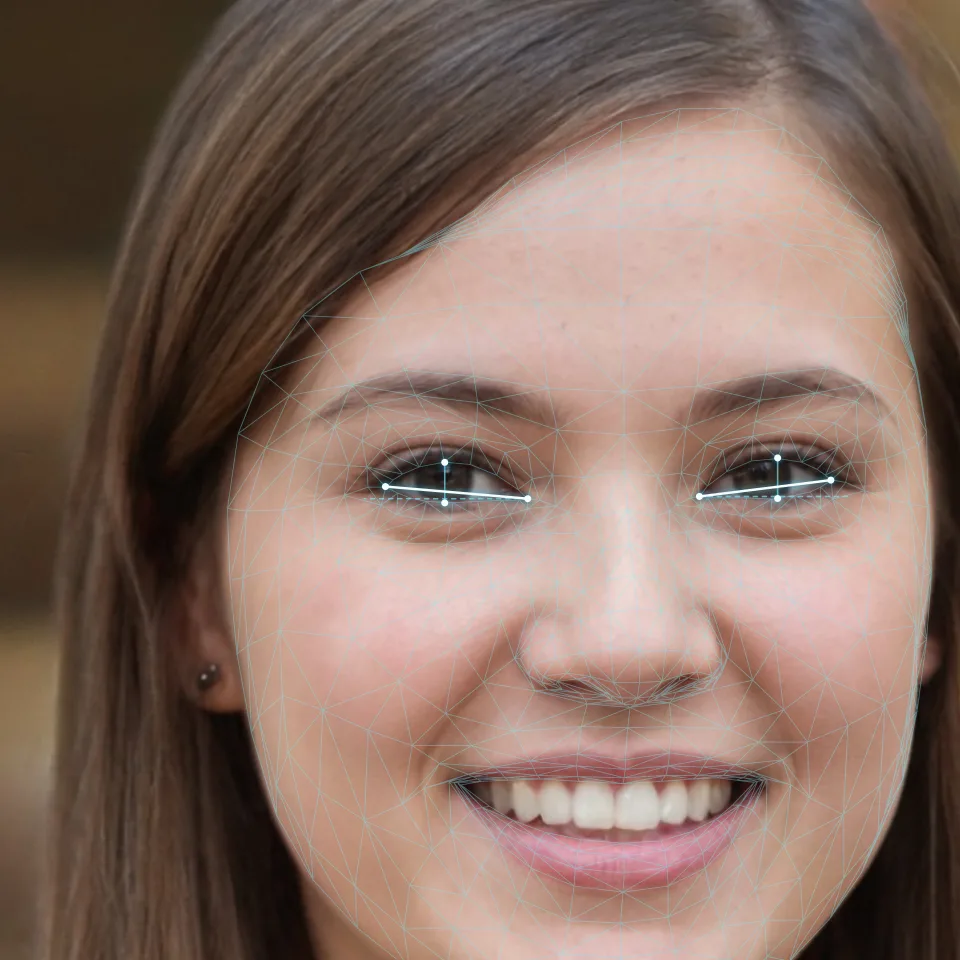
- Photo-left eye: +4.9°.
- Photo-right eye: +7.1°.
Both upturned, yet 2.2° apart. Head tilt? The head here is rolled about 0.4°. A roll adds that to one eye and subtracts it from the other, so it explains at most about 0.8°; the rest is the eyes. Measuring against the inner-corner line cancels it.
And she is smiling, which pushes the lower lid up and moves the outer corner. A neutral photo could shift both numbers.
Why this angle is so easy to get wrong
A guide on canthal tilt lists the culprits:
- Head roll: the biggest effect when you draw on the photo; the inner-corner line cancels it.
- Chin up or down: changes the geometry around the eyes.
- A turned head: the far eye shortens and its angle changes.
- Camera height: a phone above or below eye level acts like tipping the head.
- Lens: a front camera held close distorts the face.
Near 0° it is least stable. The sample eye is about 115 pixels long; mark a corner one pixel off and the angle moves about 0.5°. A jump from +1° to −1° turns upturned into downturned: same person, new label.
How to measure it honestly
- Phone propped at eye height, 1.5–2 m away (rear camera, 2×–3× zoom if you have it, 3–10 second timer); head level, chin not raised.
- Relaxed face, no smile, eyes straight at the lens, not up or down.
- Take three photos, measure both eyes on each, and use the middle value.
If the eyes differ by several degrees, suspect the photo and reshoot at eye height. If the gap stays, your eyes simply differ, which is common; see the uneven face guide. If the reading hovers around 0°, it is level; no need to pick a side.
Cross-check: if one eye varies more across the three photos than the two eyes differ, the error is in the shooting. A face report built from one front-facing photo is another way to compare the two eyes without marking corners by hand.
What liner and shadow can change
Makeup cannot move the corners. It can change the line the eye reads as.
- To read more lifted: thin upper liner that starts rising before the outer corner, tail pointing to the end of the brow, mascara on the outer third.
- Dark colour under the outer corner follows the downward line and strengthens it. For lift, sweep shadow up to the crease where the eye starts to slope down.
- To read softer and more downturned: let the tail follow the eye’s line slightly down and put lower-lash mascara at the outer end, the Japanese tare-me look.
- Tail length: stop before the socket bone at the outer edge; past it the line looks stiff.
All of it washes off, and a downturned tail left bare is an ordinary look. Shape-by-shape looks are in eye makeup for your eye shape.
FAQ
My inner corner is covered by a fold of skin. Where do I mark it?
Zoom in and find where the upper and lower lids actually meet, the same way on both eyes. A medical glossary notes such a fold makes the tilt hard to judge.
How many degrees counts as upturned?
There is no agreed cut-off. Outer corner higher means upturned; the average already sits a little above 0°, and studies have not settled on a standard angle.
My selfies and other people's photos disagree. Which is right?
Trust the one taken at eye height from 1.5–2 m with the rear camera. A selfie camera sits close to the face and is often held high or low, and both shift the reading.