Contents
Mouth to nose ratio: what is it?Measure it on the sample photo: one face, two answersHow much does expression change it?How to measure it honestly: relaxed mouth, three photosWhat lip makeup and nose contour changeFAQKey points
- Mouth width runs corner to corner, lips relaxed and closed; nose width runs across the nostril wings.
- Mouth = 1.5 × nose is a drawing rule. In one set of 14,000+ faces the middle value is about 1.2.
- A smile pulls the corners out and flares the nostrils. The smiling sample reads 1.80 or 1.49, depending on which nose points you use.
- Lip liner and nose contour cannot move the points. They change where the edges seem to be.
Mouth to nose ratio: what is it?
One number: mouth width divided by nose width.
Mouth width runs between the corners, where the upper and lower lips meet at each side. Nose width runs across the outer edges of the nostril wings. Take both from the same front photo and the units cancel.
The old drawing rule says the mouth is about 1.5 times the nose. A measurement study found real faces rarely fit it. One face-measurement site pooled 14,144 faces and worked out the inverse, nose ÷ mouth: the middle value was 0.84, which makes the mouth about 1.2 noses wide. Eight faces in ten fell between 1.09 and 1.35. That is the site’s own tally, not a peer-reviewed study.
So about 1.2 is ordinary. Exactly 1.5 sits outside most faces.
Measure it on the sample photo: one face, two answers
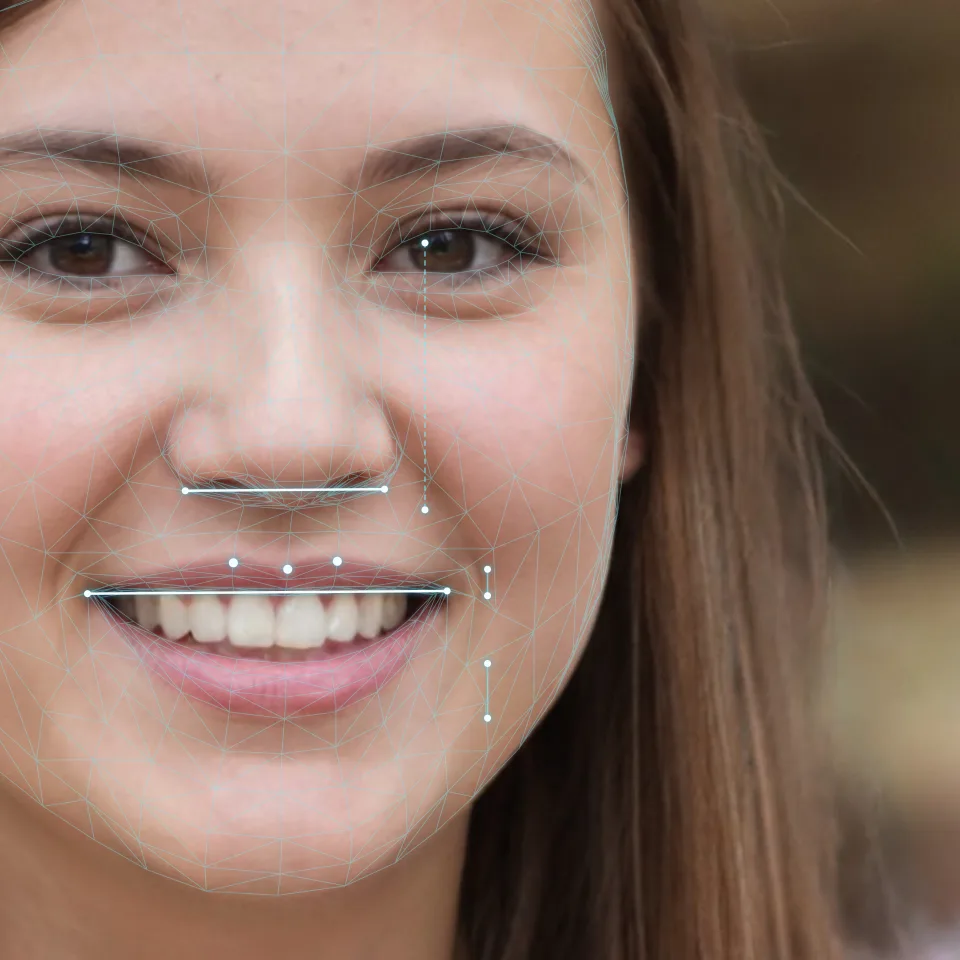
- Mouth, corner to corner: 267.
- Nose, where the wings meet the cheek: 148. 267 ÷ 148 ≈ 1.80.
- Nose, across the widest flare of the nostrils: 179. 267 ÷ 179 ≈ 1.49.
Same photo, two points on the nose, and the result jumps from well above most faces to almost exactly the drawing rule. Neither is wrong; they measure different things.
The sources do not agree either: a medical glossary uses the outermost points of the wings, a measurement guide uses the spot where the wings meet the cheek. So whenever you quote a mouth to nose ratio, say where you took the nose width.
How much does expression change it?
At rest the mouth corners barely move, so a relaxed, closed mouth gives a repeatable width. A smile pulls them outward. In one guide’s illustration, the same face with only a wider smile went from 58.0 mm to 65.7 mm, more than a tenth wider.
A smile also flares the nostrils. With top and bottom both moving, the ratio rarely stays put.
The sample is smiling, teeth showing. Its 1.80 is well above the usual 1.2, and one photo cannot say how much of that is the smile. For your own number, use a relaxed photo.
How to measure it honestly: relaxed mouth, three photos
Photo setup is in the facial thirds guide. For the mouth and nose, add:
- Phone at eye level, face square to the lens, no tilt or turn.
- Lips relaxed and lightly closed. No smile, no pressing.
- Choose your nose points once, wings at the cheek or widest flare, and keep them.
- Take three photos a few minutes apart, work out each, and keep the middle value.
If a corner is hard to find, zoom in to where the lips actually meet, not where the colour fades. If the three results differ a lot, your expression or angle is still shifting; take another set. A face report built from one relaxed photo is another way to see your mouth and nose together.
What lip makeup and nose contour change
Makeup cannot move the points; it changes where the edges seem to be.
- Defined corners. Makeup artists run a darker liner from each corner to halfway toward the cupid’s bow. One artist uses it on round lips to make the mouth look wider and more defined.
- Soft corners. Keep the liner inside the lip line at the corners and overline only the centre of each lip. The weight moves inward and the mouth reads rounder and fuller.
- Nose wings. The edges of the wings often carry shadow and redness. Artists cover them with yellow concealer, then contour down the sides and blend toward the centre, so the wings read narrower; see nose shape types.
Research also finds that lip fullness and the upper-to-lower lip balance shape impressions more than width does; see lip shape types. For the whole face, see face proportions.
FAQ
Does my mouth need to be 1.5 times my nose width?
No. It is a drawing rule that real faces rarely meet; one large dataset puts the middle value near 1.2. The ratio describes two widths, nothing more.
I only have smiling photos. Can I still measure?
Yes, but note that you were smiling and compare only with other smiling photos. Against relaxed figures, your mouth will read wide.
What else is mouth width compared with?
The distance between the pupils. One lip guide notes that on wider mouths the corners often sit below the pupils or further out.