Contents
Why does my face score change? Because it measured a different photoFive variables and what each moves on the photoHuman ratings change with the photo tooFix the variables: the same routine every timeHow FacialRate does it: a score describes this photoFAQKey points
- Test the same file twice first. Same result: the photo is what varies. Different: the tool itself wobbles.
- Light moves shading, angle moves thirds and symmetry, distance moves the nose, expression moves eyes and mouth, coverings hide points.
- Human ratings move with the photo too.
- To compare, fix the routine, take three shots, score all three and read the range.
Why does my face score change? Because it measured a different photo
Any face rating starts the same way: find the face, place points on it, then read distances, ratios and shading from those points. The photo is the only input. You stayed the same; the input didn’t.
First, run a control to separate the causes: score the same file twice.
- Same result: your usual changes come from the photos.
- Different result: the tool itself varies.
One more cause is easy to miss: tools get updated. One face-rating site that published its scores noted that its engine had been recalibrated, so old and new scores can’t be compared. Across months, check that the ruler hasn’t changed.
Five variables and what each moves on the photo
| Variable | What changes on the photo | More |
|---|---|---|
| Light | Shading and tone; side light brightens one half, overhead light shadows the brows | Selfie lighting |
| Head angle | Chin down lengthens the upper third; a turn widens the half nearer the camera | Head angle in photos |
| Distance | Closer means a bigger nose and centre, smaller sides | Selfie distortion |
| Expression | A smile widens the mouth, narrows the eyes and thins the upper lip | Smiling and proportions |
| Covering, quality | Frames hide eye corners, bangs the hairline; blur makes points harder to place | Photos with glasses |
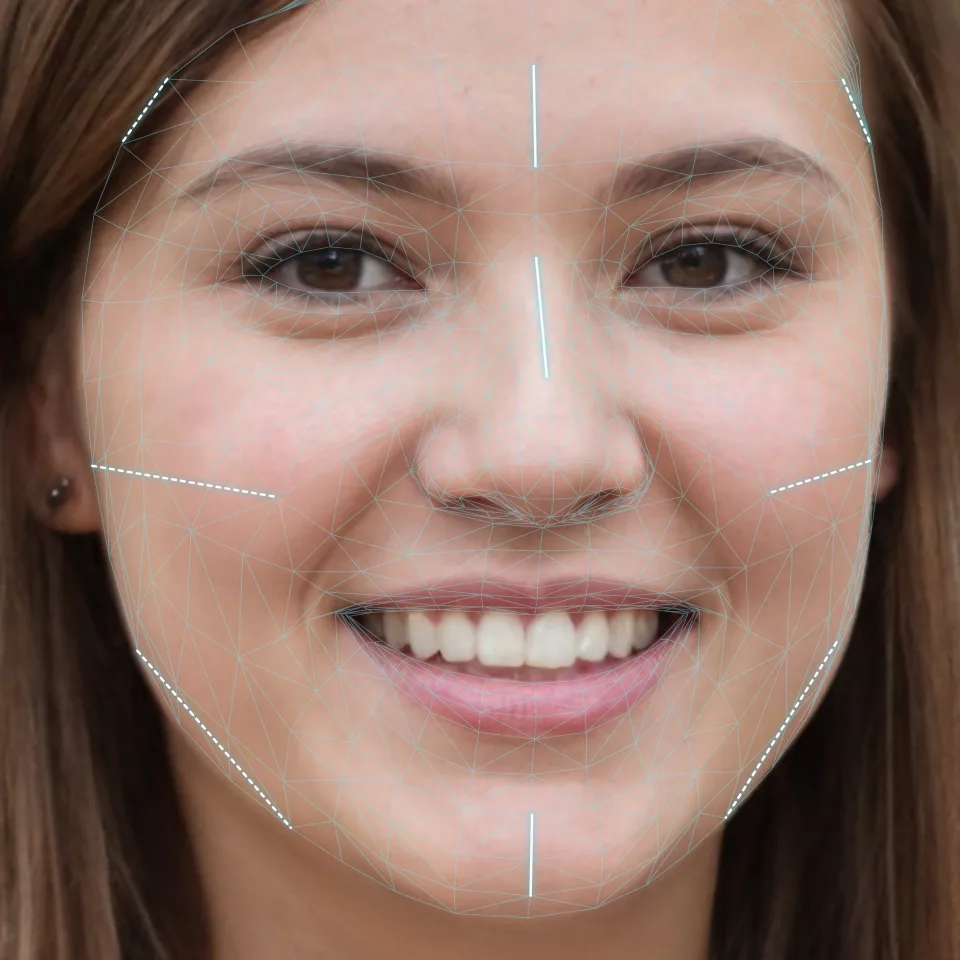
The sample photo faces a window: cheeks read 201 and 197, forehead 191, so the light is even, and the head tilts only about 0.4°. But it smiles, and eye height ÷ length is 0.29 and 0.31, narrower than at rest. Only expression is left open.
Human ratings change with the photo too
A 2011 study took 20 people, 20 web photos of each, and had 40 raters judge every photo. Ratings varied so much that, for any two people, photos could be picked to reverse who was rated more attractive. Attractiveness, the authors concluded, depends partly on the face and partly on the photo.
In the same study, passport-style photos were rated less like the person (3.92 against 4.23 on their scale), which the authors put down mainly to the missing smile.
Symmetry and averageness, they noted, can’t explain differences between photos of one person: the bones haven’t moved.
An attractiveness test learned from human ratings inherits this. The site above said the same of its numbers: symmetry varied most, partly because a slight head turn or uneven light lowered it.
Fix the variables: the same routine every time
The goal is photos you can compare, not the best-looking one. The full setup is in front-facing photo; this is what must stay the same:
- Light: the same window, the same time of day, room lights off.
- Phone: on a stand at eye level, rear camera, you standing on the same spot 1.5–2 m away.
- Expression: relaxed, mouth closed; if you smile, smile every time.
- Coverings: glasses off, hair behind the ears, beauty settings off.
- Shots: take three in a row and score all three.
The spread between those three is your routine’s noise. A later change smaller than that means nothing.
How FacialRate does it: a score describes this photo
- It says so plainly: a score describes this photo. Light, angle and expression change what the model sees, so the same person can read differently in another photo.
- Free, with no limit on tries, so you can score all three shots and compare ranges.
- More than one number: the face report shows your face type, strongest feature, three highlights and 11+ dimensions. When the score moves, see which part moved: symmetry suggests a head turn; the eyes suggest expression.
- You pick the scoring basis, women or men; it is never inferred from your photo. Pick the same one each time.
- Tips cover photography, hair, makeup and skincare only, nothing medical.
FAQ
Will the same photo give a different score twice?
That depends on the tool. Score one file twice: if it matches, your usual changes come from the photos; if not, the tool itself varies.
Which photo's score is the real one?
None alone. Photos taken the same way give readings in a range; the range tells you more than one number.
Should I smile or not?
Either, as long as you keep it the same. In a 2011 study, open-mouth smiling photos were rated more like the person.