Contents
Are AI face ratings accurate? Ask: compared with what?People don’t agree with each otherFive checks for any attractiveness testTest it yourself: same face, several photosHow FacialRate does it: the five answersNext in this seriesFAQKey points
- A face rating model learns a group's average rating, for example 60 people rating 5,500 standard photos.
- People disagree: a group average is very stable, but any two raters agree only moderately.
- Ask any tool five things: source, stability, what moves it, relative to whom, where the photo goes.
- Test stability yourself: three shots taken the same way, one score each. The spread is noise.
Are AI face ratings accurate? Ask: compared with what?
The best an AI face rating can do is land close to the average of a group of human raters.
A common 2018 dataset holds 5,500 front-facing photos, neutral and unobstructed, each rated 1 to 5 by 60 volunteers. Their average is the “answer”, and a model is judged by how far its guesses land from it.
Models that used only geometric ratios correlated 0.59 to 0.73 with that average. Deep models reached 0.83 to 0.90, missing by about 0.23 to 0.29 points per photo.
So “accurate” means close to these 60 raters’ average, on photos like these. Change the photos or the raters and you test again.
People don’t agree with each other
Raters vary. In that dataset, one volunteer usually sat 0.6 to 0.7 points from the group average.
A 2000 meta-analysis of dozens of studies found a group’s average very reliable: about .90 within a culture, .94 across cultures. Two individual raters agree only moderately, about .47 within a culture. A 2016 study put personal taste at roughly 36 to 44% of the meaningful variance, and the same rater a week later correlated only about 0.80 with their first ratings.
People also rate themselves about 1 point higher than others do (one study, 7-point scale).
A model approximates what most people would say.
Five checks for any attractiveness test
- Where does the score come from? Learned from human ratings, or a fixed formula like the golden ratio? Research links that formula only weakly to ratings; see is the golden ratio face reliable.
- How stable is it? Same face, same setup, several photos: how far apart?
- What moves it? Light, angle, distance, expression, hair or glasses in the way.
- Relative to whom? Which faces and raters is it compared against?
- Where does the photo go? Your device, or a server?
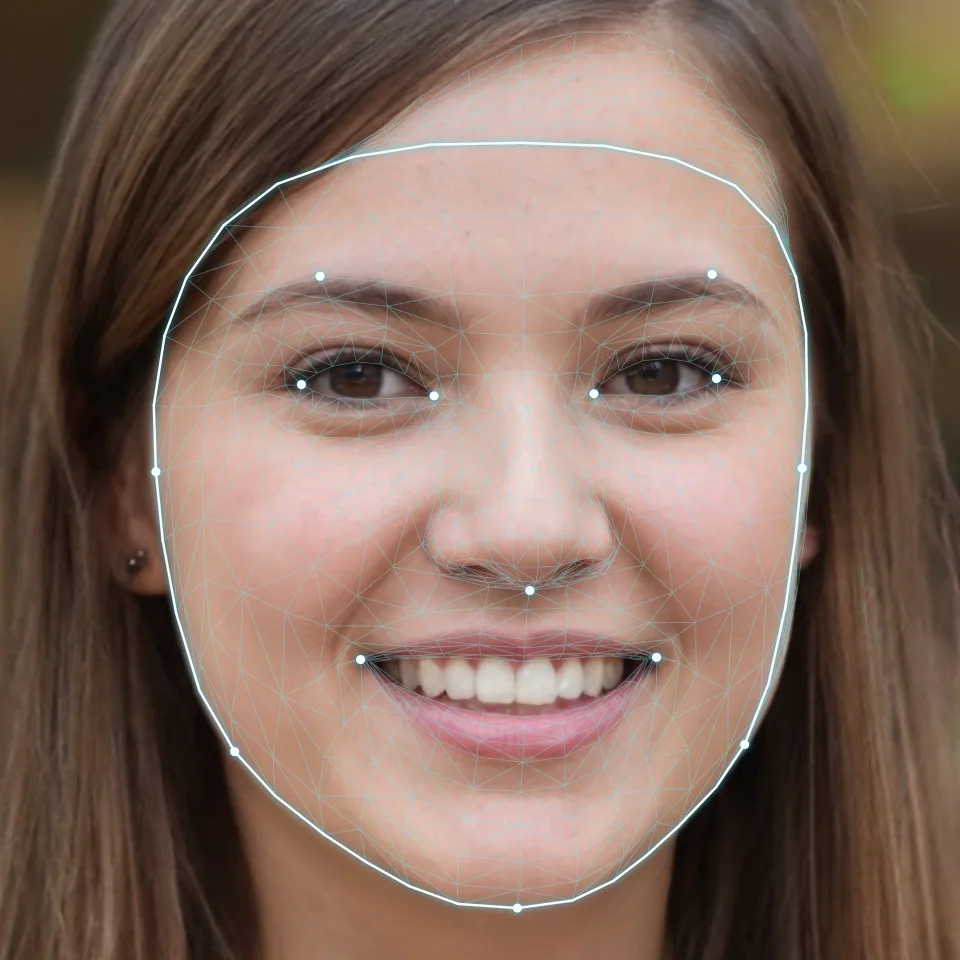
The diagram shows the first step of face analysis: find a few hundred landmarks, then read ratios from some of them.
Test it yourself: same face, several photos
A 2011 study had 40 people rate 20 photos each of 20 people. Pick the photos well and you could reverse which of any two people was rated more attractive. One face-rating site published its scores: they bunched in the middle (mean 71.5, median 75, top 10% at 84+), so a few points either way is noise. It recalibrated once, and old scores stopped being comparable.
The routine: same light, distance and expression, three shots, one score each. Then change one thing, say side light. Only a change bigger than the spread belongs to the variable. Setup: front-facing photo.
A score describes a photo. It doesn’t measure a person’s worth.
How FacialRate does it: the five answers
- Source: a machine-learning model that learned from real human ratings, not a hand-picked formula, calibrated and tested against real ratings.
- Stability: it says plainly that a score describes this photo. Light, angle and expression change what the model sees, so the same person can read differently in another photo. Tips cover photography, hair, makeup and skincare only.
- More than one number: the free face report shows your face type, strongest feature, three highlights and a reading of 11+ dimensions, with one tip to try. The full report is an optional one-time purchase, not a subscription.
- Relative to whom: you pick the scoring basis, women or men; it is never inferred from your photo.
- The photo: detection and scoring run in your browser. Neither the photo nor any face image made from it is sent to a server; the 478 face landmarks are found in the browser and the mesh is drawn on your device.
Free, no limit on tries.
Next in this series
- Is my photo uploaded
- Why does my face score change
- How to read a face score
- What makes a face attractive
FAQ
Is an AI face analyzer more accurate than a person?
It's the wrong comparison. A model learns a group's average; any one person may sit far from that average.
Why do two attractiveness tests give me such different scores?
Different scales, reference faces, raters and often photos. Only results from one tool and one photo setup compare.
Does a low score mean I'm unattractive?
No. It describes the impression this photo tends to make on certain raters, and it moves with the photo. It doesn't measure a person's worth.